
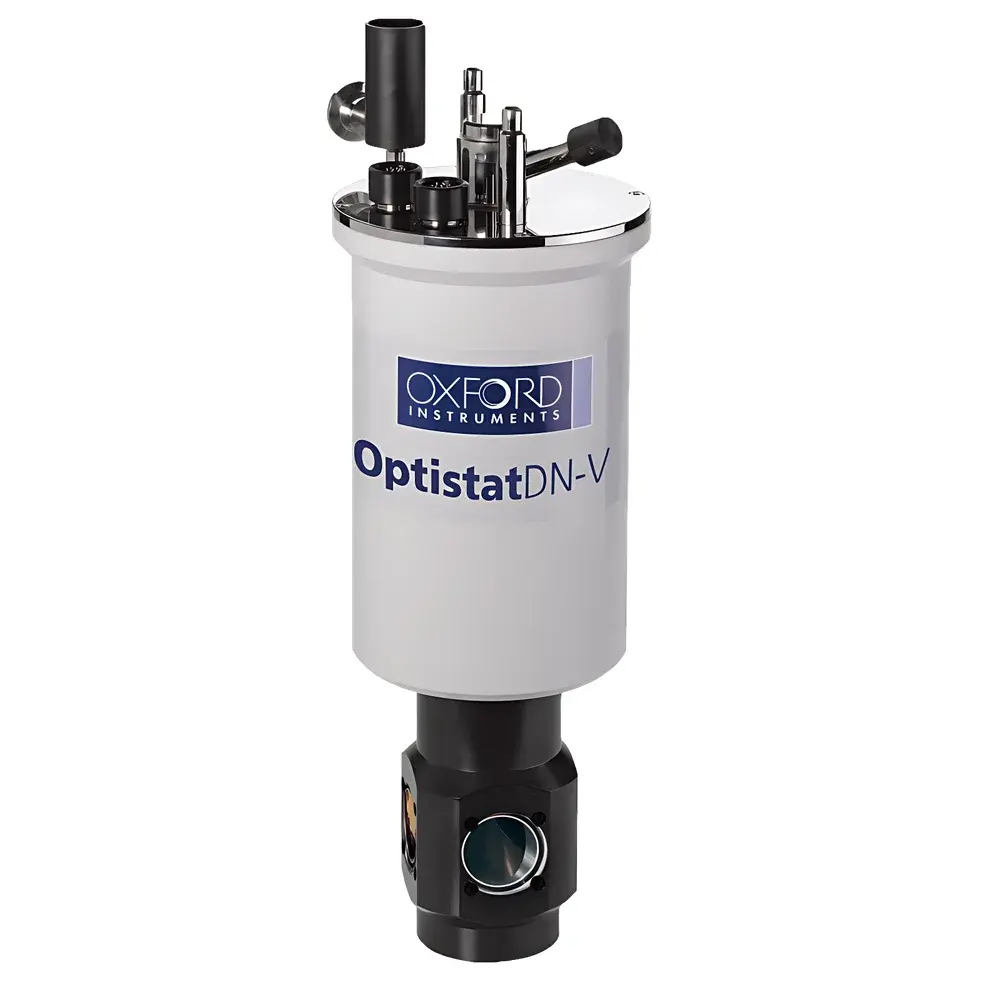
Oxford Instruments Optistat Cryogenic Optical Cryostat
| Brand | Oxford Instruments |
|---|---|
| Origin | United Kingdom |
| Manufacturer Type | Authorized Distributor |
| Origin Category | Imported |
| Model | Optistat |
| Price Range | USD 13,500 – 40,500 (FOB UK) |
Overview
The Oxford Instruments Optistat series represents a class of high-performance optical cryostats engineered for precision low-temperature spectroscopy, photoluminescence (PL), Raman, FTIR, and quantum optics experiments. Operating on closed-cycle refrigeration principles—primarily using pulse-tube or Gifford-McMahon (GM) cryocoolers—the Optistat achieves base temperatures as low as 1.5 K without requiring liquid helium, eliminating associated logistical complexity, boil-off losses, and recurring operational costs. Its design centers on maximizing optical access while maintaining thermal stability, mechanical rigidity, and electromagnetic compatibility. The system integrates seamlessly into vacuum-based optical benches and ultra-high vacuum (UHV) environments, with all structural components fabricated from oxygen-free high-conductivity (OFHC) copper and stainless steel to ensure minimal thermal gradients and long-term dimensional stability under thermal cycling.
Key Features
- Helium-free operation down to 1.5 K, enabled by advanced closed-cycle cryocooler technology
- Up to five independently configurable optical windows per unit (model-dependent), supporting transmission and reflection geometries across spectral ranges from deep UV (190 nm) to far-infrared (20 µm)
- Optimized thermal anchoring architecture with multi-stage cold heads and low-thermal-conductivity support struts to minimize parasitic heat load
- Integrated electrical feedthroughs rated for DC to 18 GHz, accommodating low-noise biasing, RF excitation, and cryogenic sensor readout
- Modular vacuum vessel design compatible with standard CF, ISO-K, or ConFlat flanges for rapid integration into existing optical tables or UHV chambers
- Direct coupling with Oxford Instruments’ Mercury iTC intelligent temperature controller, supporting PID tuning, ramp/soak profiles, and real-time thermal mapping via calibrated Cernox® or RuO₂ sensors
Sample Compatibility & Compliance
The Optistat accommodates a broad range of sample formats—including bulk crystals, thin films on substrates, nanostructures on TEM grids, and microfabricated devices mounted on custom PCB carriers. Sample mounting plates are thermally anchored to the coldest stage and feature standardized kinematic alignment features (e.g., SM1-threaded holes, Ø6 mm pin holes) for reproducible positioning. All models comply with CE marking requirements for electromagnetic compatibility (EMC Directive 2014/30/EU) and low-voltage safety (LVD Directive 2014/35/EU). When operated with Mercury iTC and optional expansion modules (e.g., LevelSense for cryogen level monitoring or GasFlow for controlled purge gas management), the system supports audit-ready logging aligned with GLP and ISO/IEC 17025 laboratory quality management frameworks.
Software & Data Management
Control and monitoring are executed via Oxford Instruments’ Mercury iTC software suite, available for Windows-based host PCs. The software provides intuitive graphical interfaces for temperature setpoint programming, real-time plotting of multiple sensor channels, and export of time-stamped ASCII or CSV datasets. Full remote API access is supported through TCP/IP and RS-232 protocols, enabling integration with LabVIEW, Python (via PyVISA), or MATLAB-based automated measurement sequences. Audit trail functionality—including user login tracking, parameter change logs, and timestamped calibration records—is enabled when operating in FDA 21 CFR Part 11-compliant mode (requires optional Mercury iTC Security Pack and network authentication configuration).
Applications
- Low-temperature photoluminescence and electroluminescence spectroscopy of semiconductors, 2D materials (e.g., MoS₂, WSe₂), and quantum dots
- Micro-Raman and resonance Raman characterization of strain, doping, and phonon dynamics in van der Waals heterostructures
- Far-infrared and THz transmission/reflection measurements of superconducting thin films and topological insulators
- Cryogenic quantum transport measurements requiring simultaneous optical excitation and electrical readout (e.g., Hanbury Brown–Twiss interferometry, single-photon source characterization)
- In-situ optical testing of space-grade detectors and infrared focal plane arrays under representative thermal vacuum conditions
FAQ
What is the lowest base temperature achievable with the Optistat without liquid cryogens?
The standard Optistat series achieves a base temperature of ≤1.5 K using a two-stage pulse-tube cryocooler; performance is verified under no-load, high-vacuum (<1×10⁻⁶ mbar) conditions.
Can the Optistat be integrated into an existing UHV system?
Yes—models with CF-100 or ISO-K250 flanges are designed for direct UHV integration; bake-out capability up to 150 °C is supported with appropriate gasket selection.
How many optical ports can be installed simultaneously?
Depending on model variant (e.g., Optistat Dry, Optistat AFM), up to five optically aligned windows may be configured—typically including one central vertical port and four side ports at 45° or 90° angles.
Is remote control and data logging compliant with regulatory audit requirements?
When equipped with Mercury iTC Security Pack and configured with network-authenticated user roles, the system meets traceability and electronic record retention requirements of ISO/IEC 17025 and FDA 21 CFR Part 11.
What electrical feedthrough options are available for low-noise measurements?
Standard configurations include 24-pin D-sub and SMA coaxial feedthroughs; optional low-thermal-EMF twisted-pair wiring and filtered DC feedthroughs (0.1 Hz–100 kHz noise floor < 1 nV/√Hz) are available upon request.



