
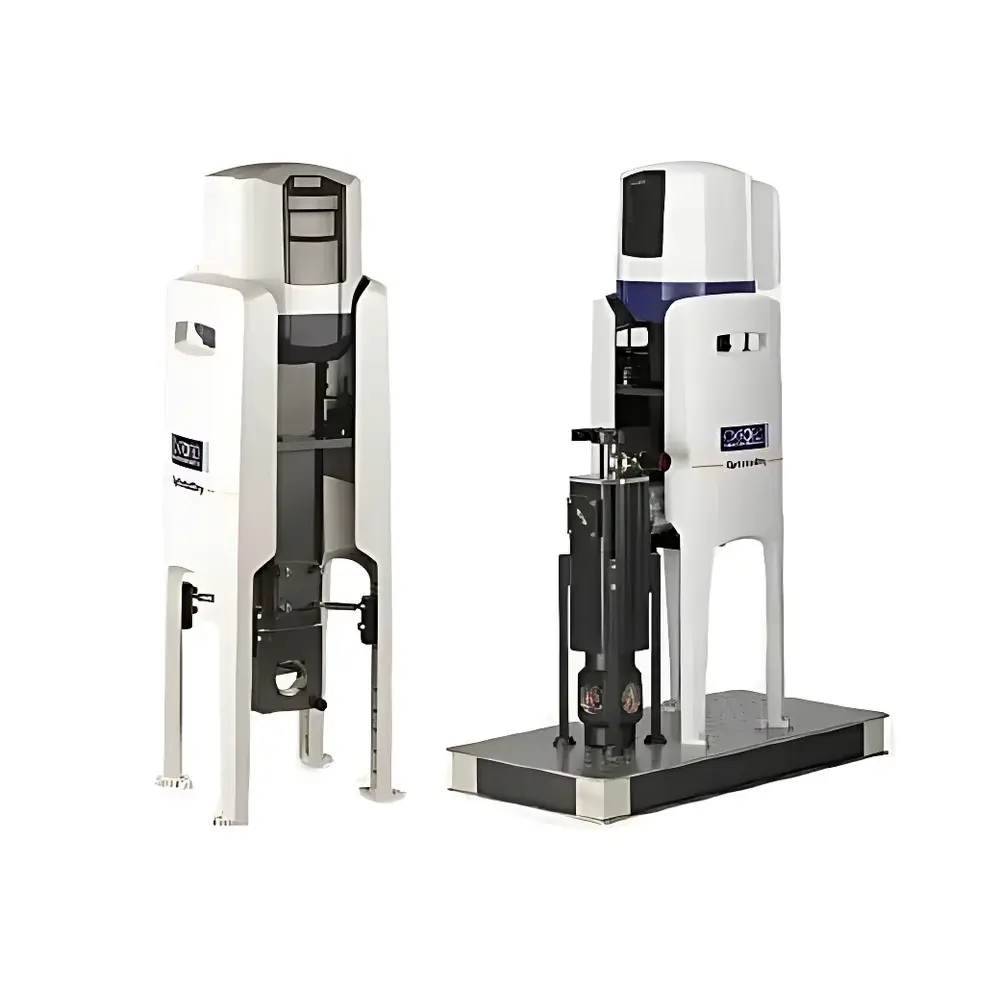
Oxford Instruments Optistat Dry Cryogenic Thermostat
| Origin | UK |
|---|---|
| Manufacturer Type | Authorized Distributor |
| Origin Category | Imported |
| Model | Optistat Dry |
| Price Range | USD 42,000 – 70,000 |
Overview
The Oxford Instruments Optistat Dry is a high-performance, closed-cycle cryogenic thermostat engineered for precision low-temperature experiments in optical, magneto-optical, and quantum transport research. Unlike liquid cryogen–dependent systems, the Optistat Dry employs a Gifford-McMahon (GM) cryocooler to achieve stable, continuous cooling without consumables. Its fully dry, helium-recirculating architecture eliminates the need for liquid nitrogen or helium refills—reducing operational overhead while enhancing experimental reproducibility and lab safety. The system operates across a broad, continuously controllable temperature range from <3 K to 300 K, with typical cooldown to 10 K achieved within 120 minutes. Its mechanical design prioritizes ultra-low vibration (<10 µm RMS when mounted on a standard optical table), critical for interferometric, confocal, or single-photon detection setups where thermal drift and mechanical perturbation must be minimized.
Key Features
- Ultra-low vibration performance: <10 µm RMS displacement at baseplate, validated under standard optical table mounting conditions
- Vertically adjustable height: 635–900 mm (Optistat Dry BLV); 800–880 mm (Optistat Dry TLEX)
- Side-access (BLV) or top-access (TLEX) sample exchange—enabling rapid, repeatable sample loading without optical realignment
- Optimized optical path: f/1 numerical aperture, 28 mm clear optical aperture, and large field-of-view compatibility for low-light-density detection
- Dual-sample-stage configuration options: reflective and transmissive sample holders with zero electrical interference
- Integrated electrical feedthroughs: up to 12 independent low-noise electrical leads via proprietary laminated PCB sample stage, with 21-pin micro-D interface (12-channel CuNi/Cu wiring on copper baseplate)
- Thermal management suite: built-in calibrated Pt100 sensor, resistive heater, and PID temperature controller with 15-pin micro-D interconnect
- Hermetic vacuum enclosure with turbo-molecular pumping system and multi-layer radiation shielding
- High-purity fused silica viewport (optional quartz or CaF₂ windows available per application requirements)
Sample Compatibility & Compliance
The Optistat Dry accommodates diverse sample geometries—from sub-millimeter quantum dots to 25 mm-diameter wafers—within its large internal bore and flexible mounting architecture. Its modular sample stage design supports both standard and custom fixtures, including magnetic field–compatible variants (when used with external superconducting magnets). All variants comply with ISO 9001-certified manufacturing protocols and meet CE marking requirements for electromagnetic compatibility (EMC Directive 2014/30/EU) and low-voltage safety (LVD Directive 2014/35/EU). The integrated temperature control firmware supports audit-trail logging and user-accessible calibration records, facilitating GLP/GMP-aligned workflows. While not FDA 21 CFR Part 11–certified out-of-the-box, the system’s digital I/O architecture allows integration with validated laboratory information management systems (LIMS) for regulated environments.
Software & Data Management
Temperature regulation is managed via Oxford Instruments’ ILM (Intelligent Laboratory Manager) software, compatible with Windows 10/11 and supporting remote operation over Ethernet or USB. The software provides real-time monitoring of cold-head temperature, compressor status, vacuum pressure, and heater power; enables programmable ramp/soak profiles with ±5 mK stability over 24 h; and exports timestamped data in CSV and HDF5 formats. All temperature setpoints, sensor calibrations, and alarm thresholds are stored in non-volatile memory with version-controlled firmware updates. Optional Python and LabVIEW drivers enable seamless integration into automated test sequences, including synchronization with lock-in amplifiers, spectrometers, or quantum measurement platforms.
Applications
The Optistat Dry serves as a foundational platform for advanced low-temperature characterization across academic and industrial R&D domains. Key use cases include photoluminescence (PL) and cathodoluminescence (CL) spectroscopy of 2D materials and perovskites; magneto-transport measurements in topological insulators and graphene heterostructures; single-photon source characterization; superconducting qubit testing; and cryogenic Raman mapping. Its side-access BLV variant is preferred for long-duration optical alignment-critical experiments, while the top-access TLEX model supports high-throughput screening with <5-minute sample swap and <45-minute thermal re-stabilization.
FAQ
What is the minimum base temperature achievable with the Optistat Dry?
The system achieves a base temperature of <3 K under standard operating conditions with no external heat load.
Is liquid cryogen required for operation?
No—this is a fully dry, closed-cycle system relying solely on helium gas recirculation via the GM cryocooler.
Can the Optistat Dry be integrated with external magnetic fields?
Yes—its non-magnetic stainless-steel construction and configurable radiation shields allow safe operation inside split-pair or bore-type magnets up to 9 T (with appropriate field-compatible accessories).
How is temperature stability maintained during optical measurements?
Stability is ensured through dual-sensor feedback (primary Pt100 + secondary diode), active PID control with adaptive gain scheduling, and mechanical decoupling of the cold head from the compressor unit via flexible helium lines.
What vacuum level does the system maintain during operation?
The integrated turbo-molecular pump achieves and sustains <1×10⁻⁷ mbar base pressure, verified by a capacitance manometer and logged in real time via ILM software.



