
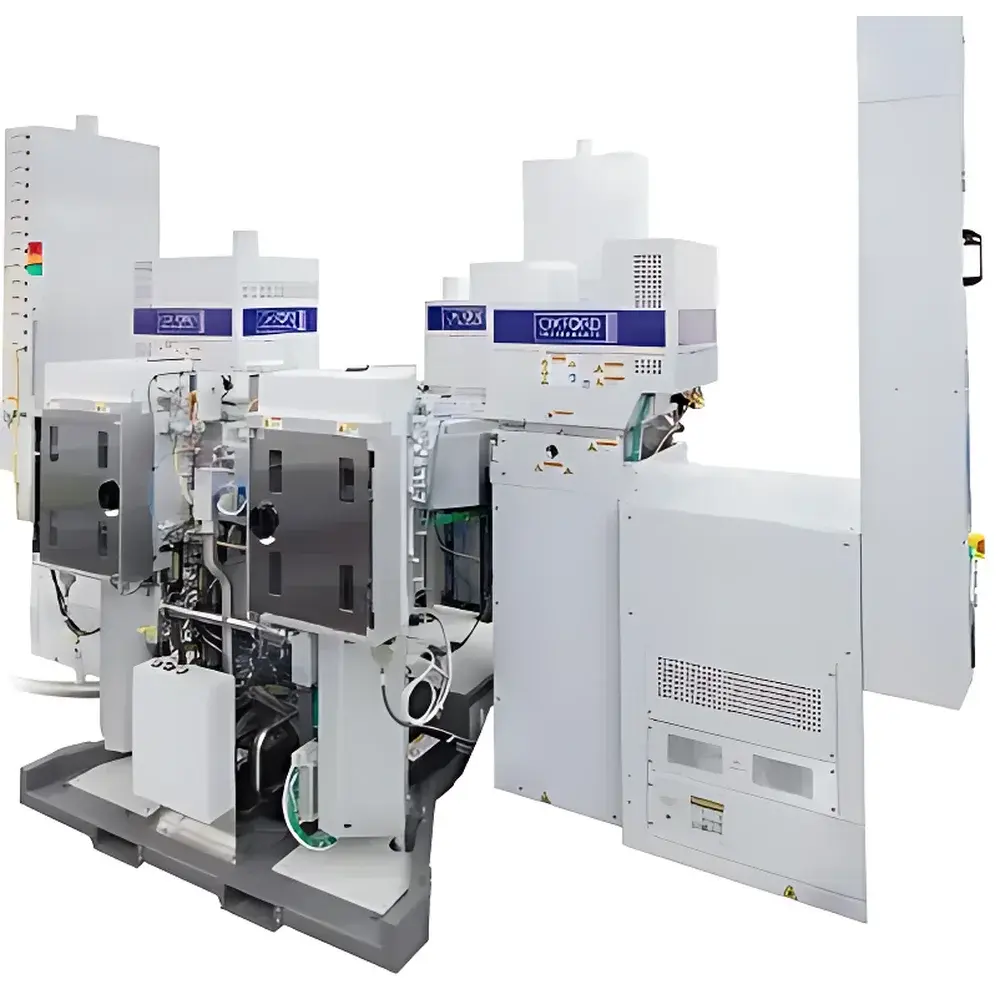
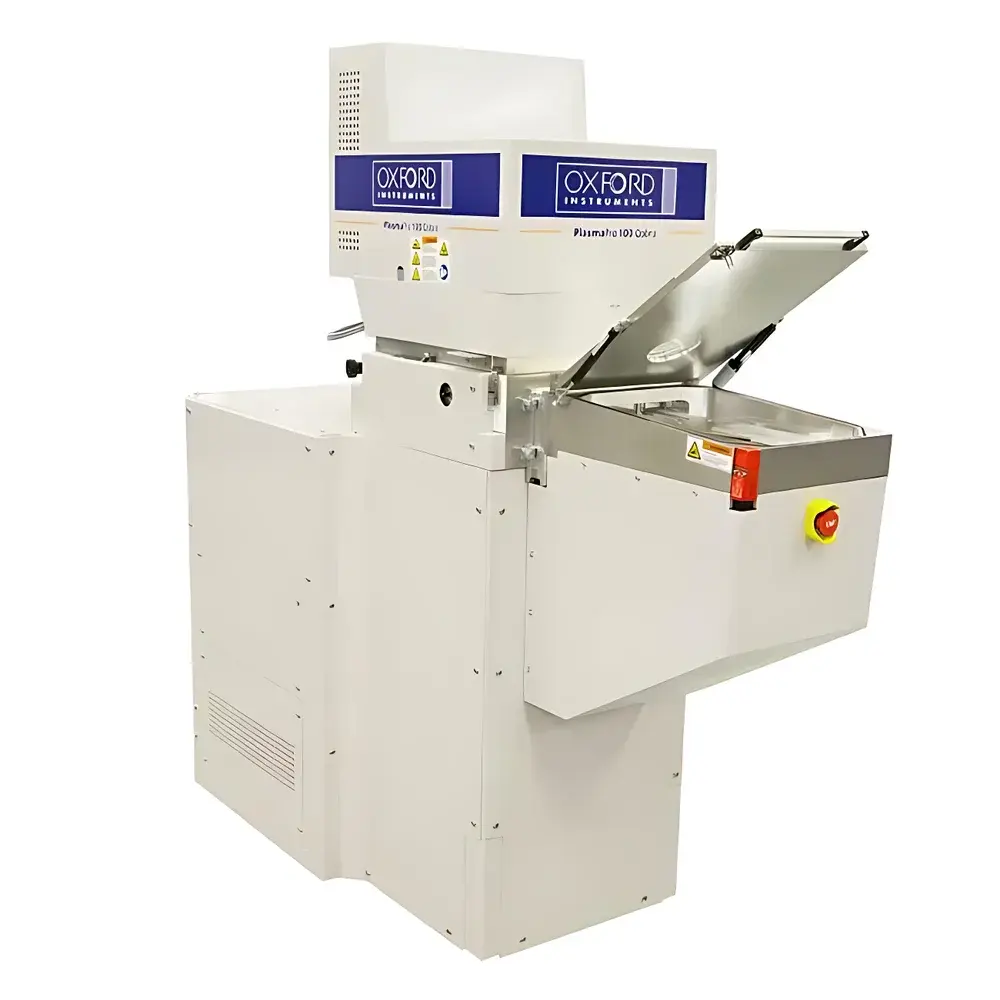
Oxford Instruments PlasmaPro 100 Cobra Etch and Deposition System
| Brand | Oxford Instruments |
|---|---|
| Origin | United Kingdom |
| Model | PlasmaPro 100 Cobra |
| Wafer Capacity | Single-wafer and batch processing up to 200 mm |
| Temperature Range | −150 °C to +400 °C |
| Electrode Cooling/Heating | Liquid nitrogen, recirculating chiller, or resistive heating |
| RF Power Delivery | Top-mounted electrode with dual-frequency (LF/RF) capability |
| ICP Source Options | 65 mm, 180 mm, 300 mm |
| Process Pressure Range | Wide operational window enabled by high-pumping-speed vacuum system |
| Substrate Thickness Compatibility | Up to 10 mm |
| Backside He–cooling | Integrated electrostatic chuck with helium backside cooling |
| Endpoint Detection | Real-time optical emission spectroscopy (OES) monitoring |
| Chamber Architecture | Symmetric, low-inductance plasma chamber with uniform gas distribution and high-conductance pumping path |
Overview
The Oxford Instruments PlasmaPro 100 Cobra is a modular, high-precision plasma etch and deposition system engineered for research, development, and pilot-scale manufacturing in micro- and nanofabrication laboratories. It operates on the principles of inductively coupled plasma (ICP) and capacitively coupled plasma (CCP), enabling independent control of ion energy and plasma density—critical for achieving atomic-level selectivity, anisotropy, and process reproducibility. The system supports both reactive ion etching (RIE) and plasma-enhanced chemical vapor deposition (PECVD) modes, with configurable hardware options including multiple ICP source diameters (65 mm, 180 mm, 300 mm), dual-frequency RF biasing (LF/RF), and precision substrate temperature control from −150 °C to +400 °C. Its compact, service-oriented architecture delivers >90% uptime and rapid tool qualification, making it suitable for GLP-compliant R&D environments and early-stage production lines requiring traceable process validation.
Key Features
- Modular platform supporting single-wafer and batch processing of substrates up to 200 mm diameter, with compatibility for wafers up to 10 mm thickness.
- Electrode temperature control via liquid nitrogen, recirculating chiller, or resistive heating—enabling cryogenic etching (e.g., Bosch, deep Si etch) and high-temperature PECVD processes.
- Integrated helium backside cooling with electrostatic chuck for precise thermal management and improved across-wafer uniformity.
- Dual-frequency RF bias (LF/RF) applied to the bottom electrode, decoupling ion energy from plasma density for optimized etch profile control and low-damage processing.
- Top-mounted ICP source with symmetric gas injection and high-conductance pumping path ensures excellent radial plasma uniformity and stable operation across wide pressure ranges (1–100 mTorr typical).
- Real-time endpoint detection using optical emission spectroscopy (OES), synchronized with process recipe execution for automated layer-by-layer etch termination.
- Automated mode switching between etch and deposition configurations; optional PlasmaPro FA variant supports failure analysis (FA) of packaged devices and bare die.
Sample Compatibility & Compliance
The PlasmaPro 100 Cobra accommodates diverse substrate materials including silicon, III–V compounds (GaAs, InP, GaN), quartz, fused silica, sapphire, and polymer-based carriers. It is routinely deployed in processes compliant with ASTM F2627 (standard guide for plasma etch process characterization), ISO 14644-1 (cleanroom classification), and industry-specific requirements for MEMS, photonics, and compound semiconductor fabrication. All software logs—including parameter sets, OES traces, RF matching data, and chamber status—are timestamped and audit-trail enabled, supporting adherence to FDA 21 CFR Part 11 and EU Annex 11 for electronic records in regulated environments.
Software & Data Management
The system runs on Oxford Instruments’ proprietary PlasmaPro Control Suite—a Windows-based, role-secured interface supporting recipe creation, remote monitoring, and automated reporting. Each process step is fully parameterized (gas flows, pressures, power levels, temperatures, durations) and stored with metadata (operator ID, timestamp, chamber history). Data export conforms to CSV and HDF5 formats for integration with laboratory information management systems (LIMS) and statistical process control (SPC) platforms. Full audit trail functionality includes user login/logout logs, parameter change history, and electronic signature support for SOP-driven workflows.
Applications
- High-aspect-ratio silicon etching (Bosch and cryogenic DRIE) for MEMS inertial sensors and through-silicon vias (TSVs).
- Low-damage GaN and AlGaN etching for RF HEMTs and power electronics.
- VCSEL and photonic integrated circuit (PIC) fabrication using InP and GaAs substrates.
- PECVD of stoichiometric SiNx and SiO2 films for waveguide cladding, passivation, and anti-reflection coatings.
- Hard mask deposition (e.g., TaN, TiN) and subsequent anisotropic etch for high-brightness LED patterning.
- Failure analysis dry etch deprocessing of molded IC packages, flip-chip assemblies, and wafer-level CSPs using the PlasmaPro FA configuration.
FAQ
What wafer sizes does the PlasmaPro 100 Cobra support?
It handles substrates from 50 mm up to 200 mm in diameter, including non-standard shapes and thick substrates (up to 10 mm), with manual or semi-automated load-lock options.
Is the system compatible with cryogenic etching processes?
Yes—the electrode temperature range extends to −150 °C using liquid nitrogen or closed-loop chiller integration, enabling ultra-low-temperature silicon and III–V etching.
Can endpoint detection be used for multi-layer stacks?
Yes—OES-based endpoint detection supports spectral fingerprinting of multiple etch interfaces, with configurable threshold triggers per layer in multi-step recipes.
Does the system meet regulatory requirements for quality-controlled environments?
All software modules include full 21 CFR Part 11 compliance features: electronic signatures, audit trails, role-based access control, and immutable log archiving.
What maintenance intervals are recommended for routine operation?
Preventive maintenance is scheduled every 6 months or after 1,000 hours of plasma-on time, covering RF match calibration, OES sensor verification, and chamber conditioning—documentation provided per ISO/IEC 17025 guidelines.



