
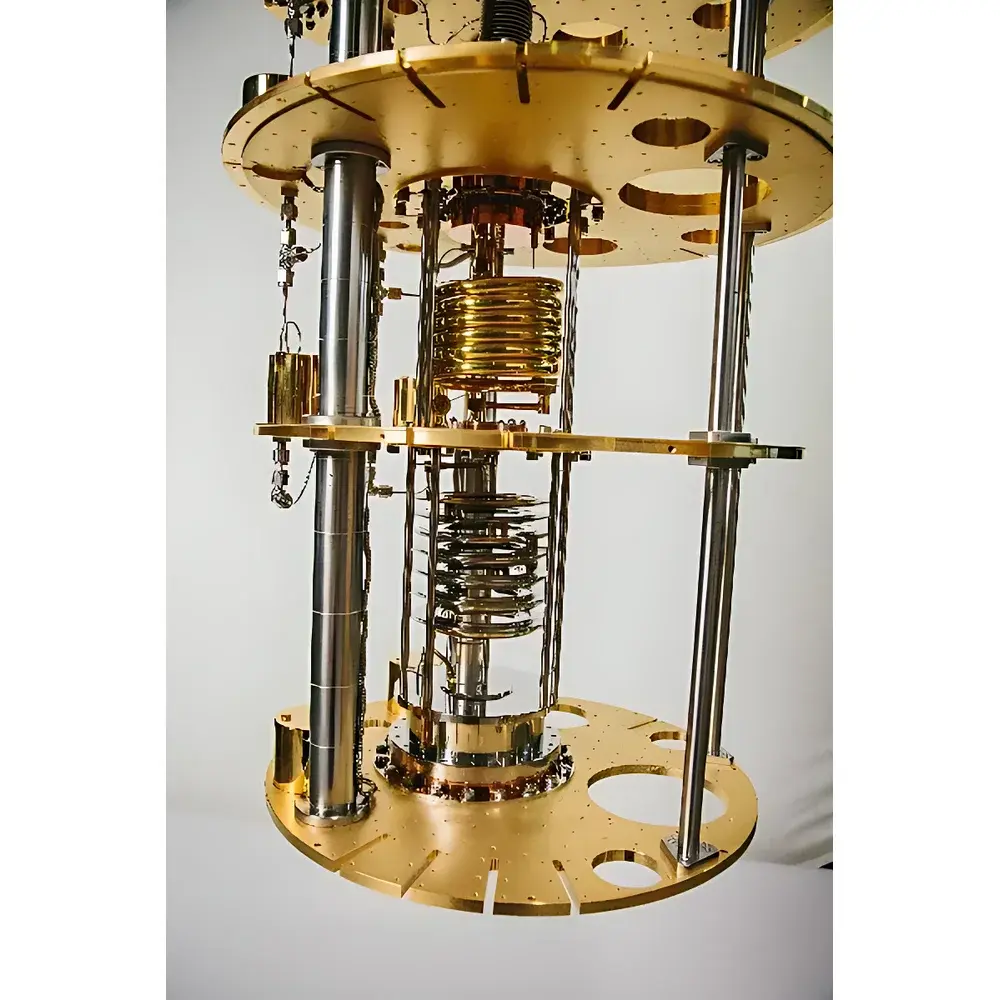
Oxford Instruments Proteox 5 mK Dilution Refrigerator
| Brand | Oxford Instruments |
|---|---|
| Origin | United Kingdom |
| Model | Proteox 5 mK |
| Cooling Principle | Helium-3/Helium-4 Dilution Refrigeration |
| Base Temperature | < 5 mK |
| Magnet Compatibility | Integrated or Standalone Oxford Superconducting Magnets (up to 18 T) |
| Cryogenic Architecture | Dry, Helium-Free Operation |
| System Configuration | Turnkey Cryostat with Vibration-Isolated Mixing Chamber and Thermal Anchoring Stages |
Overview
The Oxford Instruments Proteox 5 mK Dilution Refrigerator is a high-performance, dry, helium-free cryogenic system engineered for quantum transport, superconductivity, topological matter, and nanoscale spin physics research at ultra-low temperatures. Operating on the thermodynamic principle of helium-3/helium-4 phase separation and dilution cooling, the Proteox achieves a validated base temperature of less than 5 millikelvin in the mixing chamber under standard operating conditions—enabling access to the quantum ground state regime where thermal noise is suppressed below critical energy scales. Unlike conventional liquid-helium-based cryostats, the Proteox eliminates dependency on bulk cryogens through an integrated pulse-tube precooling stage followed by a continuously operating dilution unit. Its modular architecture supports both horizontal and vertical sample access configurations, with optimized thermal anchoring across multiple temperature stages (300 K, 50 K, 4 K, 1 K, 100 mK, and < 5 mK) to ensure minimal thermal load propagation and high thermal stability (< ±10 µK over 1 hour at base temperature).
Key Features
- Dry operation: No liquid helium handling required—reduces operational complexity, safety overhead, and long-term cost of ownership.
- Sub-5 mK base temperature: Achieved via high-efficiency dilution unit with actively stabilized He-3 circulation and low-vibration mixing chamber suspension.
- Integrated vibration mitigation: Multi-stage passive damping combined with active feedback-controlled inertial isolation minimizes mechanical coupling to sensitive quantum devices (e.g., superconducting qubits, scanning tunneling microscope tips).
- Magnet-ready platform: Designed for seamless integration with Oxford Instruments’ range of superconducting magnets—including 9 T, 12 T, and 18 T vertical-bore systems—with dedicated cold-bore thermal shielding and magnetic field homogeneity optimization.
- Modular wiring and signal routing: Standardized 128-channel low-thermal-conductivity wiring harness with filtered feedthroughs (DC to 18 GHz) and customizable RF/DC/microwave port configurations.
- Intuitive control interface: Oxford’s ILM (Intelligent Laboratory Management) software provides real-time monitoring of all cryogenic parameters—including He-3 pressure, still temperature, mixing chamber temperature, and compressor status—with automated cooldown sequences and fault diagnostics.
Sample Compatibility & Compliance
The Proteox accommodates diverse experimental geometries including bulk single crystals, thin-film heterostructures, 2D material stacks, microfabricated Hall bar devices, and custom probe cards. Sample mounting platforms support both rigid mechanical fixation and compliant thermal anchoring using high-purity copper, OFHC, or sapphire components. All internal materials are selected for ultra-low outgassing rates (per ASTM E595) and non-magnetic compatibility (ASTM A342). The system meets ISO 14644-1 Class 5 cleanroom assembly standards during factory integration and complies with CE marking requirements for electromagnetic compatibility (EN 61326-1) and low-voltage safety (EN 61010-1). For regulated environments, optional audit-trail logging and user-access controls align with GLP/GMP documentation workflows.
Software & Data Management
ILM software serves as the unified control and data acquisition hub, supporting synchronized logging of up to 256 analog/digital channels at configurable sampling rates (1 Hz to 10 kHz). Raw temperature, pressure, and magnet current data are stored in HDF5 format with embedded metadata (timestamp, calibration coefficients, instrument configuration). Export modules enable direct integration with Python (via PyTables), MATLAB, and LabVIEW environments. Optional 21 CFR Part 11-compliant version includes electronic signatures, role-based permissions, and immutable audit trails for FDA-regulated R&D applications. Remote monitoring via secure TLS-encrypted web interface allows off-site system supervision without compromising local network integrity.
Applications
- Quantum computing device characterization: Qubit coherence time mapping, gate fidelity testing, and microwave photon detection at sub-10 mK regimes.
- Topological insulator and Weyl semimetal transport: Observation of chiral anomaly, quantum anomalous Hall effect, and edge-state conductance quantization.
- Ultra-low-noise metrology: Primary resistance standard realization using graphene-based quantum Hall devices.
- Scanning probe microscopy: Low-temperature STM/STS and AFM with atomic resolution under magnetic fields up to 15 T.
- Single-electron transistor and Coulomb blockade spectroscopy: Charge sensing and orbital level spectroscopy in semiconductor quantum dots.
FAQ
What is the typical cooldown time from 300 K to base temperature?
Typical cooldown to < 5 mK requires approximately 18–22 hours, depending on thermal load and initial vacuum quality. Precooling to 4 K is completed in ~6 hours; the dilution stage engages thereafter.
Can the Proteox operate continuously without intervention?
Yes—the system is designed for unattended 7×24 operation with automated pressure regulation, He-3 inventory management, and predictive maintenance alerts via ILM.
Is retrofitting possible for existing Oxford cryostats?
Retrofitting is not supported; the Proteox is a fully integrated platform requiring factory-assembled dilution unit, pulse-tube cold head, and structural frame.
What vacuum performance is specified for the mixing chamber?
Ultimate vacuum better than 1×10⁻⁷ mbar is maintained in the mixing chamber region during operation, verified by calibrated Bayard-Alpert gauges.
How is magnetic field homogeneity ensured when integrating a superconducting magnet?
Oxford provides field-mapping reports and custom shimming solutions; cold-bore ferromagnetic shielding and persistent-mode current leads minimize field drift and spatial gradients within the sample volume.



