
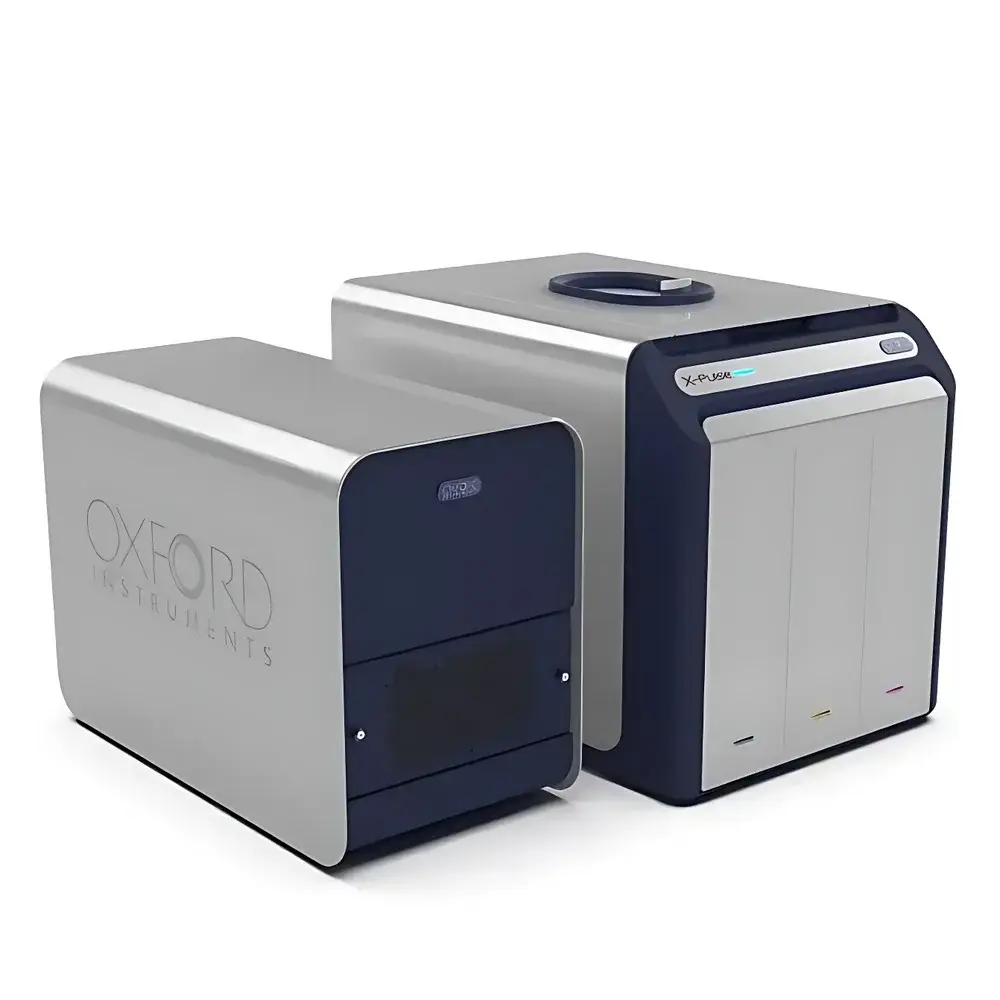
Oxford Instruments X-Pulse Broadband Multinuclear Benchtop NMR Spectrometer
| Brand | Oxford Instruments |
|---|---|
| Origin | United Kingdom |
| Model | X-Pulse |
| Instrument Type | Low-Field NMR Analyzer |
| Sample Form | Liquid |
| Operating Frequency | 60 MHz |
| Data Acquisition Mode | Pulsed Fourier Transform |
| Signal-to-Noise Ratio | >180:1 |
| Spectral Resolution | <0.35 Hz |
| ¹H Quantitative Reproducibility | Excellent |
Overview
The Oxford Instruments X-Pulse is a compact, high-stability benchtop nuclear magnetic resonance (NMR) spectrometer engineered for routine and research-grade multinuclear analysis in academic, industrial, and quality control laboratories. Operating at a fixed 60 MHz ¹H frequency, the system leverages permanent magnet technology—eliminating cryogenic liquid helium or nitrogen—and delivers robust, field-homogeneous performance suitable for quantitative ¹H, ¹⁹F, ¹³C, ³¹P, ⁷Li, ²³Na, ¹¹B, and ²⁹Si NMR spectroscopy. Its pulsed Fourier transform architecture enables full digital signal acquisition with phase-sensitive detection, supporting both 1D and 2D experiments without external shimming or field-frequency lock. Designed for accessibility without compromise, the X-Pulse integrates a self-shielded, temperature-regulated magnet with active field stabilization, ensuring long-term spectral reproducibility and minimal drift (<5 Hz/hour) under standard laboratory conditions (20–25 °C, non-vibrating bench).
Key Features
- Broadband Multinuclear Capability: Simultaneous hardware support for ≥8 nuclei (¹H, ¹⁹F, ¹³C, ³¹P, ⁷Li, ²³Na, ¹¹B, ²⁹Si) via software-selectable probe tuning—no manual coil swaps or hardware reconfiguration required.
- Advanced Pulse Sequence Suite: Factory-installed library includes standard 1D sequences (e.g., zg, noesy, selgs), DEPT-135, COSY, HSQC, HMBC, and gradient-selected ME-HSQC—enabling structural elucidation, solvent suppression, selective excitation, and heteronuclear correlation without third-party licensing.
- In Situ Flow Chemistry Monitoring: Integrated flow probe option supports real-time reaction monitoring at controlled temperatures (20–60 °C) using standard 5 mm NMR tubes or dedicated flow cells—enabling kinetic profiling of esterifications, hydrogenations, and cross-coupling reactions with sub-minute temporal resolution.
- User-Centric Design: Modular probe assembly allows user-level disassembly for cleaning or maintenance; no specialized tools or service engineer intervention required for routine inspection.
- Zero-Cryogen Operation: Permanent magnet architecture eliminates dependency on liquid cryogens, reducing operational overhead, safety hazards, and infrastructure requirements—ideal for teaching labs, synthetic chemistry suites, and GMP-adjacent QC environments.
Sample Compatibility & Compliance
The X-Pulse accepts conventional 5 mm outer-diameter NMR tubes (Wilmad 528-PP or equivalent) and is compatible with commercially available flow cells for continuous-flow applications. Sample volume ranges from 0.4 mL to 0.6 mL per acquisition. All pulse sequences adhere to IUPAC-recommended NMR data formatting standards (JCAMP-DX v5.01). The system supports audit-trail-enabled operation compliant with GLP and FDA 21 CFR Part 11 when deployed with optional electronic signature modules and networked data archiving. Instrument qualification documentation—including IQ/OQ protocols aligned with ASTM E2917 and ISO/IEC 17025—can be provided upon request for regulated environments.
Software & Data Management
Controlled via the proprietary X-Pulse Software Suite, the platform features an intuitive graphical interface built on Qt framework, with drag-and-drop experiment setup, real-time spectral preview, and automated phasing/baseline correction. Data files are stored in vendor-neutral NMR-Data-Format (NDF) compliant with NMReDATA specifications. Export options include ASCII, PNG, SVG, and Bruker TopSpin-compatible fid/ser formats. Batch processing scripts (Python API access available) enable automated integration, peak fitting, and kinetic modeling across time-series datasets—particularly valuable for reaction monitoring and quantitative assay development. Raw FIDs and processed spectra are timestamped and metadata-tagged (operator, date, pulse sequence, receiver gain, number of scans), satisfying traceability requirements for internal SOPs and external audits.
Applications
- Organic Synthesis Verification: Rapid confirmation of product identity, purity assessment, and stoichiometric quantification (e.g., residual solvents, enantiomeric excess via chiral solvating agents).
- Teaching & Pedagogy: Hands-on NMR instruction for undergraduate and graduate curricula—demonstrating spin physics, J-coupling, chemical shift anisotropy, and multidimensional correlation logic without requiring superconducting infrastructure.
- Pharmaceutical Process Analytics: In-line monitoring of API crystallization, polymorph transitions, and hydrolysis kinetics using ¹⁹F or ³¹P as intrinsic probes.
- Materials Characterization: Analysis of polymer microstructure (branching, tacticity), lithium-ion battery electrolyte decomposition pathways (⁷Li, ¹⁹F), and silicon-based precursors (²⁹Si).
- Food & Agrochemical QC: Fat/oil composition (¹H T₂ relaxometry), pesticide residue screening (¹⁹F, ³¹P), and fermentation metabolite profiling (¹H–¹³C HSQC).
FAQ
Is the X-Pulse suitable for quantitative NMR (qNMR) according to USP & ICH guidelines?
Yes—its high ¹H quantitative reproducibility (<0.5% RSD over 24 h), calibrated receiver gain, and standardized pulse widths meet the instrumental precision requirements outlined in USP and ICH Q2(R2) for assay and impurity quantitation.
Can I upgrade my existing X-Pulse to support new nuclei or pulse sequences?
All firmware and sequence libraries are delivered via secure online portal; licensed upgrades (e.g., ²⁹Si or diffusion-ordered spectroscopy) are installed remotely without hardware modification.
Does the system require RF shielding or special room installation?
No—integrated RF shielding and low electromagnetic emissions allow operation in standard laboratory spaces, including fume hoods and near HPLC or GC systems.
What sample preparation is required for flow-mode experiments?
Standard syringe-pump-driven flow cells accept 0.2–2.0 mL/min flow rates; samples must be filtered (0.45 µm) and degassed to prevent bubble formation in the detection zone.
How is magnet homogeneity maintained over time?
The permanent magnet incorporates active temperature compensation and passive shimming; daily automated field-frequency calibration (via DSS reference) ensures consistent linewidth performance without manual intervention.
Related Products





