
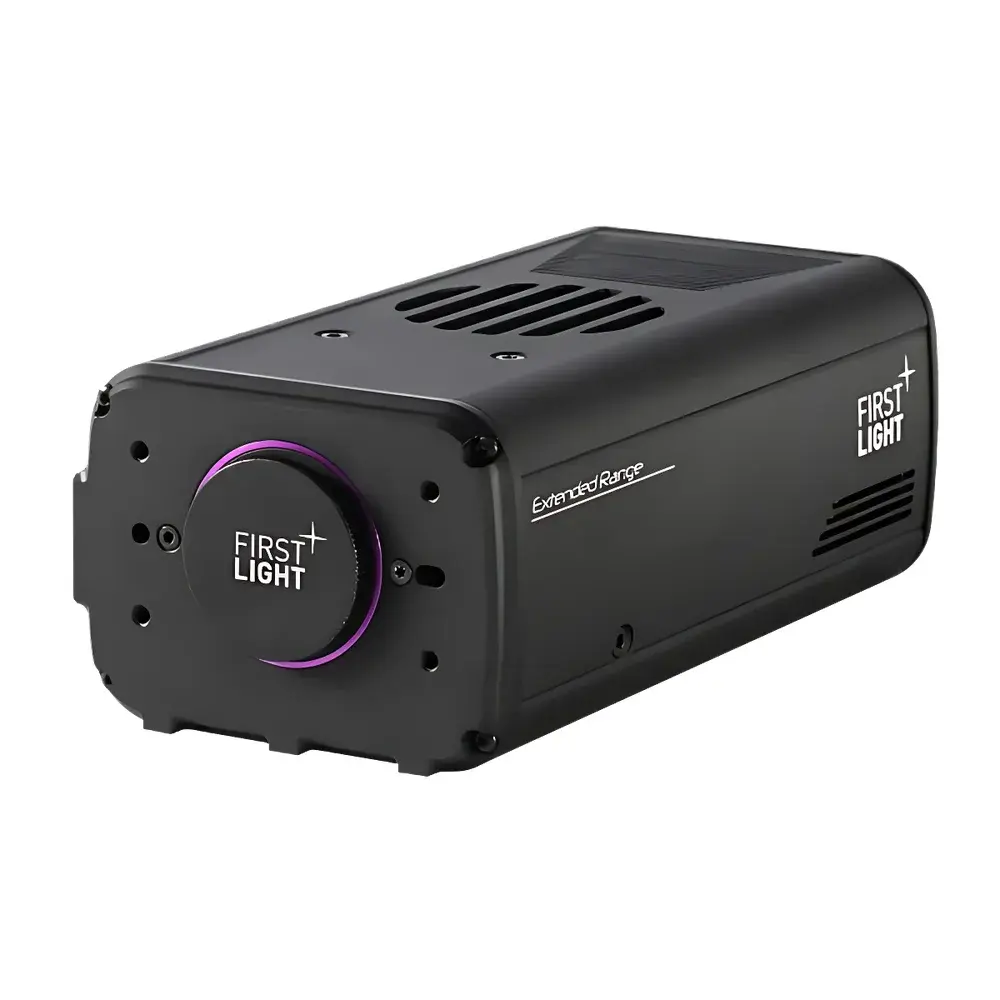
Oxford Instruments C-RED 2 ER Extended-Range InGaAs Camera
| Brand | Oxford Instruments |
|---|---|
| Origin | France |
| Model | C-RED 2 ER |
| Effective Pixels | 640 × 512 |
| Pixel Size | 15 µm |
| Frame Rate | 600 fps (full frame), up to 32,066 fps (region-of-interest) |
| Spectral Range | 1.1–1.9 µm (C-RED 2 ER 1.9) or 1.2–2.2 µm (C-RED 2 ER 2.2) |
| Read Noise | < 50 e⁻ (1.9 µm version), < 40 e⁻ (2.2 µm version) |
| Cooling | Integrated dual-stage thermoelectric cooler (ΔT ≤ 60 °C vs. ambient) |
Overview
The Oxford Instruments C-RED 2 ER is a high-sensitivity, extended-range short-wave infrared (SWIR) imaging camera engineered for scientific and industrial applications requiring high-speed, low-noise detection in the 1.1–2.2 µm spectral window. Unlike conventional InGaAs cameras limited to ~1.7 µm, the C-RED 2 ER leverages proprietary extended-range indium gallium arsenide (InGaAs) focal plane arrays (FPAs) to deliver direct, uncooled-to-cryogenic-alternative detection across two distinct spectral configurations: 1.1–1.9 µm and 1.2–2.2 µm. This capability fills a critical gap in SWIR imaging—enabling access to molecular absorption features of water, polymers, and biological tissues that are otherwise inaccessible with standard SWIR sensors. The camera operates on a VGA-format (640 × 512) detector with 15 µm pixel pitch, achieving peak quantum efficiency exceeding 70% and sub-50 e⁻ read noise—performance metrics essential for photon-starved applications such as ultrafast laser diagnostics, non-invasive tissue imaging, and real-time process monitoring.
Key Features
- Extended SWIR sensitivity: Two optimized variants—C-RED 2 ER 1.9 (1.1–1.9 µm) and C-RED 2 ER 2.2 (1.2–2.2 µm)—designed for complementary coverage of the long-wave SWIR band
- High-speed acquisition: Up to 600 frames per second at full resolution (640 × 512); >32,000 fps in user-defined ROI modes for transient event capture
- Dual-stage thermoelectric cooling: Integrated Peltier-based system delivers up to 60 °C temperature delta below ambient, eliminating the need for liquid nitrogen or Stirling coolers
- Low-noise architecture: Read noise < 50 e⁻ (1.9 µm variant) and < 40 e⁻ (2.2 µm variant) ensures high signal-to-noise ratio (SNR) even at microsecond exposure times
- Back-illuminated InGaAs sensor: Optimized for quantum efficiency >70% across operational bands, with minimal dark current due to stabilized thermal management
- Compact, ruggedized housing: Designed for integration into OEM systems, vacuum-compatible optical benches, and laboratory-grade laser setups
Sample Compatibility & Compliance
The C-RED 2 ER is compatible with standard C-mount and F-mount optical interfaces, supporting collimated and focused SWIR illumination sources including supercontinuum lasers, tunable OPOs, and broadband halogen lamps. Its spectral response aligns with ASTM E131-22 (Standard Terminology Relating to Molecular Spectroscopy) and ISO 15408-3 (security evaluation criteria for imaging sensors). While not certified for medical device use under FDA 510(k) or CE IVD, the camera meets general-purpose research instrumentation requirements under ISO/IEC 17025:2017 for measurement traceability and environmental stability. All firmware and hardware revisions undergo GLP-aligned validation protocols for reproducibility in regulated R&D environments.
Software & Data Management
Oxford Instruments provides the C-RED SDK (Software Development Kit) for Windows and Linux platforms, supporting native integration with MATLAB, Python (via NumPy/Cython bindings), LabVIEW, and C/C++. The SDK includes real-time streaming APIs, hardware-triggered acquisition modes, and pixel-level non-uniformity correction (NUC) routines. Time-stamped metadata—including exposure duration, sensor temperature, gain settings, and ROI coordinates—is embedded in each frame’s header (IEEE 1394b-compliant format). Raw data export supports HDF5 and TIFF formats, enabling compatibility with image analysis pipelines compliant with FDA 21 CFR Part 11 for audit-trail-enabled workflows. Firmware updates are delivered via secure HTTPS channels with SHA-256 signature verification.
Applications
- Laser beam profiling and M² characterization in the 1.5–2.2 µm range (e.g., thulium- and holmium-doped fiber lasers)
- Non-destructive testing (NDT) of composite materials, where water ingress and delamination exhibit strong SWIR absorption signatures
- In vivo small-animal imaging using endogenous contrast agents (e.g., oxyhemoglobin deoxyhemoglobin differential absorption beyond 1.6 µm)
- Real-time combustion diagnostics—capturing OH*, CH*, and CO₂ emission bands in gas-phase flames
- Industrial sorting of plastics and pharmaceuticals based on spectral fingerprinting in the 1.7–2.2 µm window
- Free-space optical communication link monitoring under atmospheric turbulence conditions
FAQ
Does the C-RED 2 ER require cryogenic cooling?
No. It uses a dual-stage thermoelectric cooler capable of maintaining stable sensor temperatures up to 60 °C below ambient—sufficient for dark current suppression without liquid nitrogen or mechanical refrigeration.
Can the camera be synchronized with external laser pulses?
Yes. It supports hardware-level triggering via TTL or LVDS inputs with jitter < 5 ns, enabling precise synchronization with pulsed laser sources operating from kHz to MHz repetition rates.
Is the detector sensitive to visible light?
No. The extended-range InGaAs material exhibits negligible quantum efficiency below 1.0 µm; visible-light rejection is intrinsic and does not require additional bandpass filtering.
What calibration options are available?
Factory-calibrated NUC maps are provided for each unit. Users may perform custom flat-field and dark-frame corrections using the SDK; radiometric calibration kits (NIST-traceable blackbody sources) are available as optional accessories.
How is data integrity ensured during high-speed acquisition?
The camera implements onboard frame buffering with error-correcting code (ECC) memory and cyclic redundancy check (CRC) validation on all transmitted frames—ensuring bit-perfect data transfer even at 32,066 fps over Camera Link HS or CoaXPress 2.0 interfaces.






