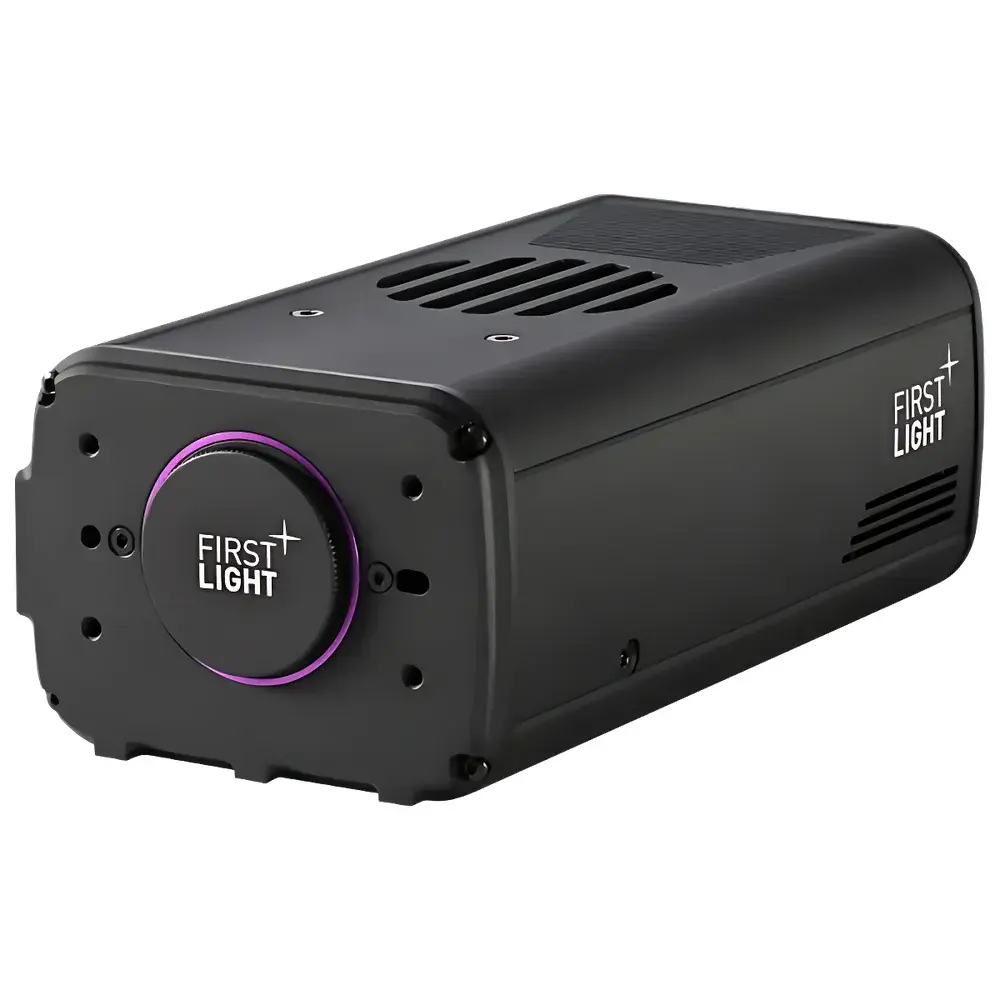
Oxford Instruments C-RED 2 Short-Wave Infrared (SWIR) Camera
| Brand | Oxford Instruments |
|---|---|
| Origin | France |
| Model | C-RED 2 |
| Effective Resolution | 640 × 512 pixels |
| Pixel Size | 15 µm |
| Frame Rate | up to 600 fps |
| Read Noise | <30 e⁻ |
| Electronic Shutter Pulse Width | <5 µs |
| Maximum Exposure Time | 60 s |
| Dynamic Range | 93 dB |
| ADC Resolution | True 16-bit |
Overview
The Oxford Instruments C-RED 2 is a high-performance, scientific-grade short-wave infrared (SWIR) camera engineered for ultra-low-noise, high-speed imaging in the 0.9–1.7 µm spectral range. Built around a monolithic 640 × 512 InGaAs PIN photodiode focal plane array (FPA), the C-RED 2 leverages deep-cooled operation (typically stabilized at −40 °C via thermoelectric cooling) to suppress dark current and enable photon-limited detection. Its core architecture implements correlated double sampling (CDS) readout combined with on-chip analog signal conditioning, delivering sub-30-electron read noise—critical for quantitative SWIR measurements where signal levels are inherently low. With native frame rates up to 600 fps at full resolution and an electronically controlled global shutter featuring pulse widths under 5 µs, the C-RED 2 supports time-resolved phenomena such as laser-induced transient absorption, combustion dynamics, and fast semiconductor inspection without motion blur or rolling-shutter artifacts.
Key Features
- Monolithic InGaAs sensor with 640 × 512 active pixels and 15 µm pitch—optimized for spatial fidelity and fill factor efficiency
- True 16-bit analog-to-digital conversion with linearity deviation <0.1% over full dynamic range
- On-sensor electronic shutter enabling exposure control from <5 µs to 60 s—fully programmable via hardware trigger interface
- 93 dB system dynamic range achieved through optimized well capacity (≥120 ke⁻) and ultra-low read noise architecture
- Integrated thermoelectric cooler (TEC) with closed-loop temperature stabilization (±0.1 °C), eliminating need for external cryogenics
- GigE Vision-compliant interface with GenICam support—ensuring compatibility with standard machine vision software environments (e.g., HALCON, Common Vision Blox, MATLAB Image Acquisition Toolbox)
Sample Compatibility & Compliance
The C-RED 2 is designed for integration into vacuum-compatible, vibration-isolated, and EMI-controlled laboratory environments typical of synchrotron beamlines, ultrafast laser labs, and semiconductor metrology setups. Its mechanical housing meets IP40 ingress protection standards and features standardized C-mount and SM1-threaded optical interfaces. From a regulatory standpoint, the camera complies with CE marking requirements (EMC Directive 2014/30/EU and RoHS Directive 2011/65/EU). While not certified for medical device use, its performance characteristics align with measurement traceability frameworks referenced in ISO/IEC 17025-accredited calibration laboratories. Data acquisition workflows can be configured to meet audit-trail requirements under GLP and GMP guidelines when paired with compliant host software supporting metadata logging and user-access controls.
Software & Data Management
Oxford Instruments provides the C-RED 2 with the open-source, cross-platform C-RED SDK (Software Development Kit), supporting C/C++, Python (via ctypes bindings), and LabVIEW APIs. The SDK enables full control over exposure timing, gain modes, region-of-interest (ROI) selection, and non-uniformity correction (NUC) calibration routines. Raw image data is streamed in lossless 16-bit TIFF or HDF5 format, preserving bit-depth integrity for downstream spectral unmixing or radiometric analysis. Optional integration with Oxford’s proprietary IRIS acquisition platform adds synchronized multi-camera triggering, real-time histogram monitoring, and automated NUC scheduling—features routinely deployed in industrial inline inspection systems requiring process consistency validation per ISO 9001 clause 8.5.2.
Applications
- Time-resolved spectroscopy: Capturing microsecond-scale decay kinetics in SWIR-emitting phosphors and quantum dot materials
- Laser beam profiling: Characterizing M², centroid stability, and hot-spot evolution in high-power fiber lasers (1064 nm, 1550 nm)
- Non-destructive testing: Subsurface defect detection in silicon wafers, polymer composites, and solar cell interconnects
- Biomedical imaging: Label-free visualization of lipid distribution and vascular oxygenation gradients in ex vivo tissue specimens
- Astronomical adaptive optics: Wavefront sensing feedback for ground-based telescopes operating in the H-band (1.49–1.79 µm)
- Industrial sorting: Real-time identification of plastic resin types (e.g., PET vs. PVC) based on SWIR spectral absorption signatures
FAQ
What cooling method does the C-RED 2 use, and is liquid nitrogen required?
The C-RED 2 employs a single-stage thermoelectric cooler (TEC) integrated directly with the sensor package. No liquid nitrogen or external cryocooler is needed; stable operation at −40 °C is achieved with standard AC power and ambient air convection.
Can the C-RED 2 be synchronized with external pulsed lasers?
Yes. The camera provides TTL-compatible input and output trigger ports supporting master-slave configurations with jitter <100 ns, enabling precise synchronization with femtosecond or nanosecond laser systems.
Is radiometric calibration available, and how is it maintained?
Factory-applied non-uniformity correction (NUC) tables are provided for each unit. Users may perform field NUC using built-in shutterless or mechanical shutter routines; calibration stability is verified annually per ISO/IEC 17025 procedures by authorized service centers.
Does the C-RED 2 support region-of-interest (ROI) readout to increase frame rate?
Yes. ROI mode allows configurable sub-arrays down to 32 × 32 pixels, enabling frame rates exceeding 3,000 fps while maintaining full 16-bit depth and low-noise performance.
What lens mounts are natively supported?
The C-RED 2 ships with a standard C-mount interface and includes an SM1-threaded adapter ring for direct coupling to Thorlabs-compatible optics assemblies and collimation tubes. Custom flange options (e.g., F-mount, M42) are available upon request.