
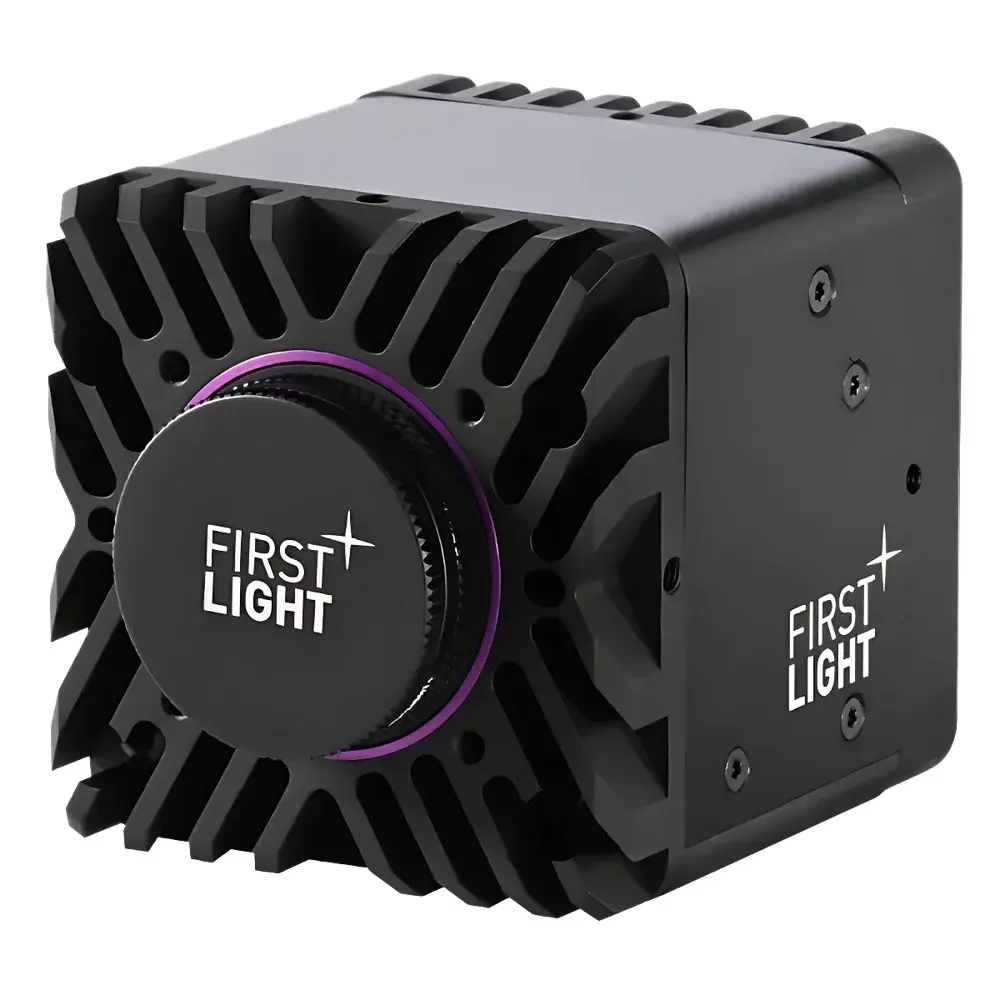
Oxford Instruments C-RED 3 SWIR Camera
| Brand | Oxford Instruments |
|---|---|
| Origin | France |
| Model | C-RED 3 |
| Resolution | 640 × 512 pixels |
| Pixel Size | 15 µm |
| Readout Speed | Up to 600 fps (full frame) |
| Integration Time | < 5 µs (electronic shutter) |
| Cooling | Uncooled |
| Form Factor | Compact OEM-ready design |
| Power Consumption | < 5 W |
| Interface | Camera Link HS or 10 GbE |
| Spectral Range | 0.9–1.7 µm |
Overview
The Oxford Instruments C-RED 3 is a high-speed, uncooled short-wave infrared (SWIR) camera engineered for demanding applications requiring sub-millisecond exposure control, high temporal resolution, and robust operation in variable thermal environments. Based on a 640 × 512 InGaAs PIN photodiode focal plane array with 15 µm pixel pitch, the C-RED 3 delivers VGA-resolution imaging across the 0.9–1.7 µm spectral band—critical for laser beam profiling, active illumination imaging, semiconductor inspection, and ultrafast transient phenomena analysis. Unlike conventional cooled SWIR cameras, the C-RED 3 eliminates thermoelectric or cryogenic cooling systems, relying instead on patented adaptive biasing circuitry to maintain stable dark current and gain characteristics across ambient temperature fluctuations (−10 °C to +50 °C). Its electronic shutter achieves integration times as low as 5 µs with negligible smear or lag—enabling precise synchronization with pulsed lasers, Q-switched sources, or time-gated illumination schemes. The architecture integrates analog-to-digital conversion, timing control, and interface electronics into a monolithic, lightweight enclosure (< 250 g), making it suitable for space-constrained setups and embedded OEM platforms.
Key Features
- Uncooled InGaAs sensor with 640 × 512 resolution and 15 µm pixel pitch for optimal spatial sampling in SWIR
- Ultra-fast electronic shutter: minimum integration time < 5 µs; full-frame readout at up to 600 fps
- Patented adaptive bias technology ensuring consistent offset and gain stability over operational temperature range
- Low power consumption (< 5 W) and compact form factor (82 × 82 × 45 mm) optimized for portable and embedded integration
- Dual high-bandwidth interface options: Camera Link HS (for deterministic latency) or 10 Gigabit Ethernet (for simplified cabling and long-distance transmission)
- Firmware-upgradable architecture supporting custom trigger modes, region-of-interest (ROI) readout, and non-uniformity correction (NUC) calibration persistence
Sample Compatibility & Compliance
The C-RED 3 is compatible with standard SWIR optical components—including aspheric lenses, bandpass filters, and beam splitters—designed for the 0.9–1.7 µm range. It supports industry-standard mounting interfaces (M42 × 0.75 and C-mount adapters available) and integrates seamlessly into existing optical benches, microscopy platforms, and industrial inspection stations. From a regulatory standpoint, the device complies with CE marking requirements (EMC Directive 2014/30/EU and RoHS Directive 2011/65/EU). Its firmware architecture supports audit-ready logging of acquisition parameters and user-defined metadata tags, aligning with GLP-compliant documentation workflows. While not certified for medical or aerospace safety standards out-of-the-box, its deterministic timing behavior and traceable calibration paths meet foundational requirements for ISO/IEC 17025-accredited laboratories performing SWIR-based material characterization.
Software & Data Management
Oxford Instruments provides the C-RED 3 SDK (Software Development Kit) for Windows and Linux (x86_64), including C/C++, Python (PyQt/NumPy), and MATLAB bindings. The included C-RED Studio application enables real-time visualization, histogram analysis, multi-frame averaging, and export to TIFF, HDF5, or raw binary formats. All acquired frames are timestamped with microsecond precision using an internal hardware clock synchronized to external TTL triggers. The SDK supports full access to programmable parameters—including gain, offset, ROI dimensions, trigger delay, and NUC table management—enabling integration into automated test sequences compliant with ASTM E2720 (Standard Practice for Digital Imaging in Nondestructive Evaluation). Data integrity is reinforced via cyclic redundancy check (CRC) validation on every frame payload during transmission.
Applications
- Laser diagnostics: Real-time monitoring of Q-switched or mode-locked laser pulses, M² measurement, and near-field/far-field beam profiling
- Industrial process control: Hot-spot detection in solar cell metallization, wafer inspection under IR illumination, and thermal signature tracking during rapid heating cycles
- Defense & security: Active SWIR imaging through obscurants (fog, smoke), covert illumination surveillance, and eye-safe LIDAR receiver modules
- Scientific research: Time-resolved spectroscopy, pump-probe experiments, and fluorescence lifetime imaging (FLIM) in NIR-II window
- OEM integration: Embedded vision subsystems for autonomous vehicles (SWIR-based perception), handheld inspection tools, and UAV-mounted remote sensing payloads
FAQ
Does the C-RED 3 require external cooling or temperature stabilization?
No. The camera operates without thermoelectric or cryogenic cooling. Its adaptive bias circuitry dynamically compensates for dark current drift across ambient temperatures from −10 °C to +50 °C.
What is the shortest possible exposure time achievable?
The electronic shutter supports integration times down to 5 µs with full-frame readout and no measurable shutter lag or image smear.
Can the C-RED 3 be synchronized with external laser pulses?
Yes. It features a high-precision TTL input for hardware triggering with sub-microsecond jitter, enabling precise time-gated acquisition relative to pulsed light sources.
Is radiometric calibration provided with the camera?
Each unit ships with factory-measured non-uniformity correction (NUC) tables and optional calibrated responsivity maps traceable to NIST standards upon request.
What software development support is available for custom integration?
Oxford Instruments provides a comprehensive SDK with source code examples, API documentation, and technical support for integration into LabVIEW, Python-based automation frameworks, and real-time OS environments.





