
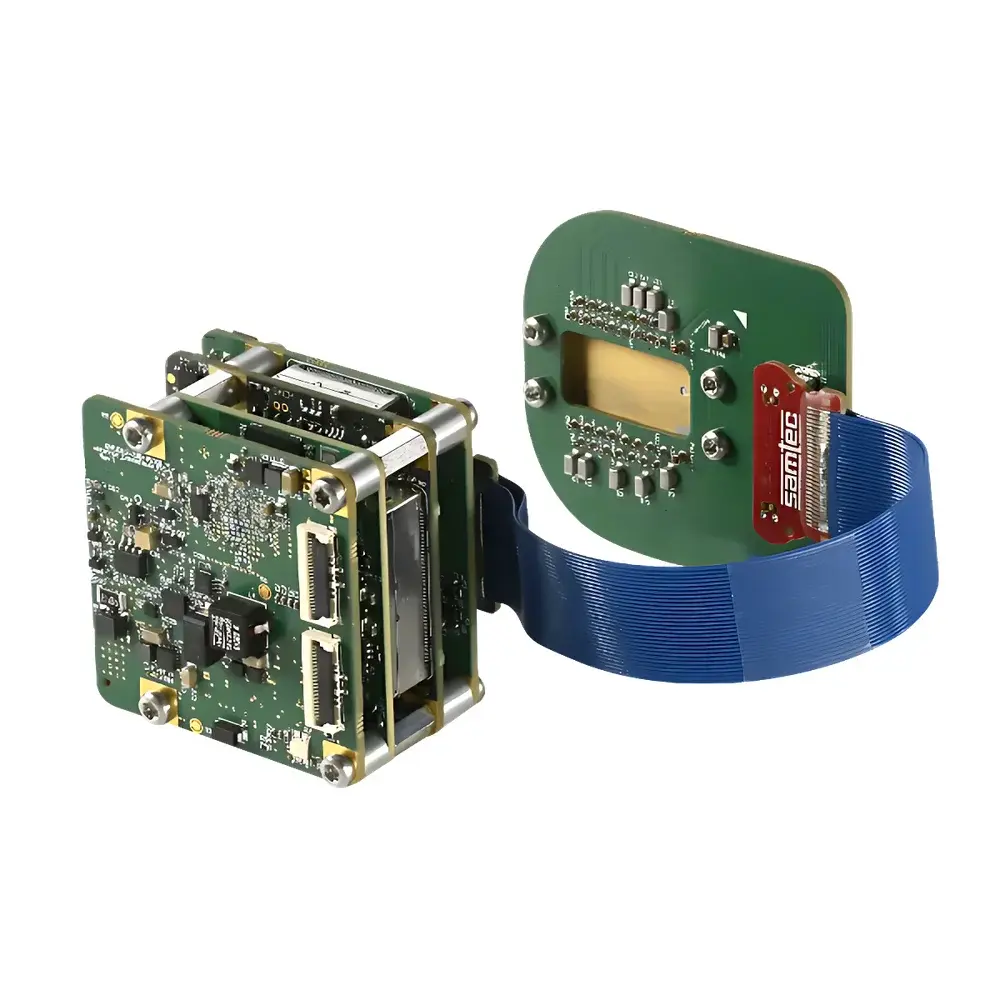
Oxford Instruments C-RED New Space SWIR Camera
| Brand | Oxford Instruments |
|---|---|
| Origin | France |
| Manufacturer Type | Authorized Distributor |
| Origin Category | Imported |
| Model | C-RED New Space |
| Effective Pixels | 640 × 512 |
| Pixel Size | 15 µm |
| Full-Frame Frame Rate | 600 fps |
| Windowed Mode (32 × 4) | 32,066 fps |
| Read Noise | <30 e⁻ |
| Dynamic Range | 93 dB (True 16-bit mode) |
| Operating Temperature Range | -40 °C to +65 °C |
| Sensor Material | InGaAs (VGA array) |
| Cooling | Advanced passive/thermoelectric hybrid thermal management |
Overview
The Oxford Instruments C-RED New Space is a space-qualified short-wave infrared (SWIR) imaging camera engineered for mission-critical optical payloads in Earth observation, scientific satellite platforms, and deep-space instrumentation. Built around a radiation-tolerant 640 × 512 indium gallium arsenide (InGaAs) focal plane array with 15 µm pixel pitch, the camera delivers high-fidelity imaging across the 0.9–1.7 µm spectral band. Its design adheres to ECSS-E-ST-20C and ECSS-Q-ST-60C standards for space electronics, including latch-up immunity, total ionizing dose (TID) resilience up to 100 krad(Si), and single-event effect (SEE) mitigation strategies. Unlike terrestrial SWIR cameras, C-RED New Space integrates hardened power regulation, fault-tolerant FPGA firmware, and hermetically sealed vacuum packaging—enabling stable operation under thermal cycling, vacuum, and microgravity conditions typical of low-Earth orbit (LEO) and geostationary transfer orbit (GTO) missions.
Key Features
- Space-qualified VGA InGaAs sensor (640 × 512, 15 µm pixels) with >80% quantum efficiency across 1.0–1.6 µm
- Ultra-high-speed imaging: 600 fps at full resolution; up to 32,066 fps in programmable sub-window modes (e.g., 32 × 4 ROI)
- Low-noise architecture: <30 e⁻ read noise (rms) at maximum frame rate, achieved via correlated double sampling (CDS) and optimized analog front-end design
- True 16-bit dynamic range with 93 dB linearity, supporting simultaneous detection of faint stellar sources and bright atmospheric glint without saturation or clipping
- Hybrid thermal management combining passive radiative surfaces and precision-controlled thermoelectric coolers (TECs), maintaining sensor temperature stability within ±0.1 °C over operational range (−40 °C to +65 °C ambient)
- FPGA-based real-time preprocessing: on-chip non-uniformity correction (NUC), bad-pixel replacement, and programmable gain/offset calibration
- Compact, modular mechanical interface (MIL-STD-1553B and SpaceWire-compatible) with <1.2 kg mass and <12 W average power consumption
Sample Compatibility & Compliance
C-RED New Space is designed for integration into optical systems requiring diffraction-limited SWIR performance—including Ritchey-Chrétien telescopes, Fourier-transform spectrometers, and laser heterodyne receivers. Its mechanical and electrical interfaces comply with ECSS-E-ST-20-07C (mechanical interfaces), ECSS-E-ST-20-08C (electrical interfaces), and ECSS-E-ST-20-09C (EMC requirements). The camera meets ESA’s PEL (Payload Equipment Level) qualification standards for vibration, shock, and thermal vacuum testing per ECSS-Q-ST-70-08C. It supports traceable calibration via NIST-traceable blackbody sources and is compatible with ISO 10110-5 surface quality specifications for optical window integration. No external cryocooler is required, eliminating moving parts and enhancing system reliability for multi-year missions.
Software & Data Management
Oxford Instruments provides the C-RED Control Suite—a cross-platform (Linux RT, VxWorks, RTEMS) SDK with deterministic real-time acquisition drivers, memory-mapped I/O access, and configurable trigger synchronization (TTL, LVDS, optical). All firmware updates are signed and verified using ECDSA-256 cryptographic signatures to ensure integrity during in-orbit reconfiguration. Data output conforms to CCSDS Packet Telemetry standard (TM Space Data Link Protocol, CCSDS 132.0-B-2), enabling seamless ingestion into ground station processing pipelines. The SDK includes built-in support for audit trails, time-stamped metadata embedding (GPS-synchronized PPS input), and compliance-ready logging aligned with ISO/IEC 17025 and NASA NPR 7123.1A documentation requirements. Optional GLP/GMP-compliant data archiving modules support 21 CFR Part 11 electronic signature and record retention protocols for dual-use science/defense applications.
Applications
- Earth observation: Cloud phase discrimination, vegetation stress monitoring, and mineral mapping via hyperspectral SWIR push-broom scanning
- Astronomy: High-cadence exoplanet transit photometry, adaptive optics wavefront sensing, and laser guide star beacon tracking
- Defense & security: Long-range target identification under adverse weather (fog, haze), covert laser designation tracking, and missile plume characterization
- Space situational awareness (SSA): Resident space object (RSO) characterization, debris tracking, and rendezvous proximity operations
- Onboard autonomous navigation: Real-time terrain-relative navigation using SWIR landmark matching in GPS-denied environments
FAQ
Is C-RED New Space qualified for launch vibration and thermal vacuum testing?
Yes. It has completed full ECSS-Q-ST-70-08C qualification, including sine sweep (10–2000 Hz, 14.1 g rms), random vibration (14.1 g rms, 20–2000 Hz), and thermal vacuum cycling (−40 °C to +65 °C, 10 cycles).
Does the camera support on-board image processing?
Yes. The Xilinx Kintex-7 FPGA enables real-time NUC, histogram equalization, centroid calculation, and ROI extraction—reducing downlink bandwidth by up to 92% compared to raw frame transmission.
What calibration documentation is provided?
Each unit ships with a full ECSS-Q-ST-60-02C-compliant calibration report, including dark current maps, PRNU coefficients, gain/offset tables, and spectral responsivity curves measured at three temperatures (−20 °C, 0 °C, +40 °C).
Can the firmware be updated in orbit?
Yes. Secure firmware updates are supported via authenticated CCSDS TM packets with rollback capability and CRC-32C integrity verification—validated under ESA’s Software Configuration Management guidelines.





