
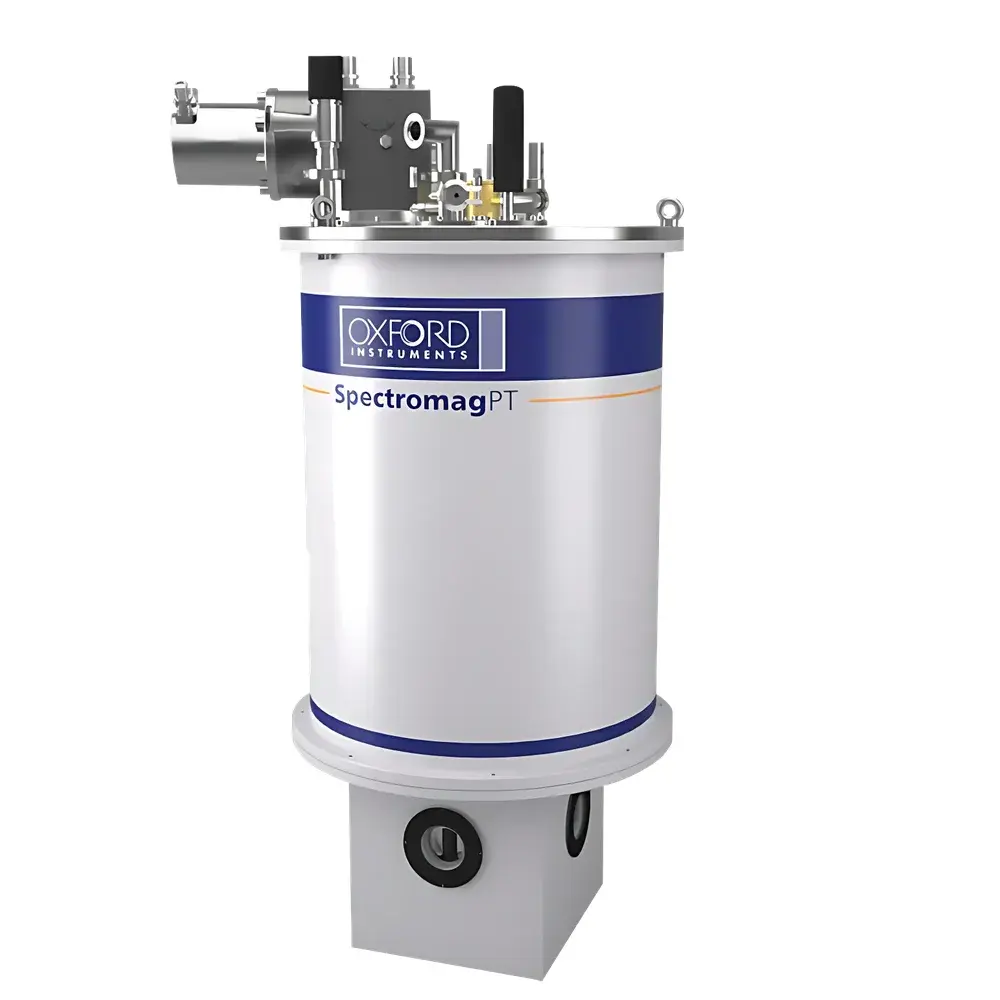
Oxford Instruments SpectromagPT Helium-Free Superconducting Magneto-Optical System
| Brand | Oxford Instruments |
|---|---|
| Origin | United Kingdom |
| Model | SpectromagPT |
| Temperature Range | 1.6 K – 300 K |
| Magnetic Field Strength | Up to 7 T |
| Optical Access | Dual-axis (parallel & perpendicular to field) |
| Sample Chamber Diameter | 30 mm |
| Temperature Stability (standard probe) | ±0.1 K |
| Cool-down Time (room temp → 4 K) | ~40 h |
| Probe Cool-down Time (to <2 K, cold insert) | <90 min |
| Field Ramp Time (to max field) | ≤60 min |
| Continuous Operation Duration | >4 weeks |
| Cryocooler Type | Closed-cycle, helium-free |
| Sample Exchange | Top-loading, no lock-in mechanism required |
| Thermal Environment | Static exchange gas cooling (no convective flow) |
| Optional Sample Stage | ±15 mm axial translation + 360° rotation about vertical axis |
Overview
The Oxford Instruments SpectromagPT is a fully integrated, helium-free superconducting magneto-optical measurement system engineered for high-precision low-temperature spectroscopy, magneto-optical Kerr effect (MOKE), Faraday rotation, photoluminescence (PL), Raman scattering, and quantum transport studies under controlled magnetic fields. Unlike traditional liquid-helium-dependent cryostats, the SpectromagPT employs a two-stage pulse-tube cryocooler coupled with a high-performance NbTi/Nb3Sn hybrid superconducting magnet, eliminating the operational complexity, supply chain dependency, and contamination risks associated with liquefied cryogens. Its core architecture enables simultaneous application of up to 7 T magnetic field—oriented either parallel or perpendicular to the optical axis—with uninterrupted optical access across both geometries. The system operates over a continuous temperature range from 1.6 K to 300 K, delivering exceptional thermal stability (±0.1 K on standard probes) without active vibration isolation beyond its passive mechanical design.
Key Features
- Helium-free operation: Fully closed-cycle refrigeration eliminates reliance on liquid helium, reducing long-term operating costs, logistical overhead, and environmental footprint while ensuring uninterrupted multi-week experimental campaigns.
- Top-loading sample exchange: Samples are introduced via a vertically inserted probe while the system remains at base temperature—no vacuum lock, no warm-up/cool-down cycles, and no degradation of thermal or magnetic stability between measurements.
- Static exchange gas cooling: Sample environment is maintained using static helium exchange gas, preventing turbulent gas flow that could induce mechanical drift or acoustic noise in sensitive optical or interferometric measurements.
- Dual-axis optical access: Optimized optical paths support both longitudinal (field-parallel) and transverse (field-perpendicular) configurations with minimal beam deviation, enabling full vectorial magneto-optical characterization.
- High-field, high-stability magnet: Constructed using industry-leading superconducting wire materials (NbTi and Nb3Sn), the magnet delivers field homogeneity better than 100 ppm over a 10 mm DSV and supports persistent mode operation with field drift <0.1 ppm/h after ramp completion.
- Modular probe architecture: Standard and optional sample stages—including translation (±15 mm) and full 360° rotation about the vertical axis—allow precise alignment and multi-angle polarization-resolved measurements without realignment of external optics.
Sample Compatibility & Compliance
The SpectromagPT accommodates a wide variety of sample formats, including thin films on substrates, bulk single crystals, microfabricated devices on chips, and optically transparent encapsulated samples. Its 30 mm diameter sample cavity provides sufficient radial clearance for custom wiring, fiber-optic feedthroughs, and multi-probe electrical connections. All vacuum and cryogenic components comply with ISO 14001 and PED 2014/68/EU pressure equipment directives. The system’s control firmware and data acquisition interface are designed to meet GLP and GMP documentation requirements, supporting audit trails, user access levels, and electronic signatures when integrated with compliant laboratory information management systems (LIMS). While not inherently FDA 21 CFR Part 11 certified, its logging architecture is compatible with third-party validation packages for regulated environments.
Software & Data Management
Oxford Instruments’ Intelligent CryoControl™ software provides unified control of temperature, magnetic field, and optional motion stages through an intuitive graphical interface. Real-time monitoring includes dual-channel temperature logging (sample stage and cold head), field ramp profiling with programmable slew rates, and synchronized trigger outputs for external detectors (e.g., CCDs, lock-in amplifiers, time-correlated single-photon counting modules). All measurement parameters and metadata—including timestamps, setpoints, and environmental conditions—are embedded in HDF5-formatted output files, ensuring FAIR (Findable, Accessible, Interoperable, Reusable) data principles. Remote operation via secure SSH or VNC is supported, and API access (Python/C++ SDKs) enables integration into automated experiment workflows and machine learning–driven parameter sweeps.
Applications
- Quantum materials characterization: topological insulators, 2D magnets, skyrmion lattices, and moiré superlattices via magneto-transport and polarized optical spectroscopy.
- Spintronics device testing: current-induced spin-orbit torques, domain wall dynamics, and spin-transfer torque switching under variable field and temperature.
- Low-temperature photophysics: exciton binding energies, valley polarization lifetimes, and magnetic-field–dependent PL linewidth analysis in perovskites and TMDCs.
- Fundamental condensed matter physics: quantum Hall effect mapping, Shubnikov–de Haas oscillations, and Berry curvature estimation via angle-resolved MOKE.
- Calibration-grade reference measurements: traceable magneto-optical calibration for ellipsometers, spectrometers, and magnetic field sensors operating below 4 K.
FAQ
Does the SpectromagPT require liquid helium refills?
No. It operates exclusively via a closed-cycle pulse-tube cryocooler and does not use or store liquid cryogens.
Can I perform in-situ sample rotation during optical measurements?
Yes. The optional motorized sample stage supports continuous 360° rotation with sub-arcminute angular resolution, fully synchronized with data acquisition.
What is the typical base temperature stability during prolonged measurements?
Under standard operating conditions, temperature fluctuations remain within ±0.05 K over 24-hour periods when using the standard probe and optimized thermal anchoring.
Is the system compatible with ultra-high vacuum (UHV) sample preparation chambers?
The SpectromagPT is designed for high-vacuum operation (≤1×10⁻⁶ mbar); UHV integration requires custom flange adapters and bake-out–compatible feedthroughs, available upon request.
How is magnetic field homogeneity verified and documented?
Each unit undergoes full-field mapping using a calibrated Hall probe array; a homogeneity report (including DSV specifications and field maps) is supplied with delivery and archived in the system’s calibration database.
Related Products



