
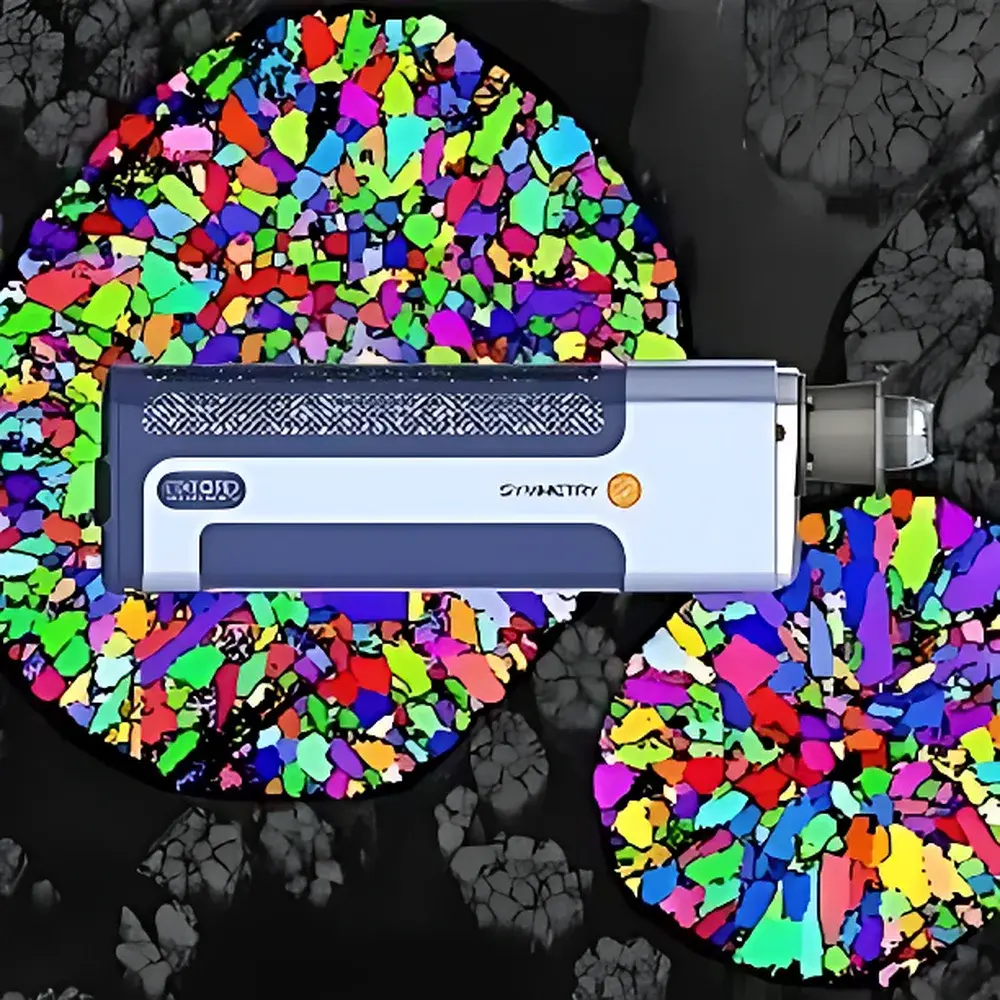
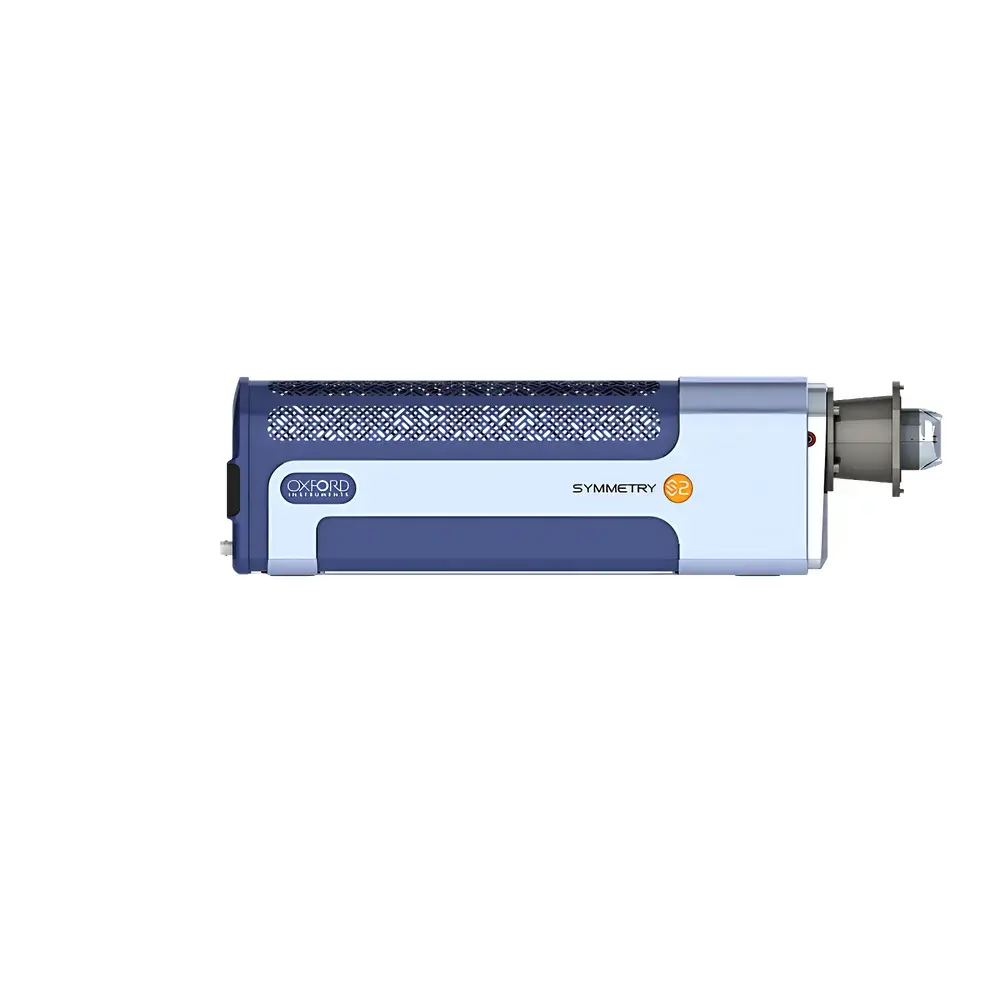
Oxford Instruments Symmetry S2 EBSD Detector for SEM/FIB-SEM
| Brand | Oxford Instruments |
|---|---|
| Origin | United Kingdom |
| Model | Symmetry S2 EBSD Detector |
| CCD Camera Resolution | 1244 × 1024 pixels |
| Pattern Resolution (High-Speed Mode) | 156 × 88 pixels |
| Spatial Resolution | 10 nm |
| Angular Resolution | 0.05° |
| Maximum Indexing Speed | 4500 patterns per second (pps) |
| Beam Current Requirement for 4500 pps | 12 nA |
| Integrated Forward Scatter Detectors (FSD) | 5-channel |
| Interface | Bellows-type SEM vacuum-compatible port with auto-calibrating tilt mechanism |
| Collision Avoidance | Proximity sensor–enabled retraction system |
Overview
The Oxford Instruments Symmetry S2 is a high-performance, CMOS-based Electron Backscatter Diffraction (EBSD) detector engineered for integration with scanning electron microscopes (SEM) and focused ion beam–SEM (FIB-SEM) platforms. Unlike legacy CCD-based systems, the Symmetry S2 leverages purpose-built back-illuminated CMOS sensor architecture to deliver unprecedented speed, sensitivity, and angular fidelity in crystallographic characterization. Its core measurement principle relies on the acquisition and indexing of Kikuchi diffraction patterns generated by elastically backscattered electrons from crystalline samples under controlled electron beam incidence. The system enables quantitative microstructural analysis—including grain boundary mapping, crystal orientation distribution (COD), phase identification, lattice strain estimation (via HR-EBSD), and texture quantification—across a broad spectrum of materials, from polycrystalline metals and deformation-processed alloys to geological specimens, advanced ceramics, semiconductor heterostructures, and battery electrode materials.
Key Features
- CMOS-native detector architecture delivering up to 4500 indexed patterns per second at 12 nA beam current—more than double the throughput of conventional CCD-based EBSD systems without compromising pattern fidelity or requiring excessive pixel binning.
- Two operational imaging modes: high-speed mode (156 × 88 pixels) optimized for rapid orientation mapping; and full-resolution mode (1244 × 1024 pixels) supporting high-resolution EBSD (HR-EBSD) for sub-pixel strain and rotation field analysis.
- Angular resolution better than 0.05°, achieved through low-distortion optical train design and precision calibration protocols—critical for accurate misorientation assessment and dislocation density estimation.
- Sub-10 nm spatial resolution enabled by high quantum efficiency phosphor screen and optimized electron-optical coupling—particularly advantageous for nanocrystalline and ultrafine-grained materials.
- Five integrated forward scatter detectors (FSDs) provide simultaneous acquisition of atomic number contrast (Z-contrast), channeling contrast, and color-coded orientation maps—enhancing correlation with compositional data from EDS.
- Vacuum-integrated bellows interface maintains SEM column integrity; proximity-sensor–activated collision avoidance ensures safe operation during stage tilting or large-sample navigation.
- Fully motorized, software-controlled tilt mechanism with automated geometric calibration—eliminating manual alignment drift across variable sample heights and stage configurations.
Sample Compatibility & Compliance
The Symmetry S2 supports routine EBSD analysis on conductive and semi-conductive samples prepared to standard SEM requirements (e.g., carbon or metal coating for insulators). It is compatible with both tungsten-filament and field-emission SEMs operating at accelerating voltages from 5 kV to 30 kV. The detector meets ISO/IEC 17025–aligned laboratory practice guidelines for instrument qualification and is routinely deployed in GLP-compliant environments for metallurgical QA/QC, failure analysis, and R&D validation. While not FDA-certified as a standalone medical device, its data output conforms to ASTM E112 (grain size), ASTM E2627 (EBSD terminology), and ISO 11270 (crystallographic texture) standards. Full audit trail functionality—including user action logging, parameter versioning, and raw pattern archiving—is supported within AZtec software to meet 21 CFR Part 11 readiness requirements where configured.
Software & Data Management
The Symmetry S2 operates exclusively with Oxford Instruments’ AZtec EBSD software suite—a modular, scriptable platform built on Microsoft .NET architecture. AZtec provides real-time pattern indexing, dynamic background correction, multi-phase confidence index optimization, and machine-learning–assisted phase identification. All raw diffraction patterns, indexing results, and metadata are stored in vendor-neutral HDF5 format, enabling interoperability with third-party analysis tools (e.g., MTEX, Dream.3D, Python-based SciPy workflows). Batch processing pipelines support automated post-acquisition refinement, including pattern sharpening, grain reconstruction, and misorientation filtering. Software updates follow a documented release cycle aligned with IEC 62304 for medical-grade software development practices, and on-site validation documentation packages are available upon request for regulated laboratories.
Applications
- Quantitative grain structure analysis in aerospace superalloys and additive-manufactured Ti-6Al-4V components.
- Phase transformation mapping in heat-treated steels and dual-phase magnesium alloys.
- Deformation microstructure characterization in cold-rolled aluminum foils and nano-twinned copper films.
- Crystallographic texture evolution studies in rolled battery cathode layers (e.g., NMC, LFP).
- Geological provenance analysis via orientation fabric quantification in quartzite and olivine aggregates.
- Strain gradient mapping in semiconductor heterojunctions using HR-EBSD mode.
FAQ
What vacuum compatibility does the Symmetry S2 require?
The detector interfaces via a dedicated bellows port rated for UHV conditions (≤1×10⁻⁷ mbar), maintaining SEM column vacuum integrity without auxiliary pumping.
Can the Symmetry S2 be used with FIB-SEM platforms?
Yes—it supports dual-beam integration with FEI/Thermo Fisher Helios and Zeiss Crossbeam systems via custom flange kits and synchronized stage control protocols.
Is AZtec software included with the hardware purchase?
Yes—AZtec EBSD v5.2 or later is supplied with perpetual license, including one year of maintenance and upgrade coverage.
How is calibration traceability maintained?
Each unit ships with NIST-traceable calibration certificates for detector geometry, pattern center position, and angular scale; periodic verification kits are available.
Does the system support automated EDS–EBSD correlative analysis?
Yes—synchronized acquisition, shared stage coordinates, and unified project file architecture enable pixel-registered phase–composition–orientation correlation without external scripting.




