
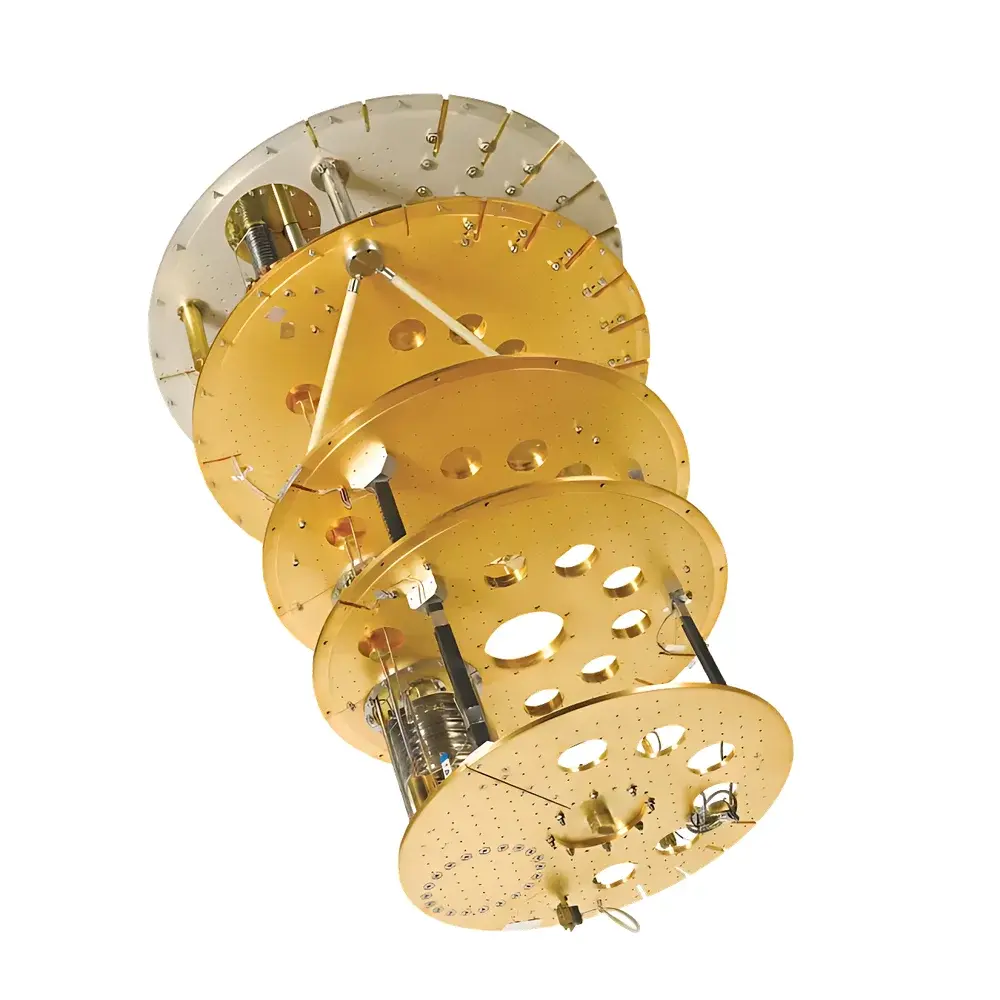
Oxford Instruments TritonXL Helium-Free Dilution Refrigerator
| Brand | Oxford Instruments |
|---|---|
| Origin | United Kingdom |
| Model | TritonXL |
| Minimum Base Temperature | < 5 mK |
| Refrigeration Power | 1000 µW at 100 mK |
| Maximum Magnetic Field Compatibility | Up to 16 T |
| Integrated Cryocoolers | Dual 1.5 W Pulse Tube Refrigerators |
| Standard Warranty | 3 years (covers all system components, including third-party cryocoolers, pumps, and electronics) |
| Service Support | Factory-authorized service network across UK, Germany, USA, China, Japan, and India |
| Vibration Mitigation | Remote pump rack, rigid floor-standing cryostat support, electrical isolation between cryostat, gas lines, and pump station |
| Gas Handling System | Dry, oil-free pumping stack (roots + diaphragm + turbomolecular pumps), fully welded pneumatic circuit with high-integrity solenoid valves |
| Sample Access | Top- and bottom-loading options |
| RF Wiring Capacity | Up to 72 semi-rigid coaxial lines with optimized attenuators |
| Optical Integration | Optional fiber feedthroughs or optical windows |
| Control Interface | Advanced software suite with remote command protocol (TCP/IP), hardware interlocks, and audit-trail-capable operation logging |
Overview
The Oxford Instruments TritonXL is a high-performance, helium-free dilution refrigerator engineered for ultra-low-temperature quantum science applications requiring thermal stability below 5 mK and compatibility with high magnetic fields up to 16 T. Unlike conventional wet dilution refrigerators, the TritonXL eliminates dependence on liquid helium by integrating two high-capacity 1.5 W pulse tube cryocoolers — enabling continuous, maintenance-optimized operation in demanding research environments. Its core thermodynamic architecture follows the standard dilution refrigeration cycle, where a mixture of 3He and 4He undergoes phase separation and continuous circulation through a still, condenser, heat exchangers, and mixing chamber. The system achieves sub-5 mK base temperatures through efficient heat exchange in the mixing chamber, supported by low-vibration mechanical design and stringent thermal anchoring strategies. Designed explicitly for quantum computing, topological matter studies, and nanoscale transport measurements, the TritonXL meets the rigorous demands of GLP-aligned laboratories and facilities operating under ISO/IEC 17025-compliant quality frameworks.
Key Features
- Helium-free operation enabled by dual-stage 1.5 W pulse tube refrigerators — eliminating liquid helium logistics, boil-off losses, and associated infrastructure costs
- Base temperature < 5 mK with 1000 µW cooling power at 100 mK — verified via calibrated RuO2 and Cernox™ sensors traceable to NIST standards
- Full integration capability with Oxford Instruments superconducting magnets (up to 16 T), including vector and split-pair configurations — magnet leads routed via vibration-damped flexible copper braids and metal bellows
- Dry, oil-free vacuum pumping system comprising roots, diaphragm, and turbomolecular pumps — avoids particulate generation from scroll or涡旋 pumps, significantly reducing risk of gas circuit blockage
- Fully welded, all-metal pneumatic circuit with high-reliability solenoid valves — ensures long-term hermetic integrity and minimizes leak pathways
- Modular quick-disconnect hardware for rapid maintenance under contamination events — compliant with cleanroom-compatible servicing protocols
- Rigid floor-standing cryostat support with active vibration decoupling — isolates the mixing chamber from building-borne and acoustic noise
- Electrical isolation between cryostat, gas lines, pump station, and instrumentation racks — critical for low-noise DC and RF measurements
Sample Compatibility & Compliance
The TritonXL accommodates diverse experimental configurations, supporting up to 72 semi-rigid coaxial lines (e.g., SS-0.085″, UT-085) with integrated microwave attenuation stages optimized for electron temperature reduction. Optional optical access includes fused silica windows (UV–IR broadband transmission) and single-mode fiber feedthroughs (SMF-28, polarization-maintaining variants). All internal wiring paths are designed for minimal thermal load and electromagnetic interference. The system complies with CE marking requirements for electromagnetic compatibility (EMC Directive 2014/30/EU) and low-voltage safety (LVD Directive 2014/35/EU). Firmware and control software adhere to data integrity principles aligned with FDA 21 CFR Part 11 for audit-trail generation, user access control, and electronic signature support — facilitating GxP-regulated quantum device characterization workflows.
Software & Data Management
Operation is managed via the ILM (Intelligent Laboratory Manager) software platform, offering both graphical user interface and scriptable TCP/IP command interface (SCPI-compatible syntax). Real-time monitoring includes mixing chamber temperature, still pressure, 3He circulation rate, and compressor status. All operational parameters are logged with timestamped metadata and stored in HDF5 format for interoperability with Python-based analysis pipelines (e.g., QCoDeS, Labber). Software supports automated cooldown sequences, interlock-triggered emergency ramp-downs, and configurable alarm thresholds. Audit logs record user login/logout events, parameter modifications, and hardware state transitions — exportable in CSV or XML for laboratory information management system (LIMS) integration.
Applications
- Quantum bit (qubit) coherence time measurement under sub-5 mK conditions and high magnetic fields
- Scanning gate microscopy and Coulomb blockade spectroscopy in 2D electron gases
- Microwave photon detection using superconducting nanowire single-photon detectors (SNSPDs)
- Andreev bound state mapping in hybrid semiconductor-superconductor nanowires
- Low-frequency noise spectroscopy of mesoscopic devices
- Calorimetric studies of quantum phase transitions in frustrated magnets
FAQ
What is the typical cooldown time from 300 K to base temperature?
Typical cooldown requires approximately 24–30 hours, depending on thermal history, vacuum quality, and whether precooling stages are actively managed.
Can the TritonXL be operated remotely without on-site personnel?
Yes — full remote operation is supported via secure TLS-encrypted TCP/IP connection, including real-time diagnostics, interlock override authorization, and automated recovery scripting.
Is third-party magnet integration supported?
Yes — while Oxford Instruments magnets are fully characterized and warrantied, integration with qualified third-party high-field systems (e.g., Cryomagnetics, American Magnetics) is possible with prior thermal and magnetic field mapping validation.
How is calibration traceability maintained across the temperature range?
Primary temperature sensors (RuO2, Cernox™, carbon-glass) are factory-calibrated against ITS-90 reference points and supplied with NIST-traceable calibration certificates; users may perform in situ verification using fixed-point references such as the superconducting transition of indium (3.41 K) or tin (3.72 K).



