
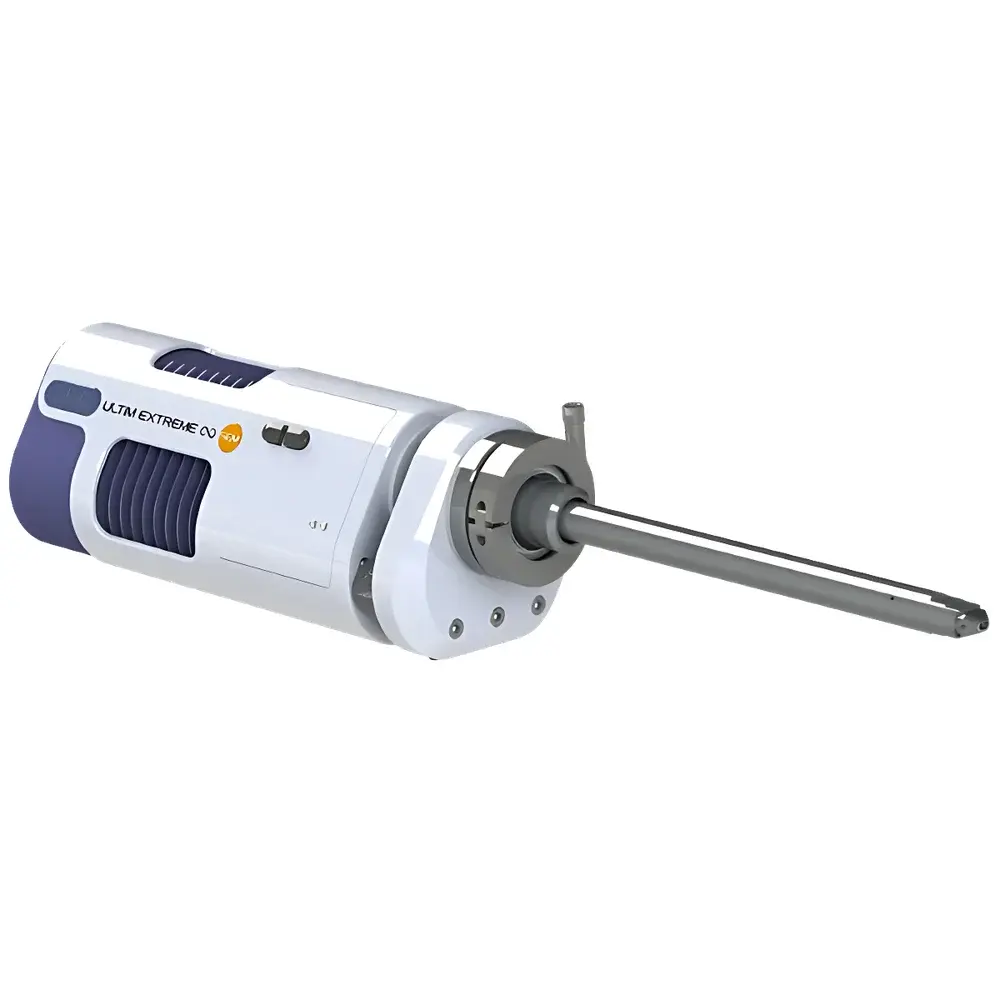
Oxford Instruments Ultim Extreme Infinity ∞ Energy Dispersive Spectrometer
| Brand | Oxford Instruments |
|---|---|
| Origin | United Kingdom |
| Manufacturer Type | Authorized Distributor |
| Origin Category | Imported |
| Model | Ultim Extreme Infinity ∞ |
| Quotation | Upon Request |
| Detector Type | Sidewall-Insertion (Side-Entry) |
| Energy Resolution | C Ka ≤ 46 eV @ 50,000 cps |
| Elemental Range | Li (Z=3) to Cf (Z=98) |
| Window Type | Windowless |
Overview
The Oxford Instruments Ultim Extreme Infinity ∞ is a high-performance, windowless energy dispersive spectrometer (EDS) engineered exclusively for integration with field-emission scanning electron microscopes (FEG-SEM). Designed to operate at ultra-low accelerating voltages (1–3 kV) and minimal working distances, it enables quantitative elemental analysis of nanoscale features, beam-sensitive materials, and surface-sensitive specimens without compromising spatial resolution or spectral fidelity. Its measurement principle relies on solid-state silicon drift detector (SDD) technology, where incident X-ray photons generate charge carriers proportional to their energy, allowing precise discrimination across the full elemental range from lithium (Li, Z=3) to californium (Cf, Z=98). The detector’s core innovation lies in its optimized geometry: a uniquely shaped sensor, ultra-short take-off angle, miniature electron trap, and an effective solid angle up to 7–8× greater than conventional 100 mm² EDS systems—directly translating into higher count rates, improved peak-to-background ratios, and enhanced low-energy X-ray collection efficiency.
Key Features
- Windowless SDD architecture eliminating absorption losses for light elements (B, C, N, O, F), significantly improving detection sensitivity below 1 keV
- High solid angle design (≥1.0 sr) enabling >7× greater X-ray collection efficiency compared to standard side-entry detectors
- Energy resolution of ≤46 eV at C Ka (50,000 cps) and ≤127 eV at Mn Ka (200,000 cps), meeting ASTM E1508 and ISO 22309 requirements for spectral performance verification
- Optimized for FEG-SEM platforms with sub-1 nm imaging capability, supporting simultaneous high-resolution imaging and microanalysis under identical beam conditions (kV, probe current, WD)
- Integrated thermal management system ensuring long-term stability during extended acquisition sessions, critical for GLP/GMP-compliant laboratories
Sample Compatibility & Compliance
The Ultim Extreme Infinity ∞ is compatible with a broad spectrum of sample types—including insulating polymers, biological cryo-sections, battery cathode particles, catalyst nanoparticles, and thin-film multilayers—without requiring conductive coating in many cases due to its high signal-to-noise ratio at low kV. Its windowless configuration eliminates hydrocarbon contamination risks associated with polymer windows and supports routine analysis of oxygen- and nitrogen-rich materials (e.g., oxides, nitrides, organic matrices). The system complies with IEC 61000-6-3 (EMC emissions) and meets essential safety requirements per IEC 61010-1. For regulated environments, optional audit-trail-enabled software modules support FDA 21 CFR Part 11 compliance when deployed with AZtec software v4.5 or later.
Software & Data Management
Controlled via Oxford Instruments’ AZtec platform, the Ultim Extreme Infinity ∞ leverages Tru-Q IQ quantification algorithms, which incorporate physics-based absorption and fluorescence corrections validated against NIST SRM standards. TruMap spectral deconvolution resolves critical overlaps such as Si Lα/Si Kα, S Kα/Mo Lα, and Nb Mα/Mo Mα—enabling accurate phase identification in complex alloys and ceramics. Real-time mapping, batch processing, and automated report generation are fully scriptable using Python APIs. All raw spectra, acquisition metadata, and processing history are stored in vendor-neutral HDF5 format, facilitating long-term archival and third-party interoperability per ISO/IEC 17025 data integrity guidelines.
Applications
- Nanomaterial characterization: grain-boundary chemistry in polycrystalline thin films, dopant distribution in 2D semiconductors, and interface segregation in heterostructures
- Life sciences: elemental mapping of freeze-fractured cellular sections, metalloprotein localization, and calcification studies in soft tissue
- Advanced manufacturing: inclusion analysis in aerospace superalloys, coating thickness validation via layer-by-layer EDS profiling, and solder joint intermetallic quantification
- Energy research: cathode degradation mechanisms in Li-ion batteries, sulfur distribution in solid-state electrolytes, and catalyst poisoning assessment in PEM fuel cells
- Forensics & geosciences: trace element fingerprinting of glass fragments, mineral phase discrimination in meteorites, and volcanic ash compositional stratigraphy
FAQ
What vacuum compatibility requirements does the Ultim Extreme Infinity ∞ have?
It operates under standard SEM column vacuum conditions (≤1×10⁻⁴ Pa) and requires no additional differential pumping stages due to its sealed, bakeable detector housing.
Can this detector be retrofitted onto legacy SEM models?
Yes—Oxford Instruments provides mechanical and electrical interface kits for major OEM platforms including Zeiss, Thermo Fisher Scientific, JEOL, and Hitachi, subject to chamber port availability and flange compatibility.
How is energy calibration maintained over time?
Automated daily calibration routines reference Mn Ka (5.895 keV) and Cu Ka (8.040 keV) peaks; drift correction is applied using internal reference sources traceable to NPL-certified standards.
Is light-element quantification validated against certified reference materials?
Yes—Oxford Instruments publishes annual validation reports demonstrating <5% relative error for B, C, N, and O quantification on NIST SRM 2702, 2709, and 2710a under standardized operating protocols.
Does the system support automated particle analysis workflows?
AZtec Particle Analysis module enables size-resolved compositional classification, statistical clustering, and export to CSV/Excel formats compliant with ISO 13322-2 for image-based particle metrology.



