
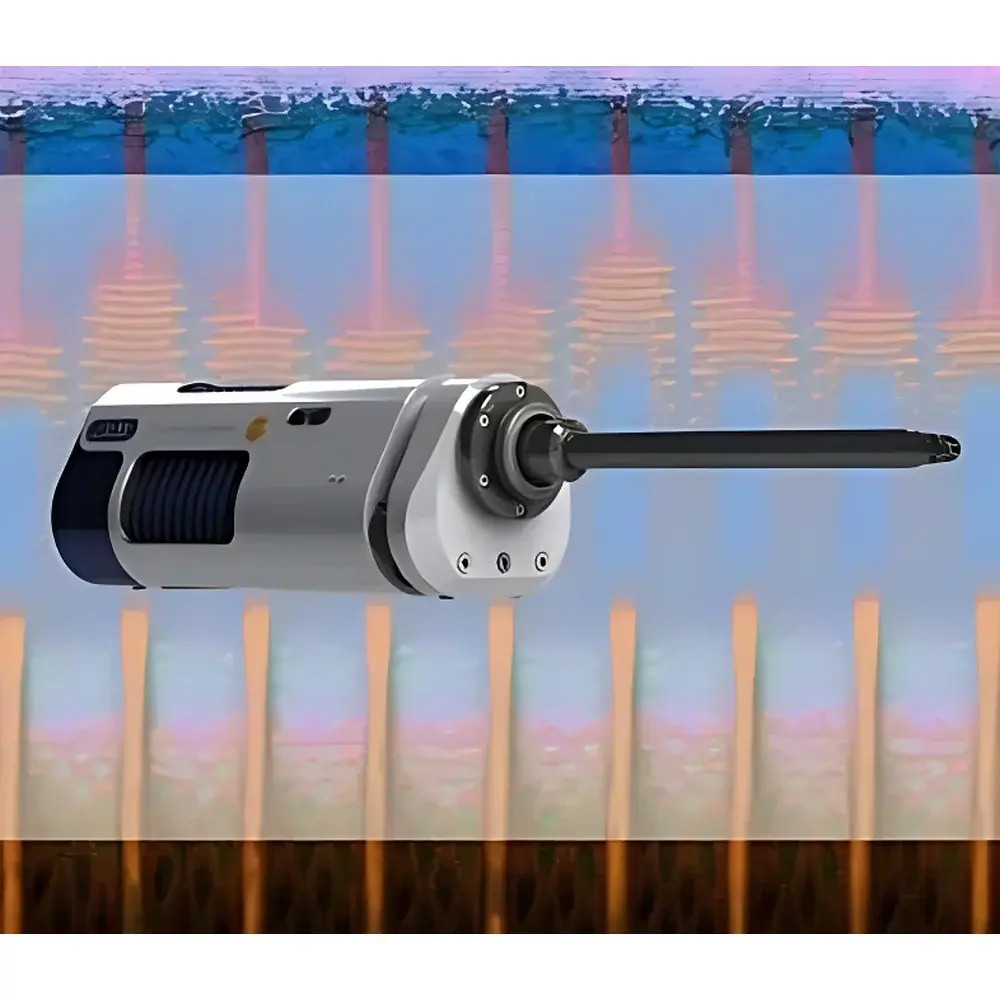
Oxford Instruments Ultim Extreme Windowless Super EDS Detector
| Brand | Oxford Instruments |
|---|---|
| Origin | United Kingdom |
| Manufacturer Type | Authorized Distributor |
| Origin Category | Imported |
| Model | Ultim Extreme |
| Instrument Type | Multi-Detector Configuration |
| Energy Resolution | 127 eV (Mn Kα) |
| Peak-to-Background Ratio | 20,000:1 |
| Maximum Count Rate | 500,000 cps |
| Elemental Detection Range | Li to Bi |
| Detector Active Area | 100 mm² |
| Window Type | Windowless |
Overview
The Oxford Instruments Ultim Extreme is a next-generation windowless silicon drift detector (SDD) engineered specifically for high-spatial-resolution energy-dispersive X-ray spectroscopy (EDS) in field-emission scanning electron microscopes (FE-SEM). Unlike conventional EDS detectors constrained by beryllium or polymer windows—whose absorption severely attenuates low-energy X-rays below 1 keV—the Ultim Extreme eliminates the window entirely. This enables direct detection of ultra-low-energy X-ray photons, including those from light elements such as lithium (Li), boron (B), carbon (C), nitrogen (N), and oxygen (O), with exceptional signal-to-noise performance. Its optimized racetrack-shaped sensor geometry and compact electronics architecture maximize solid angle collection at ultra-short working distances (≤3 mm) and low accelerating voltages (1–3 kV), making it uniquely suited for nanoscale surface analysis, thin-film characterization, and interface chemistry studies where traditional EDS systems fail to deliver quantitative elemental contrast.
Key Features
- Windowless SDD design enabling full spectral access from Li (54 eV) to Bi (9.9 keV) without low-energy absorption losses
- Racetrack-shaped 100 mm² active sensor geometry engineered to increase effective solid angle by up to 5× compared to Ultim 170 at sub-3 mm working distance
- Advanced Extreme electronics providing real-time pulse processing at >500,000 cps while preserving <127 eV energy resolution (Mn Kα)
- Peak-to-background ratio of 20,000:1 ensures high-fidelity quantification even in low-count-rate, low-voltage acquisitions
- Integrated electronic trap design supporting accurate quantitative analysis up to 7 kV beam energy, with robust high-energy peak deconvolution
- Compact mechanical footprint compatible with standard FE-SEM detector mounting interfaces, including immersion lens configurations operating up to 30 kV
Sample Compatibility & Compliance
The Ultim Extreme supports a broad range of conductive and non-conductive samples—including nanoparticles, 2D materials, battery cathode/anode cross-sections, catalysts, and oxide heterostructures—without requiring heavy metal coating when operated at ≤2 kV. Its low-voltage capability aligns with ASTM E1508 (Standard Guide for Quantitative Analysis by Energy Dispersive Spectroscopy) and ISO 16700 (Microbeam analysis — Electron probe microanalysis — Guidelines for wavelength- and energy-dispersive X-ray spectrometry). The detector’s firmware and AZtec Live software comply with FDA 21 CFR Part 11 requirements for audit trail, electronic signature, and data integrity in regulated environments. Full GLP/GMP traceability is supported via configurable acquisition metadata logging and secure database archiving.
Software & Data Management
The Ultim Extreme operates natively within Oxford Instruments’ AZtec platform, leveraging Tru-Q® quantitative engine and TruMap™ low-voltage spectral deconvolution algorithms. AZtec Live enables real-time spectrum imaging, live elemental mapping, and dynamic background subtraction during acquisition—critical for distinguishing overlapping peaks (e.g., Si Kα/Li Kα, C Kα/B Kα) under sub-2 kV conditions. All spectra are stored in standardized .eds format compliant with NIST SRD 191 (Electron Microscopy Data Exchange Standard). Raw data export supports HDF5 and MSA formats for third-party processing in MATLAB, Python (hyperspy), or Thermo Avizo. System calibration logs, detector health diagnostics, and vacuum interlock status are automatically embedded in acquisition metadata.
Applications
- Nanoscale lithium distribution mapping in solid-state battery electrodes at 1.5 kV, achieving <10 nm spatial resolution in conjunction with high-resolution FE-SEM imaging
- Surface oxidation state analysis of transition metal dichalcogenides (TMDs) using O K-edge and metal L-edge quantification at 1.2 kV
- Interface chemistry profiling across AlGaN/GaN HEMT heterostructures with sub-5 nm depth sensitivity via low-kV EDS line scans
- In situ contamination-free analysis of beam-sensitive organic-inorganic perovskites without carbon coating
- High-throughput particle ID and compositional classification in semiconductor defect review workflows using automated AZtec Particle Analyser
FAQ
Does the Ultim Extreme require liquid nitrogen or Peltier cooling?
No—it uses a high-efficiency thermoelectric cooler capable of maintaining stable -20°C sensor temperature under continuous operation, eliminating cryogen dependency.
Can it be retrofitted into existing FE-SEM systems?
Yes—mechanical and electrical interfaces conform to standard Oxford Instruments detector mounts (e.g., JEOL, Thermo Fisher, Zeiss, Hitachi), with optional adapter kits available for legacy systems.
How does its light-element sensitivity compare to windowed SDDs?
At 1 kV acceleration voltage, the Ultim Extreme delivers ≥10× higher count rate for B Kα and ≥30× for Li Kα relative to comparable-area windowed detectors, due to zero absorption loss and enhanced solid angle.
Is AZtec software included with the detector?
Yes—full AZtec Live license with Tru-Q®, TruMap™, and advanced mapping modules is supplied as part of the system configuration.
What maintenance intervals are recommended for optimal performance?
Detector vacuum integrity and electronic calibration should be verified quarterly; annual factory recalibration is recommended to maintain <127 eV resolution certification per ISO/IEC 17025-accredited procedures.



