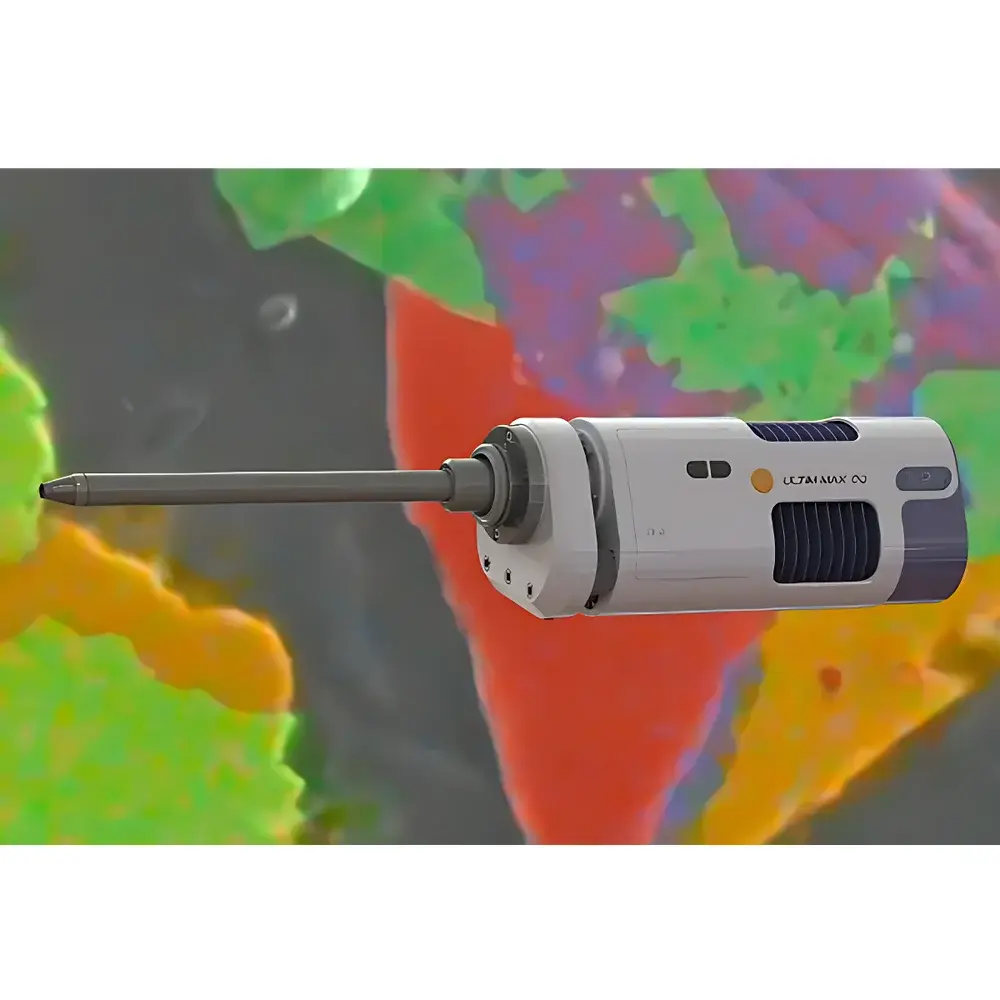
Oxford Instruments Ultim Max Infinity ∞ Energy Dispersive Spectrometer
| Brand | Oxford Instruments |
|---|---|
| Origin | United Kingdom |
| Manufacturer Type | Authorized Distributor |
| Origin Category | Imported |
| Model | Ultim Max Infinity ∞ |
| Quotation | Upon Request |
| Detector Mounting | Tilting (Side-Entry) |
| Energy Resolution | C Ka < 46 eV @ 50,000 cps |
| Elemental Detection Range | Be (Z=4) to Cf (Z=98) |
| Detector Active Area Options | 40 mm², 65 mm², 100 mm², 170 mm² |
| Window Type | SuperATW (Atmospheric Thin Window) |
Overview
The Oxford Instruments Ultim Max Infinity ∞ is a high-performance, side-entry energy dispersive spectrometer (EDS) engineered for integration with field-emission scanning electron microscopes (FE-SEM) and focused ion beam–SEM (FIB-SEM) platforms. It operates on the principle of X-ray photon detection via silicon drift detector (SDD) technology, where incident characteristic X-rays from electron-beam–induced excitation are converted into charge pulses, digitized, and spectrally resolved to yield quantitative elemental composition and spatial distribution data. The Ultim Max Infinity ∞ represents a paradigm shift in EDS architecture by decoupling detector area from spectral performance—enabling identical analytical fidelity across all active area configurations (40–170 mm²). This uniformity eliminates trade-offs between collection efficiency and resolution, making it uniquely suited for demanding applications in nanomaterials characterization, light-element analysis (down to beryllium), and high-speed mapping under variable beam conditions.
Key Features
- Uniform spectral performance across all detector sizes (40 mm², 65 mm², 100 mm², and 170 mm²), eliminating resolution degradation at larger areas;
- SuperATW ultra-thin polymer window enabling high-transmission detection of low-energy X-rays from light elements (Be–F), critical for oxide, nitride, and polymer interface analysis;
- Energy resolution of ≤46 eV at C Ka line under 50,000 cps input count rate, supporting robust carbon-phase discrimination and boron/carbon/nitrogen/oxygen (BCNO) quantification in advanced ceramics and 2D materials;
- Mn Ka resolution ≤127 eV at 200,000 cps, facilitating rapid, high-fidelity elemental mapping without peak broadening or spectral distortion;
- Integrated Tru-Q® IQ real-time spectrum processing engine—calibrated per-detector on the host SEM platform—to deliver traceable, reproducible qualitative identification and matrix-corrected quantitative results compliant with ISO 14735 and ASTM E1508 standards;
- Hardware-accelerated pulse processing with advanced sum-peak correction and dead-time modeling, ensuring accurate peak deconvolution and artifact-free X-ray maps even during dynamic stage movement or beam rastering.
Sample Compatibility & Compliance
The Ultim Max Infinity ∞ is compatible with vacuum-compatible solid samples ranging from conductive metals and semiconductors to insulating ceramics, polymers, and biological specimens (with appropriate coating). Its wide elemental coverage (Be to Cf) supports regulatory and research workflows requiring actinide analysis (e.g., nuclear forensics, spent fuel characterization) as well as routine QC of battery cathode materials (Ni, Co, Mn, O) and catalyst formulations (Pt, Pd, Ru, Ce). The system complies with IEC 61000-6-3 (EMC) and meets essential requirements of the EU Machinery Directive 2006/42/EC when installed per Oxford Instruments’ integration guidelines. All spectral acquisition and processing modules support audit-trail logging aligned with FDA 21 CFR Part 11 and GLP/GMP documentation frameworks.
Software & Data Management
Controlled via AZtec software v4.5+, the Ultim Max Infinity ∞ delivers synchronized acquisition of EDS spectra, elemental maps, and electron images within a single user interface. AZtec supports automated phase identification (PhaseMap), grain-boundary analysis (GrainID), and layer-thickness modeling (Strata). Raw spectral data is stored in vendor-neutral .emsa format (per IUPAC recommendations), while processed reports export to PDF, CSV, and HDF5 for third-party statistical analysis (e.g., PCA, clustering). All processing parameters—including background subtraction method, peak integration limits, and standardless quantification model—are embedded in metadata, ensuring full traceability and reprocessing capability. Optional AZtec Live enables real-time chemical imaging (LCI), overlaying element-specific intensity gradients onto secondary electron (SE) or backscattered electron (BSE) images with sub-100 ms latency.
Applications
- Nanoparticle composition profiling in heterogeneous catalysts and quantum dot assemblies;
- Light-element mapping at interfaces of SiO₂/Si, Al₂O₃/GaN, and LiCoO₂/graphite battery electrodes;
- High-throughput inclusion analysis in aerospace-grade aluminum alloys (Fe, Si, Cu, Mg distributions);
- Actinide partitioning studies in simulated nuclear waste forms (U, Pu, Am, Cm detection);
- In situ heating/cooling stage EDS during phase transformation experiments (e.g., martensitic transitions, oxide reduction);
- Correlative FIB-SEM–EDS tomography for 3D elemental reconstruction of interconnect voids and solder joint intermetallics.
FAQ
Is the Ultim Max Infinity ∞ compatible with non-Oxford SEM platforms?
Yes—it supports standardized Bruker Esprit, Thermo Fisher Velox, JEOL Stream, and Zeiss SmartSEM interfaces via OEM-certified hardware drivers and ASCOM-compliant communication protocols.
What vacuum requirements apply to the SuperATW window?
The SuperATW window requires chamber pressure ≤1 × 10⁻⁵ mbar for optimal light-element transmission; extended exposure to pressures >5 × 10⁻⁴ mbar may reduce window lifetime.
Can Tru-Q® IQ be used for standardless quantification in regulatory submissions?
Yes—Tru-Q® IQ implements φ(ρz)-based matrix corrections validated against NIST SRM 2136 and 2137 reference materials; full uncertainty propagation reports are generated per ISO/IEC 17025 requirements.
How does the Infinity architecture mitigate count-rate-induced resolution loss?
Through proprietary pulse pile-up rejection, adaptive shaping time optimization, and real-time dead-time correction calibrated at 10,000–200,000 cps intervals, maintaining FWHM stability within ±1.5 eV across the operational range.
Is AZtec software validated for GxP environments?
AZtec v4.5+ includes 21 CFR Part 11-compliant electronic signatures, role-based access control, and immutable audit trails—validated per IQ/OQ/PQ protocols supplied with each installation.