
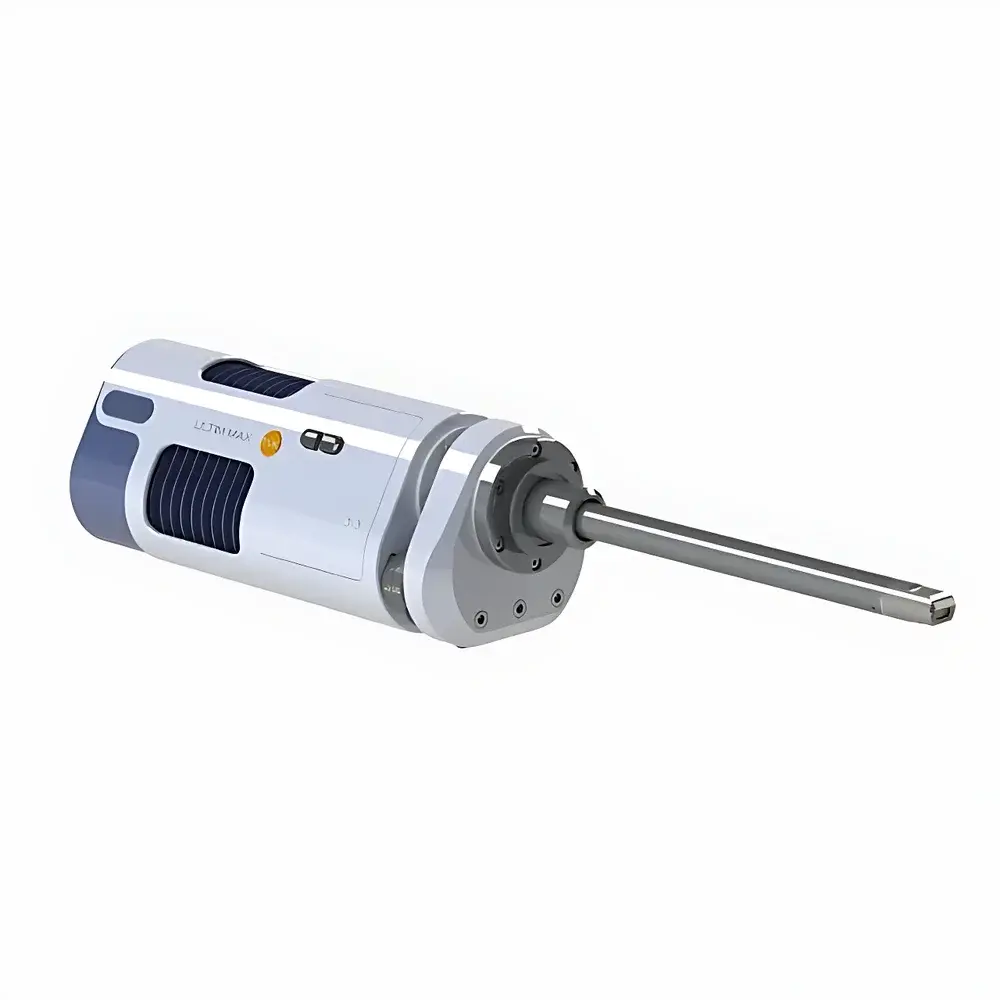
Oxford Instruments Ultim Max TLE Large-Area Silicon Drift Detector for TEM
| Brand | Oxford Instruments |
|---|---|
| Origin | United Kingdom |
| Manufacturer Type | Authorized Distributor |
| Origin Category | Imported |
| Model | Ultim Max TLE |
| Instrument Type | Side-Insertion EDS Detector |
| Energy Resolution | 125 eV (Mn Kα) |
| Peak-to-Background Ratio | 200,000:1 |
| Maximum Count Rate | >200,000 cps (Xplore TEM), up to 400,000 cps (Ultim Max TLE, quantitative mode) |
| Elemental Detection Range | Beryllium (Be) to Californium (Cf) |
| Active Detector Area | 80 mm² (Xplore TEM), 100 mm² (Ultim Max TLE) |
| Window Type | Windowless |
Overview
The Oxford Instruments Ultim Max TLE is a high-performance, large-area silicon drift detector (SDD) engineered specifically for integration with transmission electron microscopes (TEMs) operating at 120–300 kV. It employs direct detection of characteristic X-rays emitted from ultra-thin specimens under electron beam irradiation, enabling spatially resolved elemental identification and quantification at atomic-scale probe sizes. Unlike conventional Si(Li) or early-generation SDDs, the Ultim Max TLE leverages an optimized crystal geometry, windowless architecture, and Extreme-grade low-noise electronics to maximize solid angle collection (0.5–1.1 srad), enhance low-energy X-ray sensitivity—particularly critical for light elements such as Be, B, C, N, and O—and maintain spectral fidelity at count rates exceeding 400,000 counts per second (cps). Its design prioritizes signal-to-noise ratio, energy resolution stability under thermal load, and compatibility with in situ heating holders up to 1000 °C—making it suitable for dynamic materials characterization workflows requiring both compositional accuracy and temporal resolution.
Key Features
- 100 mm² active SDD area with proprietary crystal shaping for enhanced geometric efficiency and reduced charge trapping
- Windowless configuration eliminating absorption losses for soft X-rays below 1 keV, enabling reliable Be–F detection without polymer window artifacts
- Energy resolution of ≤125 eV at Mn Kα (5.895 keV) under standard TEM operating conditions (200 kV, 1 nA probe current)
- Peak-to-background ratio exceeding 200,000:1, supporting robust background subtraction and trace-element detection down to ~0.1 wt% in thin-foil samples
- Real-time dead-time correction and pulse pile-up rejection algorithms validated for quantitative EDS at sustained rates up to 400,000 cps
- Mechanically reinforced side-insertion mount compatible with JEOL, Thermo Fisher Scientific (FEI), and Hitachi TEM platforms, including double-tilt and heating holders
Sample Compatibility & Compliance
The Ultim Max TLE is qualified for use with standard 3 mm TEM grids, ultramicrotomed polymer sections, FIB-lifted lamellae, and in situ heating/cooling stages. Its windowless design eliminates concerns related to window rupture or carbon deposition during prolonged acquisition, while its radiation-hardened front-end electronics ensure long-term stability under high-dose imaging conditions. The system complies with ISO 16174:2016 (EDS performance testing in electron microscopy), supports ASTM E1508–22 Annex A1 for quantitative thin-film analysis, and integrates seamlessly into GLP/GMP-compliant laboratories through optional audit-trail-enabled software modules compliant with FDA 21 CFR Part 11 requirements.
Software & Data Management
Controlled via AZtecTEM software (v4.5+), the Ultim Max TLE supports synchronized acquisition with STEM imaging, automated spectrum imaging (SI) mapping at pixel dwell times as low as 10 µs, and multi-frame spectral averaging for noise reduction. AZtec’s Live Quant engine applies matrix corrections (ZAF or φ(ρz)) in real time, referencing NIST Standard Reference Materials (SRMs) such as SRM 2100a (Cu–Au alloy) and SRM 1263a (Fe–Cr–Ni stainless steel). All raw spectra, processing parameters, instrument metadata, and calibration logs are stored in vendor-neutral .emsa format, ensuring interoperability with third-party analysis tools including HyperSpy, DigitalMicrograph plugins, and Python-based machine learning pipelines.
Applications
- Atomic-resolution chemical mapping of catalyst nanoparticles, grain boundaries, and interfacial phases in advanced alloys and ceramics
- Quantitative light-element analysis in battery cathode materials (e.g., Li, O, F distribution in NMC and solid-state electrolytes)
- In situ thermal evolution studies of phase segregation, oxidation kinetics, and dopant redistribution up to 1000 °C
- Correlative EDS–EELS analysis where precise stoichiometric constraints improve core-loss deconvolution accuracy
- Failure analysis of semiconductor devices, including dopant profiling across heterojunctions and contamination tracing in gate oxides
FAQ
Is the Ultim Max TLE compatible with aberration-corrected TEMs operating at 300 kV?
Yes—the detector’s radiation-tolerant electronics and optimized collimation optics maintain spectral integrity and count-rate linearity even under high-brightness probe conditions typical of Cs-corrected systems.
How does the windowless design affect vacuum compatibility with TEM columns?
The detector integrates via differential pumping stages and is isolated from the main column vacuum by a conflat-flanged aperture; no additional column venting or pressure compromise is required.
Can AZtecTEM perform automated particle analysis on spectrum images?
Yes—using the ParticleID module, users can define morphology-based masks, extract composition histograms per particle class, and export statistics to CSV or Excel formats for statistical process control.
What calibration standards are recommended for routine energy scale verification?
Oxford Instruments recommends quarterly verification using Cu foil (Cu Lα = 0.93 keV) and Mn reference (Mn Kα = 5.895 keV), both traceable to NIST SRM 2100a.
Does the system support remote diagnostics and firmware updates?
Yes—via secure HTTPS-based AZtec Connect, enabling encrypted remote access for troubleshooting, log review, and over-the-air firmware deployment under IT-administered network policies.



