
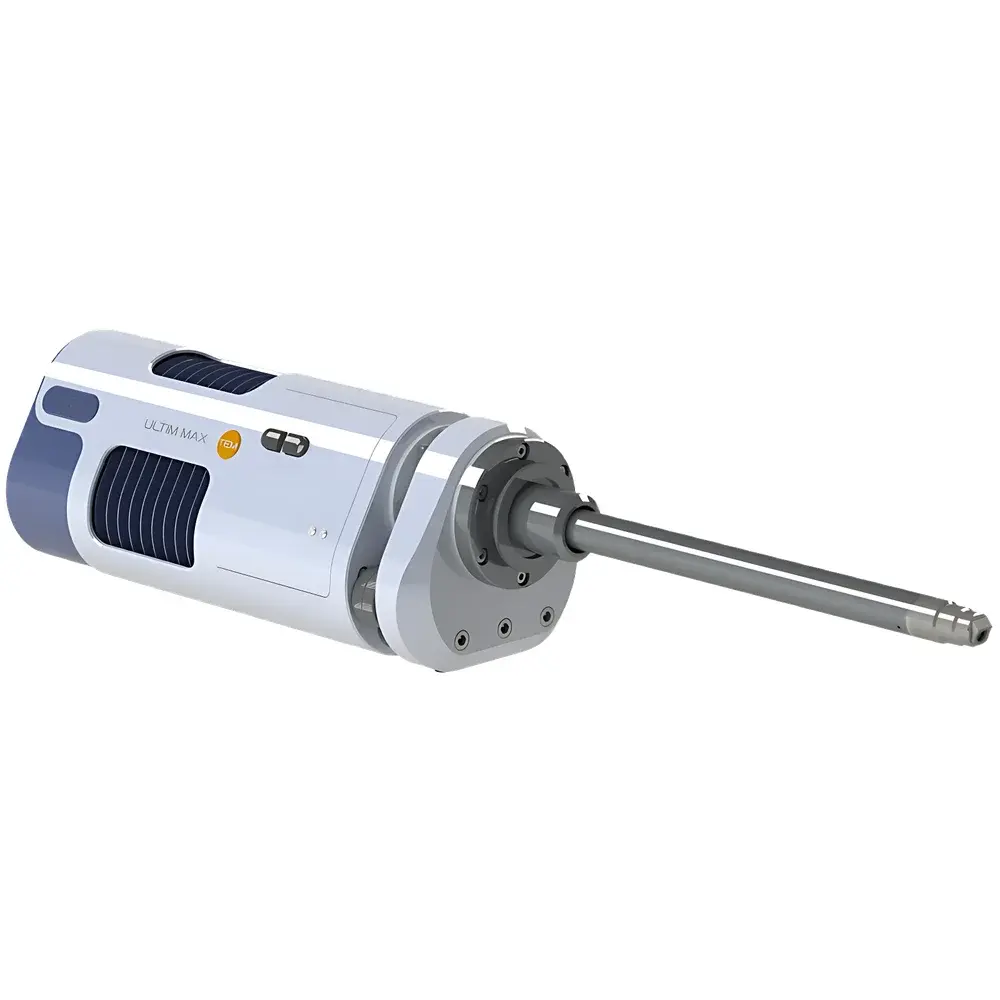
Oxford Instruments UltimMax TEM Transmission Electron Microscopy Energy Dispersive Spectrometer
| Brand | Oxford Instruments |
|---|---|
| Origin | United Kingdom |
| Model | UltimMax TEM |
| Instrument Type | Side-entry (tilt-compatible) |
| Energy Resolution | 125 eV (Mn Kα) |
| Peak-to-Background Ratio | 200,000:1 |
| Maximum Count Rate | 400,000 cps |
| Elemental Detection Range | Be to Cf |
| Detector Active Area | 80 mm² |
| Window Type | Windowless |
| Solid Angle | 0.2–0.6 srad |
| Low-Energy X-ray Sensitivity Gain | Up to 8× vs. conventional windowed detectors |
| In Situ Operation Temperature | Up to 1000 °C |
| Compatible Accelerating Voltages | Up to 200 kV |
Overview
The Oxford Instruments UltimMax TEM is a high-performance, windowless energy dispersive spectrometer (EDS) engineered specifically for integration with transmission electron microscopes (TEMs). It operates on the principle of X-ray energy dispersion: when a focused electron beam interacts with a thin specimen in the TEM, characteristic X-rays are emitted; the UltimMax TEM detects and resolves these photons by energy using a silicon drift detector (SDD), enabling quantitative elemental identification and spatial mapping at nanometre-scale resolution. Its design prioritises high collection efficiency, low electronic noise, and robust signal fidelity under demanding operational conditions—including high accelerating voltages (up to 200 kV), elevated in situ temperatures (up to 1000 °C), and dynamic beam scanning modes. Unlike conventional EDS systems constrained by polymer or ultrathin windows that absorb soft X-rays, the windowless architecture of the UltimMax TEM preserves spectral integrity across the full detectable range (beryllium to californium), particularly enhancing sensitivity for light elements (e.g., C, N, O, F) critical in materials science, catalysis, and battery research.
Key Features
- 80 mm² large-area silicon drift detector optimised for high solid angle collection (0.2–0.6 srad), positioned closer to the specimen to maximise X-ray capture without compromising TEM column geometry or tilt capability.
- Windowless detector assembly eliminates absorption losses below 1 keV, delivering up to 8× higher sensitivity for low-energy X-rays compared to windowed counterparts—enabling reliable detection of boron, carbon, nitrogen, and oxygen in beam-sensitive or ultra-thin specimens.
- Advanced low-noise electronics and pulse processing firmware achieve an energy resolution of ≤125 eV at Mn Kα (5.895 keV), supporting precise peak deconvolution in complex multi-element spectra.
- Real-time high-throughput acquisition at sustained count rates up to 400,000 counts per second (cps), maintaining spectral fidelity and quantitative accuracy without dead-time correction artifacts.
- Thermally stable mechanical design qualified for in situ heating experiments up to 1000 °C, with vacuum-compatible materials and active cooling to ensure detector performance stability during long-duration acquisitions.
- Side-entry (tilt-compatible) mounting configuration preserves full TEM stage tilt range (±30° typical), facilitating tomographic EDS and crystallographically aligned analysis.
Sample Compatibility & Compliance
The UltimMax TEM supports analysis of diverse TEM specimen types—including lamellae prepared by FIB-SEM, electropolished foils, graphene-supported nanoparticles, and in situ heating/cooling holders. Its windowless construction eliminates risk of window rupture during differential pumping or gas-environment experiments. The system complies with international standards governing analytical electron microscopy, including ASTM E1508 (standard guide for quantitative elemental analysis by EDS), ISO 16700 (microanalysis — EDS for SEM and TEM), and supports audit-ready data acquisition workflows aligned with GLP and GMP environments. Full traceability of acquisition parameters (beam voltage, probe current, dwell time, live time, detector bias, temperature) is embedded in every spectrum file.
Software & Data Management
Controlled via Oxford Instruments’ AZtecTEM software suite, the UltimMax TEM enables seamless integration with major TEM platforms (Thermo Fisher Scientific, JEOL, Hitachi). AZtecTEM provides real-time spectrum acquisition, live elemental mapping, quantification using φ(ρz) matrix corrections, and advanced multivariate statistical analysis (e.g., PCA, cluster analysis) for phase identification. All data—including raw spectra, maps, and metadata—are stored in vendor-neutral HDF5 format, ensuring long-term archival compatibility. Software features full support for 21 CFR Part 11-compliant user authentication, electronic signatures, and audit trails—essential for regulated laboratories conducting failure analysis, pharmaceutical impurity characterisation, or semiconductor defect review.
Applications
- Nanoscale compositional analysis of catalysts, quantum dots, and 2D materials, where light-element distribution dictates functional performance.
- Interface chemistry and interdiffusion studies in heterostructures, such as metal/oxide or semiconductor/metal junctions.
- In situ thermal evolution of precipitates, segregation, or oxidation kinetics in alloys and ceramics.
- Quantitative stoichiometry determination in complex oxides (e.g., perovskites, spinels) and battery electrode materials (NMC, LFP, solid electrolytes).
- Correlative analysis combining EDS with electron energy loss spectroscopy (EELS) and high-resolution imaging for comprehensive structure–property correlation.
FAQ
Is the UltimMax TEM compatible with 300 kV TEMs?
The UltimMax TEM is validated for operation up to 200 kV. For 300 kV systems, Oxford Instruments recommends consultation to assess detector shielding requirements and potential modifications to maintain optimal resolution and count-rate linearity.
Does the windowless design require special vacuum protocols?
Yes—the detector must operate in ultra-high vacuum (UHV) conditions (<1×10⁻⁷ mbar) to prevent contamination of the bare SDD surface. Standard TEM column vacuum interlocks and chamber bake-out procedures apply.
Can AZtecTEM perform automated particle analysis on EDS maps?
Yes—AZtecTEM includes ParticleMetric functionality for size-resolved, composition-classified particle analysis, with configurable thresholds for area, intensity, and elemental ratios.
What calibration standards are supplied with the system?
A certified NIST-traceable Cu standard is included for energy calibration; additional reference materials (e.g., Co, Fe, Si) are available upon request for quantitative verification.
Is remote diagnostics supported?
Yes—Oxford Instruments’ SecureConnect service enables encrypted remote access for proactive maintenance, firmware updates, and technical support, subject to customer IT policy approval.




