
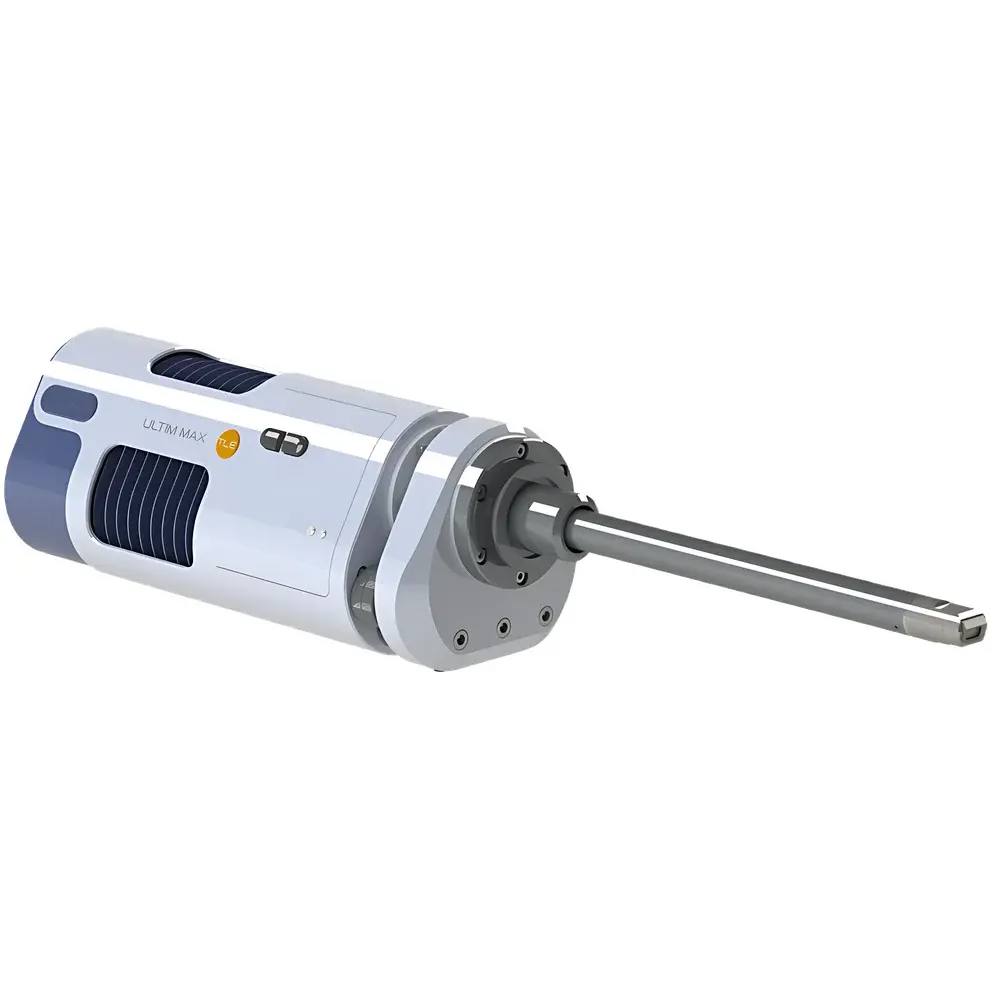
Oxford Instruments UltimMax TLE Transmission Electron Microscopy Energy Dispersive Spectrometer
| Brand | Oxford Instruments |
|---|---|
| Origin | United Kingdom |
| Model | UltimMax TLE |
| Detector Type | Tilting Insertion Geometry |
| Energy Resolution | 125 eV (Mn Kα) |
| Peak-to-Background Ratio | 200,000:1 |
| Maximum Input Count Rate | 400,000 cps |
| Elemental Detection Range | Be to Cf |
| Active Detector Area | 100 mm² |
| Window Type | Windowless |
| Solid Angle | 0.5–1.1 srad |
Overview
The Oxford Instruments UltimMax TLE is a high-performance, windowless silicon drift detector (SDD) engineered specifically for integration with transmission electron microscopes (TEMs). It operates on the principle of energy-dispersive X-ray spectroscopy (EDS), where characteristic X-rays emitted from electron-beam-excited specimens are resolved by their energy to identify and quantify elemental composition at atomic-scale spatial resolution. Designed for demanding analytical TEM applications—including atomic-resolution mapping, in situ heating experiments, and low-dose nanoscale analysis—the UltimMax TLE delivers exceptional sensitivity to light elements (starting from beryllium) while maintaining robust performance under high beam currents and elevated specimen temperatures up to 1000 °C. Its optimized mechanical architecture enables stable, reproducible insertion into the TEM column without compromising vacuum integrity or optical alignment.
Key Features
- Windowless 100 mm² SDD sensor providing enhanced detection efficiency for low-energy X-rays (Be–F), critical for accurate light-element quantification in ceramics, catalysts, and 2D materials.
- Ultra-high peak-to-background ratio (200,000:1) ensures superior spectral clarity and improved detection limits, particularly for trace elements embedded within complex matrices.
- Energy resolution of ≤125 eV at Mn Kα (5.89 keV) under standard operating conditions, meeting ISO 14703:2022 requirements for EDS detector performance verification.
- Tilting insertion geometry minimizes shadowing effects and maximizes geometric collection efficiency—especially beneficial for double-tilt holders and tomography stages.
- Extreme-grade electronics support sustained operation at input count rates up to 400,000 cps without significant dead-time distortion or pulse pile-up, enabling rapid, high-fidelity spectral acquisition during dynamic experiments.
- Optimized crystal geometry and thermal management allow stable spectral calibration over extended acquisition periods, even during in situ heating stages reaching 1000 °C.
Sample Compatibility & Compliance
The UltimMax TLE is compatible with all major TEM platforms including JEOL, Thermo Fisher Scientific (FEI), and Hitachi systems equipped with standard EDS port interfaces. Its windowless design eliminates absorption losses for soft X-rays, making it suitable for beam-sensitive biological thin sections, lithium-containing battery cathodes, and oxide heterostructures. The system complies with ISO/IEC 17025:2017 general requirements for competence of testing and calibration laboratories, and supports audit-ready data workflows aligned with GLP and GMP environments. When paired with AZtecTEM software, it facilitates full traceability per FDA 21 CFR Part 11 requirements, including electronic signatures, audit trails, and secure user access controls.
Software & Data Management
Controlled via Oxford Instruments’ AZtecTEM platform, the UltimMax TLE supports real-time spectrum acquisition, live elemental mapping, and automated phase identification using integrated crystallographic databases (e.g., ICDD PDF-4+). Quantitative analysis leverages Cliff-Lorimer and ZAF correction models, with optional standards-based or standardless protocols validated against NIST SRM reference materials. All spectra, maps, and processing parameters are stored in vendor-neutral HDF5 format, ensuring long-term archival compatibility and third-party interoperability (e.g., with HyperSpy or DigitalMicrograph plugins). Batch processing, scripting via Python API, and remote monitoring via secure TLS-encrypted connections further enhance laboratory workflow scalability.
Applications
- Atomic-column-resolved elemental mapping in high-angle annular dark-field (HAADF) STEM mode for interfacial chemistry analysis in perovskites and quantum dot heterostructures.
- In situ thermal EDS during heating experiments to monitor cation diffusion, oxidation state evolution, and phase segregation kinetics in catalytic nanoparticles.
- Quantitative analysis of light-element dopants (e.g., B, C, N, O) in SiC power semiconductors and AlN substrates under low-kV conditions.
- Correlative EDS–EELS studies where complementary bonding and compositional information is required at sub-nanometer resolution.
- Failure analysis of advanced interconnect metallization, including Cu–Sn–Ni ternary systems in 3D IC packaging.
FAQ
What vacuum requirements does the UltimMax TLE impose on the TEM column?
The detector is designed for ultra-high vacuum (UHV) compatibility, requiring base pressures ≤1×10⁻⁷ mbar; no additional differential pumping is needed due to its integrated gate valve and bakeable flange design.
Can the UltimMax TLE be retrofitted onto older TEM models?
Yes—mechanical adapters and interface firmware updates are available for JEOL 2100, FEI Tecnai G2, and Hitachi H-9500 systems, subject to port diameter and clearance validation.
How is energy calibration maintained during in situ heating experiments?
AZtecTEM implements continuous internal reference tracking using Mn Kα from a built-in calibration source, correcting for thermal drift in real time without interrupting data acquisition.
Does the system support automated drift correction during long-duration mapping?
Yes—integrated stage position feedback and image correlation algorithms enable sub-pixel registration across multi-hour spectral imaging sessions.
Is spectral deconvolution supported for overlapping peaks (e.g., S Kα and Pb Mα)?
AZtecTEM includes constrained least-squares fitting with physically informed background modeling and library-based interference correction, validated per ASTM E1508-18 guidelines for EDS quantitative analysis.



