
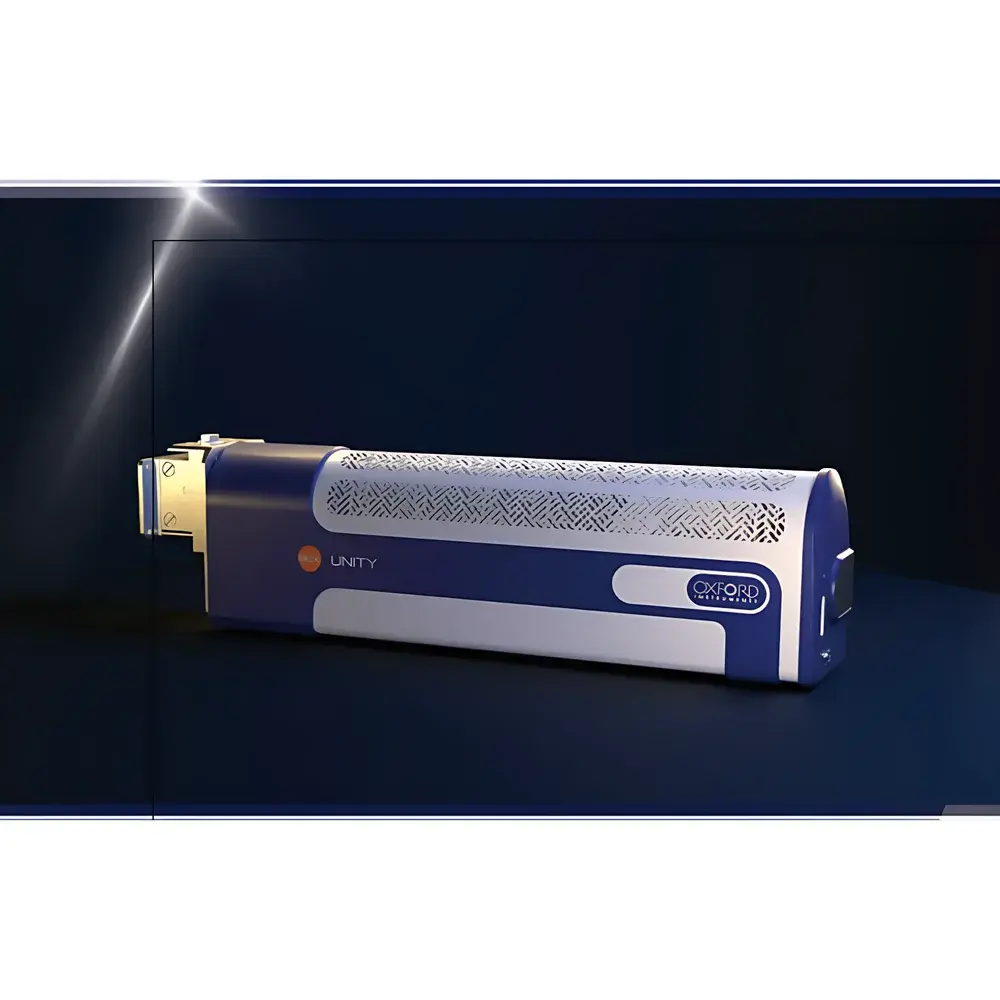

Oxford Instruments Unity BEX Imaging Detector
| Brand | Oxford Instruments |
|---|---|
| Origin | United Kingdom |
| Model | Unity |
| Mounting Type | Side-entry (inclined insertion) |
| Detector Architecture | Integrated Backscattered Electron (BSE) and Energy-Dispersive X-ray (EDS) Sensor Assembly |
| Positioning | Mounted directly beneath the objective lens pole piece |
Overview
The Oxford Instruments Unity BEX Imaging Detector is an engineered solution for simultaneous, high-fidelity acquisition of topographic and compositional information in scanning electron microscopy (SEM). Unlike conventional EDS-only or BSE-only detectors, Unity implements a co-located, dual-sensor architecture—integrating a high-sensitivity backscattered electron (BSE) detector and a pair of large-area silicon drift detectors (SDDs) for energy-dispersive X-ray spectroscopy—within a single compact module positioned directly beneath the SEM objective lens pole piece. This strategic placement maximizes solid angle for X-ray collection while preserving optimal BSE signal geometry, enabling true spatial and temporal correlation between atomic number contrast (Z-contrast) and elemental distribution. The system operates on the principle of synchronized signal acquisition: BSE data provides immediate morphological context at video-rate speeds, while EDS data delivers quantitative elemental mapping with sub-micron spatial resolution—all without mechanical repositioning or sequential scanning. This eliminates parallax error, reduces stage dwell time, and fundamentally decouples imaging speed from analytical fidelity.
Key Features
- Integrated BSE–EDS co-location: Dual-sensor assembly mounted under the pole piece ensures geometric consistency and eliminates registration drift between morphology and composition maps.
- Shadow-free imaging: Dual symmetric X-ray detectors eliminate topographic shadowing artifacts common in tilted or rough samples—including cross-sections, trenches, and porous materials—by capturing X-rays from complementary azimuthal angles.
- Large-field-of-view compatibility: Optimized front aperture design permits unobstructed beam passage even at extreme tilt angles and in “fisheye” or panoramic SEM modes, supporting both macro-navigation and high-resolution microanalysis.
- Low-vacuum operational mode: Seamless transition from high vacuum to low vacuum (up to 100 Pa) enables charge-free imaging of non-conductive or hydrated specimens without coating—preserving native surface structure.
- Peltier-cooled BSE sensor: Custom geometry and thermoelectric cooling enhance signal-to-noise ratio and dynamic range, delivering robust Z-contrast across beam energies from 5 keV to 30 keV.
- High-throughput signal processing: Powered by the X4 pulse processor and Tru-Q quantification engine, Unity supports real-time spectral deconvolution and live chemical imaging via AZtecLive.
Sample Compatibility & Compliance
Unity is compatible with all major SEM platforms equipped with standard side-entry detector ports and compatible pole-piece configurations (e.g., FEI/Thermo Scientific, Zeiss, JEOL, Hitachi). It supports analysis of conductive, semi-conductive, and insulating materials—including geological sections, battery cathodes, polymer composites, biological tissues (after appropriate preparation), and metallurgical cross-sections. The system complies with ISO 16700:2016 (EDS microanalysis), ASTM E1508-21 (quantitative elemental analysis), and supports audit-ready workflows aligned with GLP and GMP requirements through AZtec’s 21 CFR Part 11-compliant software architecture—including electronic signatures, full audit trail, and secure user access controls.
Software & Data Management
Unity is fully integrated into the AZtec platform (v4.5+), leveraging its modular architecture for unified control, acquisition, and interpretation. AZtecLive enables real-time overlay of BSE intensity, elemental distribution, and RGB-coded compositional maps—updated dynamically as the stage moves. All acquired datasets are stored in vendor-neutral HDF5 format with embedded metadata (beam parameters, working distance, detector geometry, calibration history). Batch processing, automated phase identification (using PhaseMap), and statistical clustering (via Machine Learning Toolkit) are supported. Data export adheres to MIAME/MIAPE standards and is compatible with third-party visualization tools including DigitalMicrograph, HyperSpy, and Python-based scientific stacks (NumPy, SciPy, scikit-image).
Applications
- Materials science: Rapid phase identification in multiphase alloys, ceramic composites, and additive-manufactured microstructures.
- Geosciences: Quantitative mineral mapping of thin sections with automatic silicate/non-silicate classification.
- Electronics failure analysis: Correlation of defect morphology (via BSE) with localized contamination (e.g., Cl, Na, Al) on PCB traces and solder joints.
- Life sciences: Elemental distribution in calcified tissues, metalloprotein localization, and nanoparticle uptake studies—without heavy-metal staining.
- Quality control: In-line verification of coating uniformity, filler dispersion in polymers, and interfacial reactions in bonded assemblies.
FAQ
Can Unity be retrofitted onto existing SEMs?
Yes—Unity is designed as a field-upgradeable detector for compatible SEM models. Installation requires only mechanical integration, electrical connection to the SEM interface, and AZtec software licensing.
Does Unity require changes to standard SEM operating procedures?
No—users retain familiar workflows. Beam settings, stage control, and image acquisition remain unchanged; Unity adds new modalities without disrupting legacy protocols.
How does Unity improve detection limits compared to conventional EDS systems?
By doubling effective solid angle via dual SDDs and optimizing take-off angle through pole-piece mounting, Unity increases X-ray count rate by up to 3× at equivalent beam currents—directly improving minimum detection limits (MDLs) for trace elements.
Is AZtec software included with Unity?
Unity requires AZtec v4.5 or later. A base AZtec license is included; advanced modules (e.g., AZtecFeature, AZtecTEM) are optional and licensed separately.
What maintenance is required for the Unity detector?
The Peltier-cooled BSE sensor and SDDs are sealed and maintenance-free. Annual energy calibration and resolution verification using certified reference materials (e.g., Cu, Mn, Co) are recommended for quantitative compliance.



