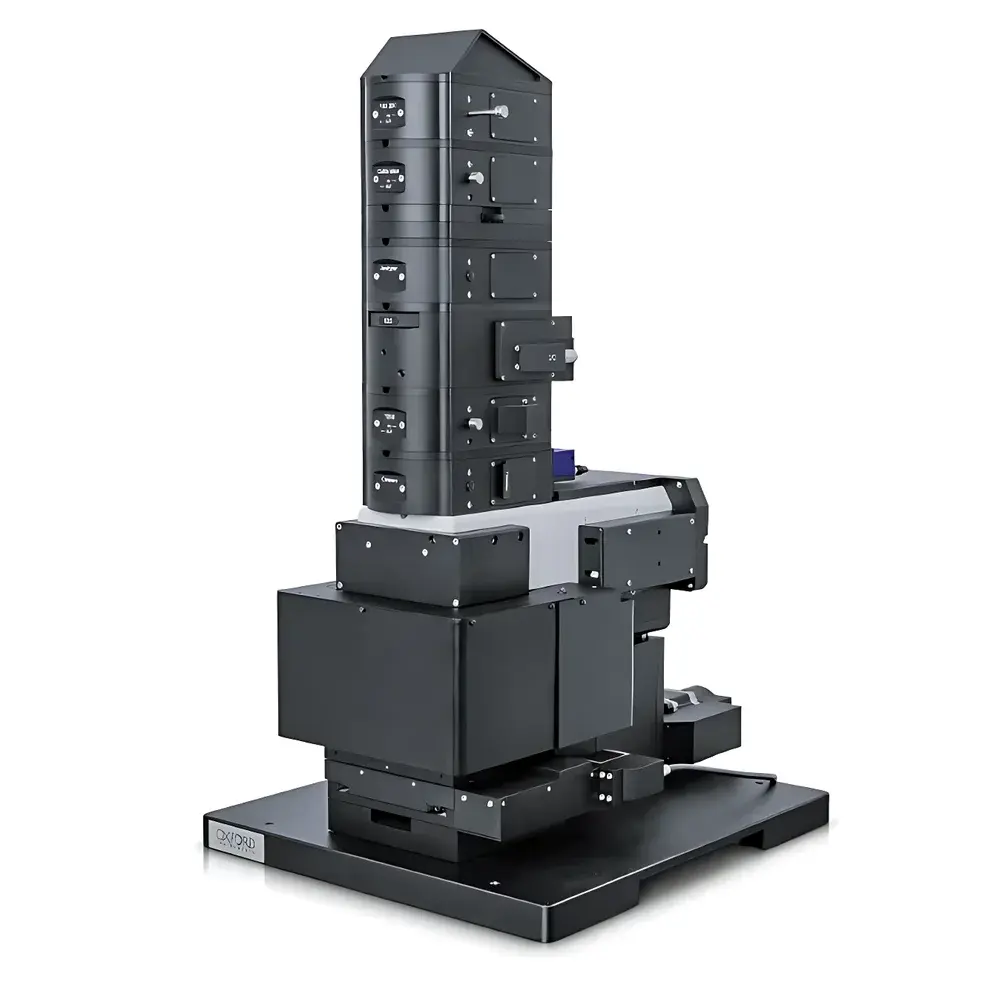
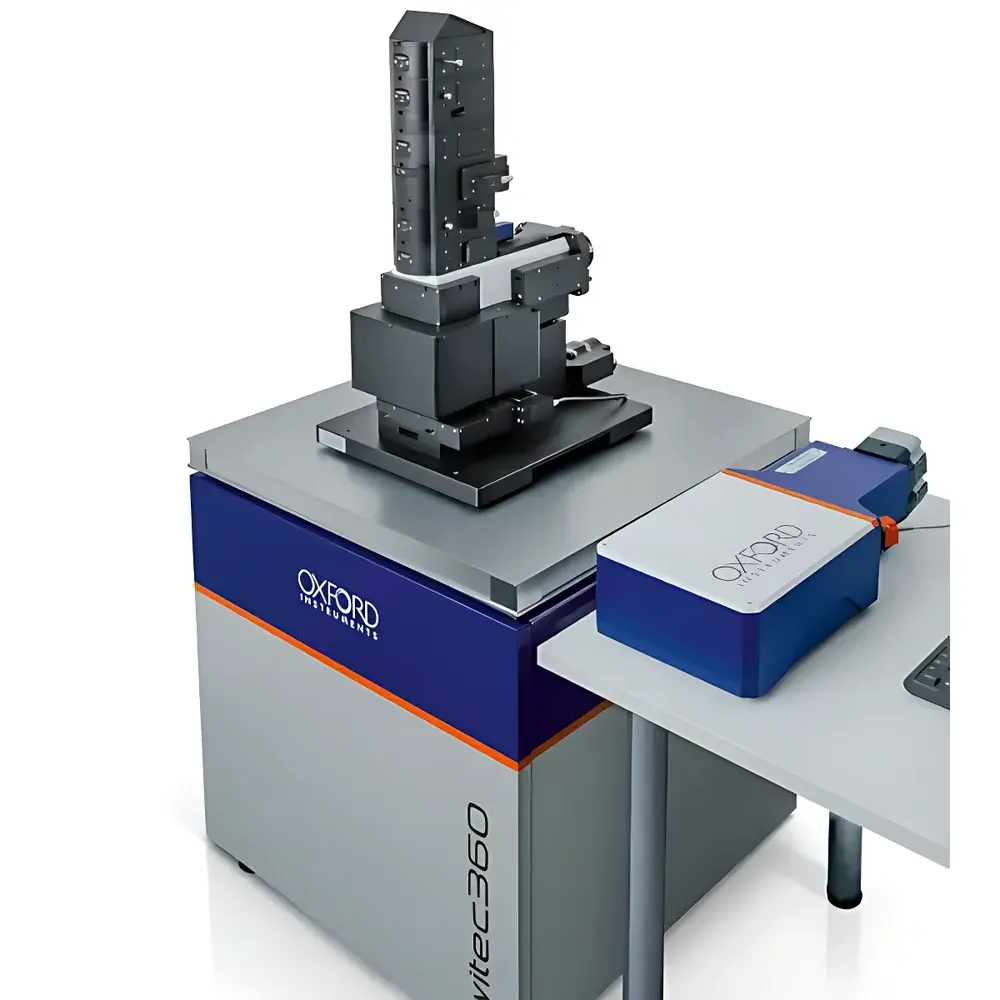
Oxford Instruments WITec alpha360 Raman Imaging Microscope
| Brand | Oxford Instruments |
|---|---|
| Origin | United Kingdom |
| Manufacturer Type | Authorized Distributor |
| Product Origin | Imported |
| Model | WITec alpha360 Raman Imaging Microscope |
| Pricing | Available Upon Request |
Overview
The Oxford Instruments WITec alpha360 Raman Imaging Microscope is a high-performance, confocal Raman imaging platform engineered for nanoscale chemical characterization and correlative multimodal analysis. Built upon WITec’s proven TrueConfocal™ scanning principle, the system combines diffraction-limited spatial resolution with ultra-high spectral fidelity to deliver quantitative molecular fingerprinting at sub-300 nm lateral resolution. Unlike conventional widefield or non-scanning Raman systems, the alpha360 employs point-excitation and point-detection via precision piezo-driven XYZ stage scanning—ensuring true optical sectioning, minimal out-of-focus background, and intrinsic depth discrimination. This architecture is essential for reliable analysis of heterogeneous biological specimens, thin-film stacks, polymer blends, and 2D materials where chemical heterogeneity spans submicron domains. The system operates across an extended spectral range (350–1100 nm), with optional excitation lines spanning UV (266 nm) to NIR (1064 nm), enabling resonance enhancement, fluorescence suppression, and minimization of photodamage in live-cell and tissue applications.
Key Features
- True confocal Raman imaging with <300 nm lateral resolution (λ/2) and <950 nm axial resolution, dependent on excitation wavelength and objective NA
- Ultra-high spectral resolution of ≤0.1 cm⁻¹ (at 633 nm excitation), achieved via high-throughput, aberration-corrected spectrometers with selectable grating options
- Sub-millisecond single-spectrum acquisition (≤1 ms per pixel without binning or averaging), enabling rapid hyperspectral mapping of large fields-of-view
- Fully modular optical design supporting simultaneous or sequential integration of complementary techniques: AFM, SNOM, FLIM, and white-light microscopy
- Motorized, software-controlled turret with up to six objectives (including oil-, water-, and air-immersion variants) and automated focus stabilization
- Integrated laser combiner with up to four independently modulated, TEM₀₀ lasers (266, 488, 532, 633, 785, 1064 nm), each with adjustable power control and shutter synchronization
Sample Compatibility & Compliance
The alpha360 accommodates a broad range of sample formats—from unstained cryosections and cultured monolayers to intact organoids, semiconductor wafers, and battery electrode cross-sections—without requiring conductive coating or vacuum. Its open-stage architecture supports environmental chambers (temperature, humidity, gas control) and electrochemical cells for in situ and operando studies. All hardware and firmware comply with CE marking requirements and adhere to IEC 61000-6-3 (EMC) and IEC 61000-6-4 (immunity) standards. For regulated environments, the system supports audit-trail-enabled operation under 21 CFR Part 11-compliant software modules (optional), fulfilling GLP/GMP documentation requirements for pharmaceutical process development and QC laboratories.
Software & Data Management
Control, acquisition, and analysis are unified within WITec Project PLUS—a modular, scriptable platform supporting batch processing, multivariate statistical analysis (PCA, cluster analysis), and spectral unmixing algorithms. Raw data are stored in vendor-neutral HDF5 format with embedded metadata (excitation wavelength, grating, integration time, stage coordinates), ensuring long-term FAIR (Findable, Accessible, Interoperable, Reusable) compliance. Integration with third-party tools—including Python (via WITec API), MATLAB, and ImageJ/Fiji—is supported for custom algorithm deployment. Automated calibration routines (wavelength, intensity, spatial) are traceable to NIST-certified standards and logged with timestamped version history.
Applications
- Subcellular lipid/protein distribution mapping in fixed and live neurons using 785 nm excitation and low-dose protocols
- Strain and doping heterogeneity quantification in graphene and transition metal dichalcogenides (TMDs)
- Pharmaceutical polymorph identification and crystallinity assessment in tablet cross-sections
- Correlative Raman-AFM analysis of amyloid fibril mechanical properties versus chemical composition
- In situ monitoring of solid-electrolyte interphase (SEI) evolution on Li-ion battery anodes during cycling
- Microplastic identification and polymer classification in environmental filter samples without labeling
FAQ
Is the alpha360 compatible with live-cell imaging under physiological conditions?
Yes—the system supports temperature- and CO₂-controlled stage enclosures, low-noise NIR excitation (785/1064 nm), and real-time focus stabilization, enabling time-lapse Raman imaging of adherent mammalian cells for up to 6 hours.
Can spectral data be exported for external multivariate analysis?
Absolutely—all spectra and hyperspectral cubes are saved in HDF5 format with complete metadata; Python and MATLAB interfaces allow direct import into scikit-learn, PLS Toolbox, or custom deep-learning pipelines.
Does the system meet regulatory requirements for GxP laboratories?
When configured with optional 21 CFR Part 11 software modules, the alpha360 provides electronic signatures, role-based access control, and immutable audit trails—fully compliant with FDA, EMA, and PMDA expectations for analytical instrument qualification.
What level of service and application support is provided post-installation?
Oxford Instruments offers comprehensive remote diagnostics, annual performance verification (including spectral and spatial calibration), and dedicated application scientist support—including method development workshops tailored to life science, materials, and pharma use cases.