
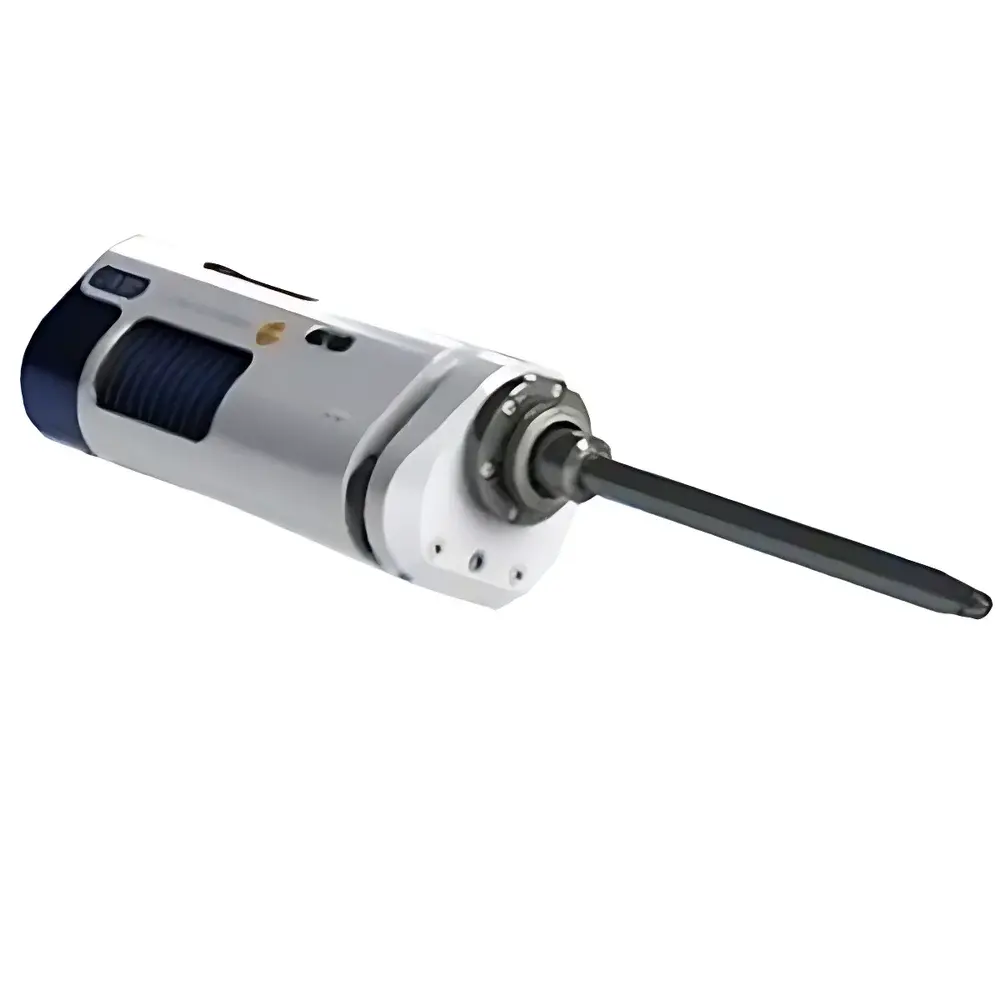
Oxford Instruments Xplore 30 Energy Dispersive Spectrometer
| Brand | Oxford Instruments |
|---|---|
| Origin | United Kingdom |
| Model | Xplore 30 |
| Detector Type | Tilting (Side-Entry) |
| Energy Resolution | 129 eV at Mn Kα |
| Peak-to-Background Ratio | 20,000:1 |
| Maximum Count Rate | 1,000,000 cps |
| Elemental Detection Range | Be to Cf |
| Active Detector Area | 300 mm² |
| Window Type | Beryllium Window |
Overview
The Oxford Instruments Xplore 30 Energy Dispersive Spectrometer (EDS) is a high-performance, side-entry silicon drift detector (SDD) system engineered for routine and advanced elemental microanalysis in scanning electron microscopy (SEM) environments. Built upon the proven Ultim Max platform architecture, the Xplore 30 integrates next-generation signal processing electronics—including the proprietary Extreme low-noise circuitry and the X1 pulse processor—to deliver exceptional spectral fidelity across a broad dynamic range of count rates. Its core measurement principle relies on the detection and energy discrimination of characteristic X-ray photons emitted from a specimen under electron beam excitation. With an active SDD area of 300 mm² and a beryllium entrance window optimized for light-element transmission (down to beryllium), the Xplore 30 supports quantitative and qualitative analysis with high spatial resolution, robust reproducibility, and minimal dead-time distortion—even at sustained count rates up to 1 Mcps. Designed for integration into modern field-emission and tungsten SEMs, it operates within standard vacuum interfaces and complies with IEC 61000-6-3 (EMC) and IEC 61010-1 (safety) requirements for laboratory instrumentation.
Key Features
- 300 mm² large-area silicon drift detector with integrated Peltier cooling and vacuum-compatible beryllium window for enhanced light-element sensitivity (Be–F)
- Extreme low-noise front-end electronics enabling 129 eV energy resolution at Mn Kα under 100,000 cps—maintained up to 1,000,000 cps without significant degradation
- X1 digital pulse processor supporting real-time spectrum acquisition, adaptive pile-up rejection, and dead-time correction with sub-microsecond processing latency
- Tilting (side-entry) mechanical design optimized for rapid installation, alignment stability, and minimal shadowing across variable working distances and tilt angles
- Modular hardware architecture permitting field-replaceable detector modules and firmware-upgradable electronics—reducing instrument downtime and extending service life
- Integrated thermal management system ensuring stable detector temperature (±0.1 °C) over extended acquisition periods, critical for long-duration mapping and time-resolved analysis
Sample Compatibility & Compliance
The Xplore 30 is compatible with conductive, semi-conductive, and coated non-conductive specimens commonly analyzed in materials science, geology, metallurgy, and failure analysis laboratories. It supports standard SEM chamber configurations (including low-vacuum and ESEM modes when used with appropriate detector shielding). The system conforms to ISO/IEC 17025 calibration traceability requirements when paired with certified reference materials (e.g., NIST SRM 2100, NIST SRM 2101). Data output adheres to ASTM E1508-22 (Standard Guide for Quantitative Analysis by Energy-Dispersive Spectroscopy) and supports GLP/GMP audit trails via optional software modules compliant with FDA 21 CFR Part 11 (electronic records and signatures). All detector housing materials meet RoHS Directive 2011/65/EU restrictions on hazardous substances.
Software & Data Management
Controlled via Oxford Instruments’ AZtec software platform (v4.5 or later), the Xplore 30 enables fully automated acquisition, live spectrum display, point-and-click quantification (ZAF and φ(ρz) matrix corrections), phase identification, and high-resolution elemental mapping (up to 4096 × 4096 pixels). AZtec includes embedded spectral deconvolution algorithms (based on iterative least-squares fitting), automatic peak identification with interference correction, and batch-processing workflows for multi-sample analysis. Raw spectral data is stored in standardized .eds and .msa formats; processed results export to CSV, Excel, TIFF, and HDF5 for integration with third-party analytical tools (e.g., Python-based SciPy/Pandas pipelines or MATLAB). Audit logging, user access controls, and electronic signature support are available in AZtec Enterprise editions to meet regulatory documentation requirements.
Applications
- High-throughput compositional screening of alloys, ceramics, and composites in quality control laboratories
- In situ phase mapping of multiphase battery cathode materials (e.g., NMC, LFP) under controlled beam conditions
- Trace element detection and distribution analysis in geological thin sections (e.g., REE partitioning in zircon)
- Contamination identification on semiconductor wafers and packaging substrates using high-speed line scans
- Corrosion product characterization in aerospace-grade aluminum and titanium alloys per ASTM G163 guidelines
- Forensic particulate analysis (e.g., gunshot residue, paint chips) requiring certified reporting under ISO/IEC 17025-accredited protocols
FAQ
What is the minimum detectable element with the Xplore 30?
Beryllium (Be, Z=4) is routinely detectable under optimal conditions (high beam current, low kV, clean surface, and extended dwell time); detection limits depend on matrix absorption and background statistics.
Does the Xplore 30 require liquid nitrogen cooling?
No—it uses thermoelectric (Peltier) cooling only, eliminating cryogen handling and enabling continuous unattended operation.
Can the detector be upgraded in the field?
Yes—the modular design allows replacement of the detector assembly, preamplifier board, and pulse processor independently, with firmware updates delivered via AZtec.
Is the Xplore 30 compatible with older SEM models?
It supports legacy SEMs with standard DIN or ISO flange interfaces and analog/digital signal outputs; compatibility verification requires review of SEM manufacturer’s EDS port specifications.
How is energy resolution verified and maintained?
Resolution is validated during factory calibration using Mn Kα emission from a Fe–Mn alloy standard; users may perform periodic verification using built-in diagnostic spectra and AZtec’s resolution monitoring tool.





