
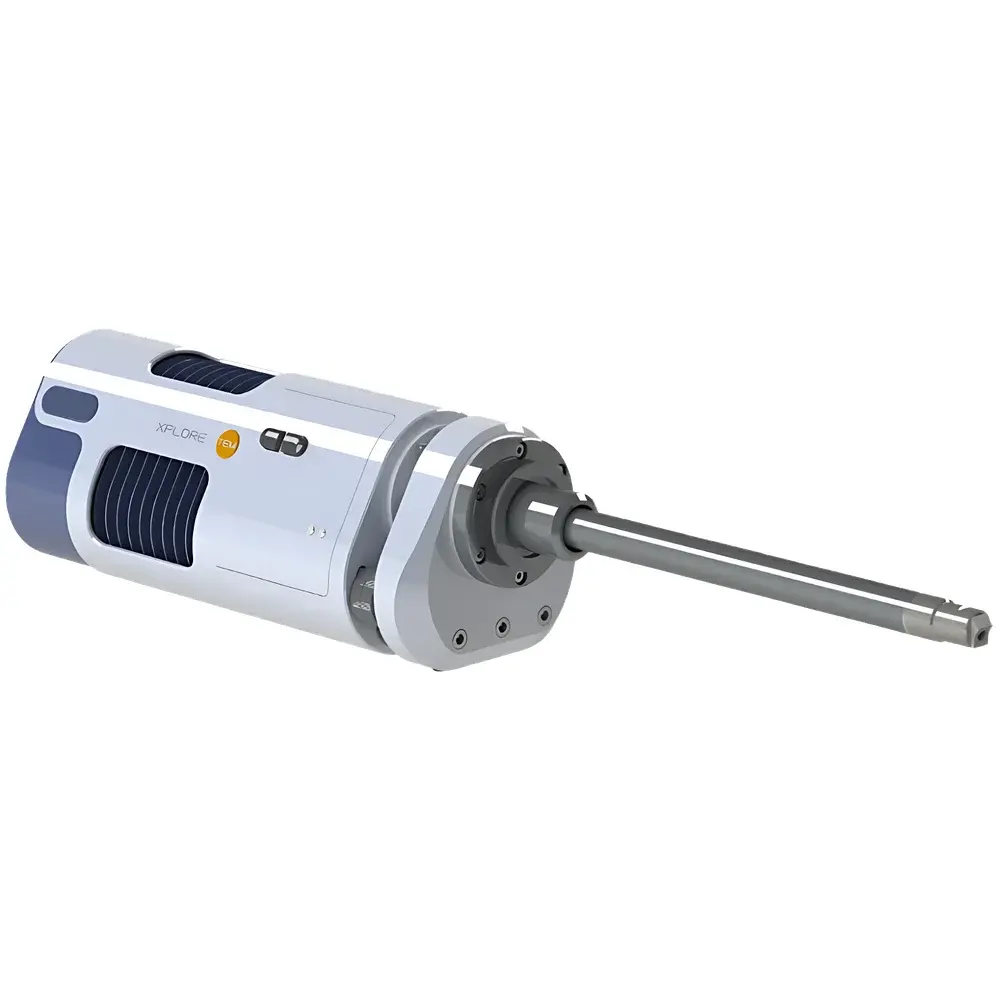
Oxford Instruments Xplore TEM Transmission Electron Microscopy Energy Dispersive Spectrometer
| Brand | Oxford Instruments |
|---|---|
| Origin | United Kingdom |
| Model | Xplore TEM |
| Instrument Type | Side-entry (tilt-compatible) EDS system for TEM |
| Energy Resolution | 125 eV (Mn Kα) |
| Peak-to-Background Ratio | 200,000:1 |
| Maximum Input Count Rate | 200,000 cps |
| Elemental Detection Range | Beryllium (Be) to Californium (Cf) |
| Detector Active Area | 80 mm² |
| Window Type | Windowless (ultra-thin polymer support) |
Overview
The Oxford Instruments Xplore TEM is a high-performance, side-entry energy dispersive spectrometer (EDS) engineered specifically for integration with 120 kV and 200 kV transmission electron microscopes (TEMs). It leverages silicon drift detector (SDD) technology combined with low-noise, high-bandwidth electronics to deliver rapid, quantitative elemental analysis at nanoscale spatial resolution. The system operates on the principle of X-ray photon detection following electron-beam-induced inner-shell ionization — enabling simultaneous acquisition of characteristic X-ray spectra across the full detectable elemental range (Be–Cf). Its windowless architecture eliminates absorption losses for light elements, while the large 80 mm² active area and optimized solid angle (0.1–0.4 srad, depending on pole-piece gap and detector positioning) maximize X-ray collection efficiency without compromising beam stability or sample tilt compatibility.
Key Features
- Windowless SDD design with ultra-thin polymer support — ensures high transmission for low-energy X-rays (down to Be Kα at 108 eV), critical for accurate light-element quantification in ceramics, polymers, battery materials, and biological ultrathin sections.
- 125 eV energy resolution at Mn Kα (5.89 keV) — meets ISO 14735-1 requirements for EDS performance verification and enables reliable peak deconvolution in complex multi-phase samples.
- Peak-to-background ratio of 200,000:1 — enhances detection limits for trace constituents (<100 ppm in favorable matrix conditions) and improves accuracy in low-dose analytical scenarios common in beam-sensitive specimens.
- Maximum input count rate of 200,000 cps — supports high-current, high-resolution mapping and rapid spectrum acquisition without significant dead-time distortion or pulse pile-up artifacts.
- Side-entry (tilt-compatible) mechanical configuration — maintains full goniometer tilt range (±30° typical) and accommodates standard double-tilt or tomography holders without interference.
- Thermoelectric cooling (Peltier) with active temperature stabilization — eliminates liquid nitrogen dependency while sustaining detector performance over extended acquisition sessions.
Sample Compatibility & Compliance
The Xplore TEM is compatible with all major TEM platforms operating at 120 kV and 200 kV acceleration voltages, including JEOL, Thermo Fisher Scientific (FEI), and Hitachi systems. Its compact, vacuum-integrated housing meets UHV-compatible flange standards (CF or ISO-K) and interfaces seamlessly with existing column vacuum manifolds. The system complies with IEC 61000-6-3 (EMC emission) and IEC 61000-6-2 (immunity) standards. For regulated environments, data acquisition and processing workflows support audit-trail generation and user-access controls aligned with FDA 21 CFR Part 11 and EU Annex 11 requirements when deployed with Oxford’s AZtecTEM software suite under validated configurations.
Software & Data Management
Controlled via Oxford Instruments’ AZtecTEM software, the Xplore TEM delivers fully integrated spectral acquisition, real-time background subtraction, standardless and standards-based quantification (ZAF/φ(ρz)), and high-fidelity elemental mapping (point, line, area). The software supports batch processing of large hyperspectral datasets, automated phase identification using EDS + diffraction correlation, and export of metadata-rich files compliant with the ASTM E1508-20 and ISO/IEC 17025 reporting frameworks. All raw spectra and processed results are stored in vendor-neutral .msa or .emsa formats, ensuring long-term archival integrity and third-party interoperability. Optional GLP/GMP modules provide electronic signatures, change logs, and instrument calibration history tracking.
Applications
- Quantitative phase analysis in metallurgical intermetallics and weld interface characterization.
- Light-element mapping (B, C, N, O, F) in Li-ion cathode materials and solid electrolytes.
- In situ TEM EDS monitoring of nanoparticle oxidation/reduction dynamics under controlled gas environments.
- Trace contaminant identification in semiconductor device cross-sections (e.g., Cu diffusion in SiO₂ gate dielectrics).
- Morphology-correlated elemental distribution in soft matter (e.g., block copolymer domain composition, cryo-TEM vitrified biological complexes).
- High-angle annular dark-field (HAADF)-guided spectrum imaging for atomic-column-resolved chemistry in aberration-corrected STEM-EDS.
FAQ
Is the Xplore TEM compatible with 300 kV TEMs?
Yes — while optimized for 120–200 kV operation, the detector’s radiation hardness and signal-to-noise architecture allow stable use up to 300 kV; however, optimal light-element sensitivity is achieved below 200 kV due to reduced bremsstrahlung background.
Does the windowless design require special vacuum protocols?
The detector incorporates a differential pumping stage and is rated for operation down to 1×10⁻⁷ mbar; no additional vacuum modifications are required beyond standard TEM column base pressure specifications.
Can AZtecTEM perform automated particle analysis (APA) on TEM images?
Yes — APA is supported via integration with DigitalMicrograph or SmartSEM image feeds, enabling morphology-driven EDS classification and statistics generation per particle class.
What calibration standards are recommended for routine QC?
Oxford Instruments provides certified reference materials (CRMs) including NIST SRM 2100 (Cu–Au alloy), NIST SRM 2101 (Ti–Al–V), and custom thin-film standards traceable to NPL and BAM.
Is remote diagnostics and firmware updates supported?
Yes — AZtecTEM includes secure, encrypted remote access capability for technical support, with firmware update notifications and version-controlled deployment logs.





