
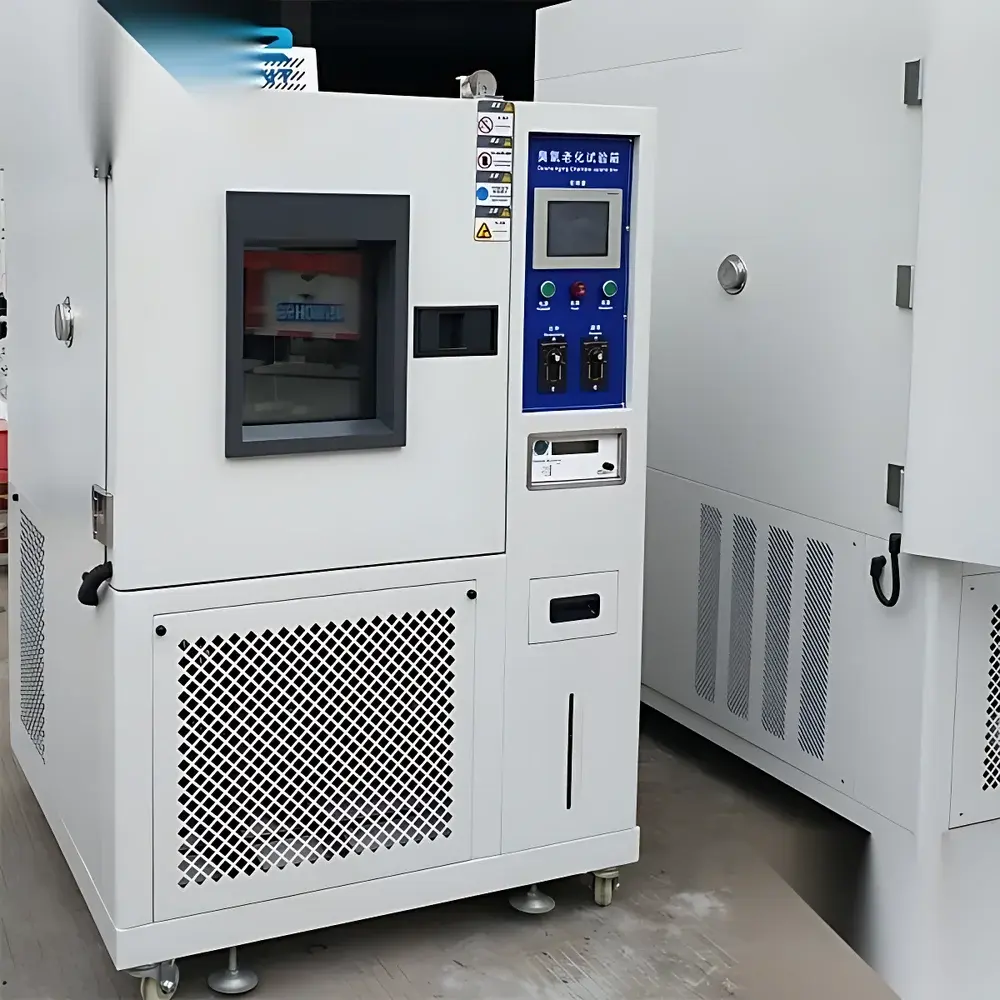
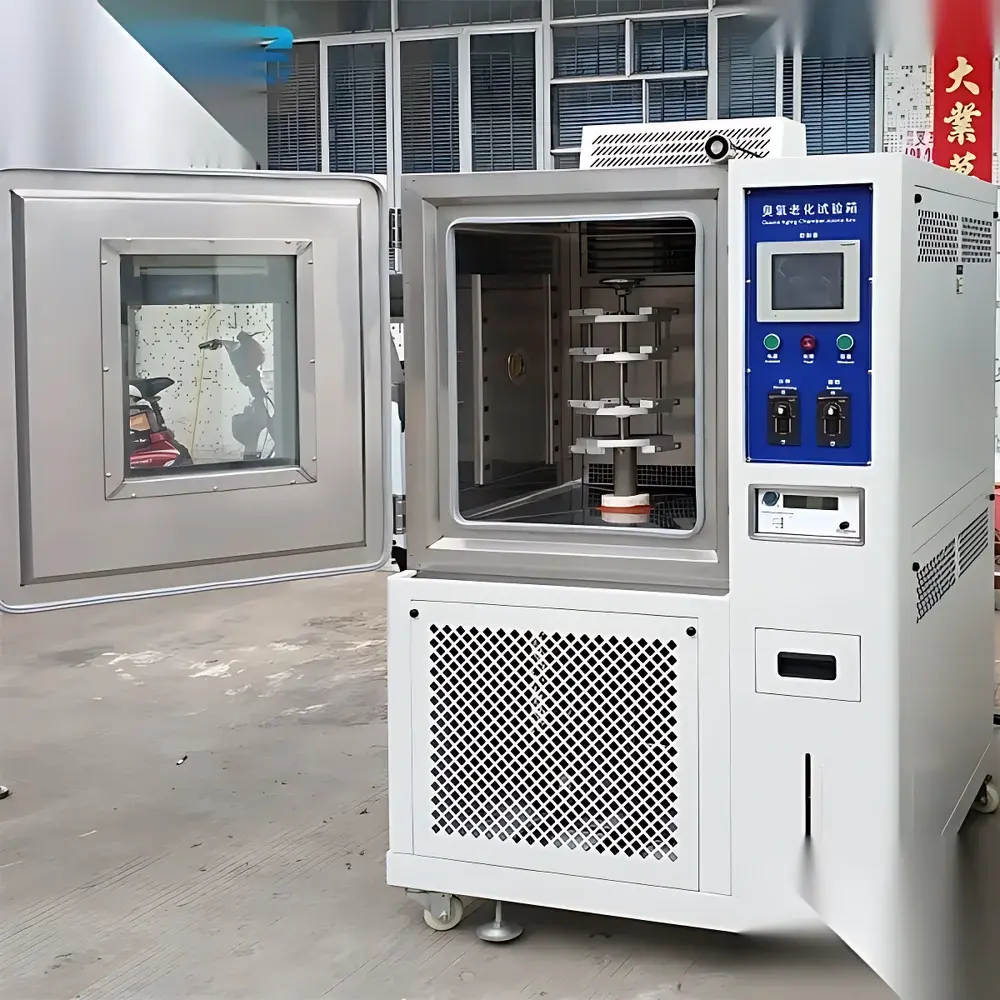
Ozone Aging Test Chamber with Dynamic Stretching Function – QY Series
| Key | Brand: Other Brands |
|---|---|
| Origin | Imported |
| Manufacturer Type | General Distributor |
| Ozone Concentration Range | 50–1500 ppm (pphm) |
| Temperature Range | 25–40 °C |
| Humidity Range | 30–65 % RH |
| Temp. Uniformity | ±0.5 °C |
| Sample Mounting | Dynamic (360° rotation at 1 rpm) & Static options |
| Gas Flow Velocity | 8–16 mm/s |
| Control System | Siemens PLC + Weintek Color Touchscreen |
| Ozone Detection | Non-dispersive UV Sensor (≥5 yr lifespan) |
| Compliance | GB/T 7762–2003, GB/T 2951.21–2008, GB/T 11206–2009, ISO 1431-1:2004 |
Overview
The Ozone Aging Test Chamber with Dynamic Stretching Function (QY Series) is an engineered environmental test system designed to evaluate the ozone resistance of elastomeric materials under accelerated, controlled conditions. It operates on the principle of exposing rubber specimens to precisely regulated ozone concentrations—ranging from 50 to 1500 ppm (parts per hundred million)—while simultaneously applying mechanical strain via dynamic stretching or static elongation. This dual-stress methodology replicates real-world service conditions where ozone-induced surface cracking is exacerbated by tensile deformation, such as in automotive seals, conveyor belts, and vibration-damping components. The chamber employs silent discharge ozone generation and non-dispersive ultraviolet (UV) absorption detection to ensure stable, traceable, and metrologically sound ozone dosing. All gas pathways are fully sealed and recirculated, eliminating ambient leakage and supporting occupational safety compliance (OSHA 29 CFR 1910.1200).
Key Features
- Fully enclosed stainless-steel test chamber with inert internal surfaces to prevent catalytic ozone decomposition.
- Adjustable ozone concentration control (50–1500 ppm) via PID-regulated silent discharge ozone generator; calibration traceable to NIST-traceable standards.
- Dual-mode sample mounting: dynamic stretching via 360° continuously rotating sample rack (1 rpm), engineered to follow cycloidal trajectory per ASTM D1149 reference geometry; static fixture option available for comparative baseline testing.
- Integrated non-dispersive UV ozone analyzer with ≥5-year sensor lifetime, real-time digital display, and 4–20 mA analog output for external data logging.
- Climate-controlled environment: temperature range 25–40 °C (±0.5 °C stability), humidity 30–65 % RH, independently adjustable and monitored.
- Siemens S7-1200 PLC paired with Weintek cMT Series color touchscreen HMI for intuitive parameter setting, profile storage, alarm management, and audit-ready event logging.
- Gas flow velocity maintained at 8–16 mm/s across specimen zone to ensure uniform ozone mass transfer without turbulent disruption of surface reaction kinetics.
- Calibration interface provided for third-party metrological verification; all ozone generation, distribution, and scrubbing occurs within a closed-loop recirculation circuit.
Sample Compatibility & Compliance
The QY Series accommodates standard dumbbell-shaped, ring, or strip specimens per ISO 1431-1 and GB/T 7762. Custom fixture kits support irregular geometries up to 100 × 100 × 100 cm (QY-1000 model). The system meets mandatory requirements for regulatory submission testing under ISO 1431-1:2004 (Rubber — Resistance to ozone cracking — Part 1: Static strain test) and extends capability to dynamic protocols aligned with internal R&D methodologies used in Tier-1 automotive and aerospace elastomer development. All electrical and gas-handling subsystems comply with IEC 61000-6-2 (EMC immunity) and IEC 61000-6-4 (EMC emission) standards. Optional 21 CFR Part 11-compliant software modules support electronic signatures, audit trails, and user access control for GLP/GMP environments.
Software & Data Management
Embedded firmware enables programmable multi-step test profiles—including ramped ozone concentration, stepped temperature/humidity, and timed dynamic actuation sequences. Real-time data streams (ozone ppm, temp, RH, elapsed time) are logged at 1 Hz resolution and exportable via RS232 or USB to CSV/Excel-compatible formats. Optional PC-based software provides statistical analysis of crack initiation time (CIT), crack density indexing, and Weibull reliability modeling against exposure dose (ppm·hr). Raw sensor outputs include full diagnostic codes and self-calibration status flags—critical for FDA or Notified Body inspection readiness.
Applications
- Accelerated evaluation of antioxidant and antiozonant additive efficacy in natural rubber (NR), styrene-butadiene rubber (SBR), nitrile rubber (NBR), and ethylene propylene diene monomer (EPDM).
- Qualification of rubber compounds for automotive weatherstripping, tire sidewalls, and engine mounts exposed to urban ozone-rich atmospheres.
- Comparative lifecycle assessment of vulcanization systems (e.g., sulfur vs. peroxide cure) under combined oxidative and mechanical stress.
- Supporting ISO/IEC 17025-accredited laboratories in issuing certified test reports for material specification conformance (e.g., SAE J200, ASTM D2000).
- Root-cause analysis of field failures linked to ozone-induced microcracking under sustained strain.
FAQ
What ozone concentration accuracy is achievable over extended test durations?
The UV photometer maintains ±5 ppm absolute accuracy across the 50–1500 ppm range, verified daily via zero-air and span-gas calibration routines embedded in the controller firmware.
Can the system operate unattended for 168-hour (7-day) continuous tests?
Yes—hardware watchdog timers, redundant thermal cutoffs, and automatic ozone scrubbing upon power loss ensure safe long-duration operation without operator intervention.
Is third-party calibration certification included with delivery?
A factory-as-built calibration certificate (traceable to national standards) is supplied; ISO/IEC 17025-certified field calibration services are available upon request.
How is ozone safely decommissioned after testing?
An integrated catalytic ozone destruct unit thermally converts residual ozone to oxygen prior to exhaust, meeting local industrial hygiene ventilation requirements.
Are spare parts and consumables (e.g., UV lamp, discharge tube) stocked internationally?
Critical spares—including UV sensor modules, ozone generator tubes, and PLC firmware update kits—are held in regional distribution hubs across EU, NA, and APAC regions.



