
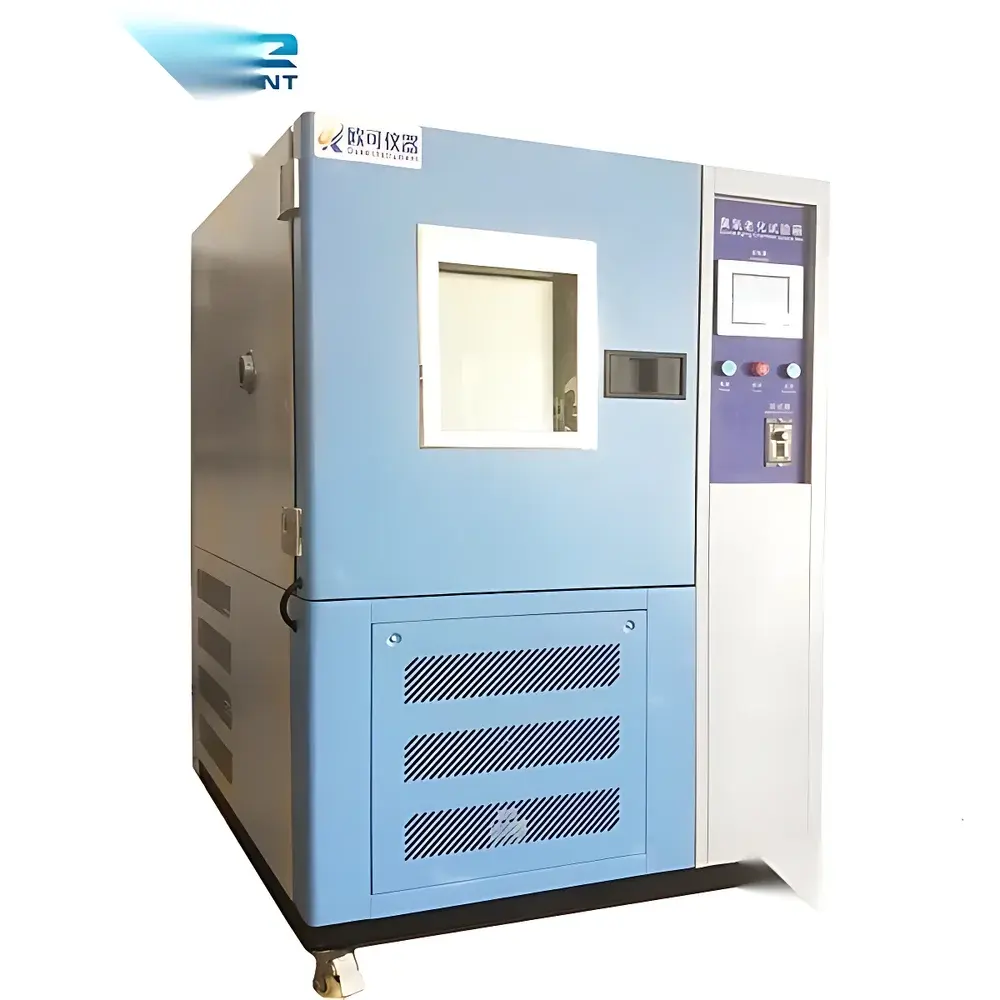
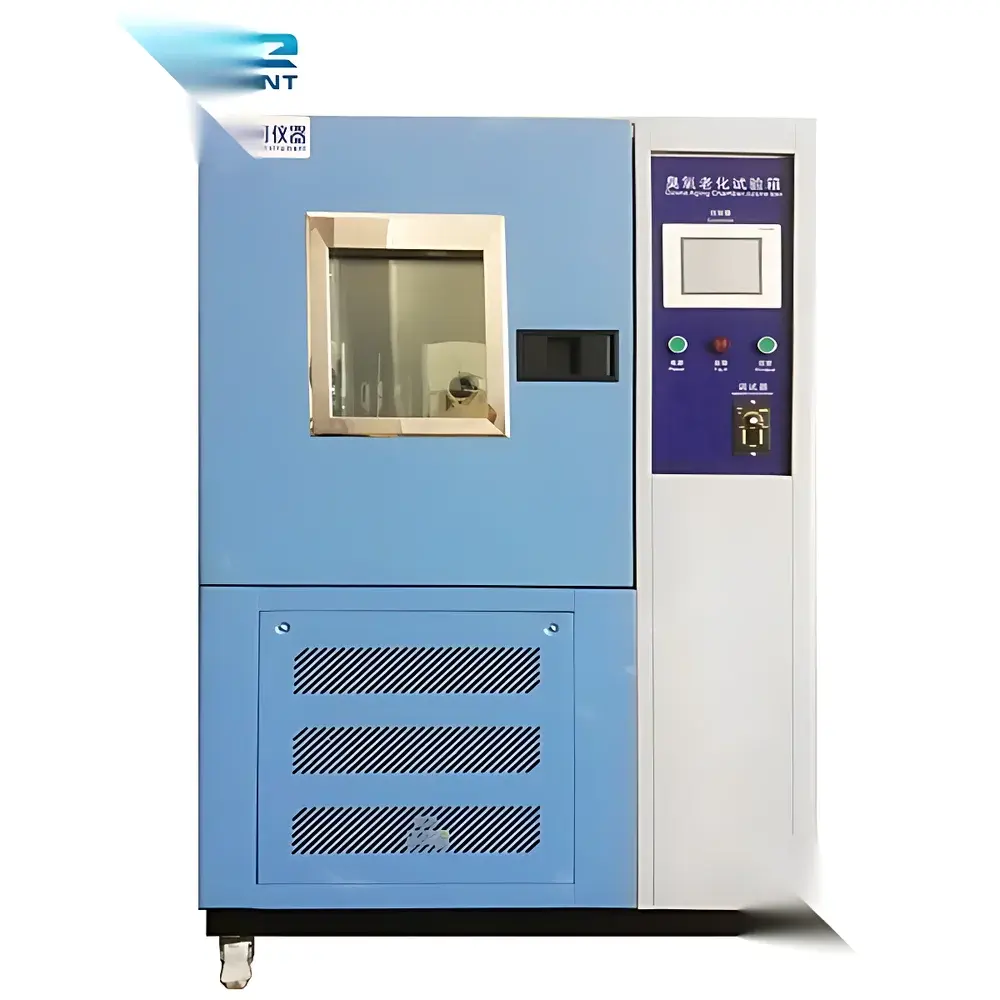
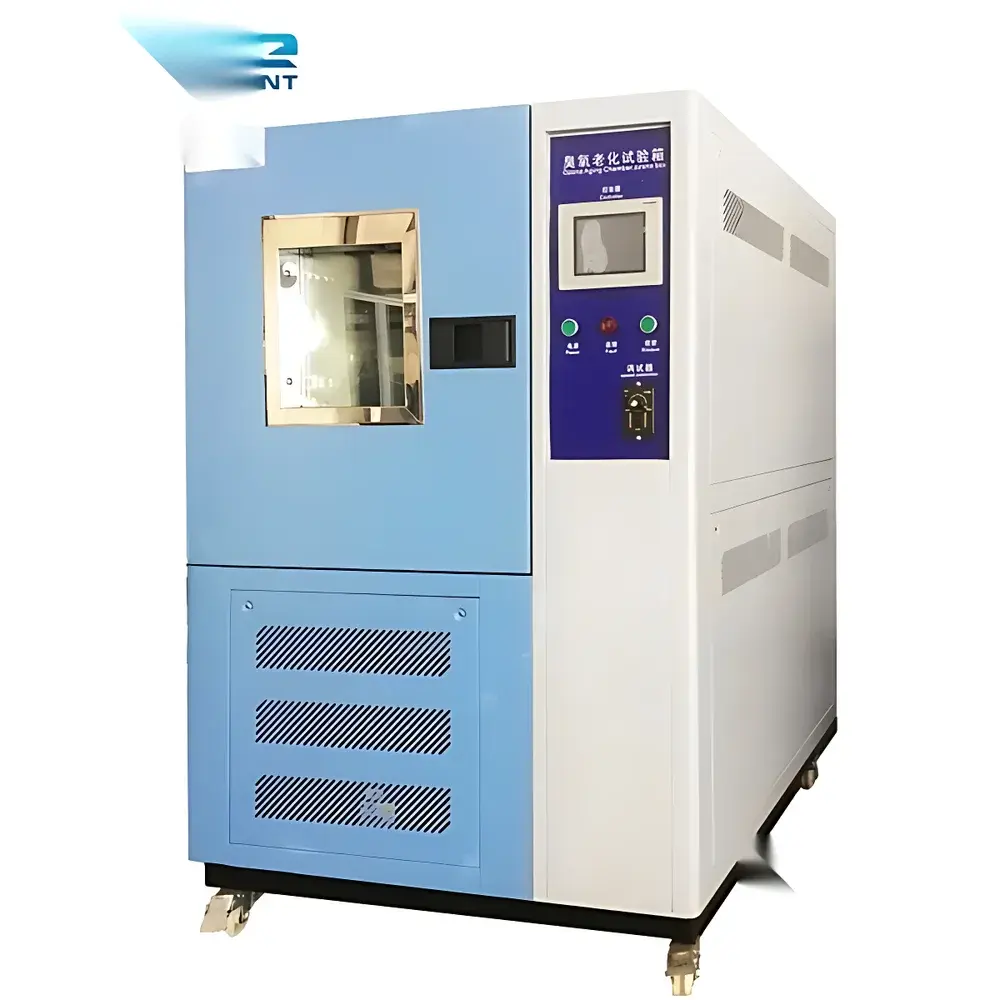
Ozone Aging Test Chamber – QY Series (Customizable Environmental Test Chamber for Rubber & Elastomer Degradation Assessment)
| Brand | Other Brands |
|---|---|
| Origin | Imported |
| Manufacturer Type | Authorized Distributor |
| Ozone Concentration Range | 50–1500 ppm (pphm) |
| Temperature Range | 25–40 °C |
| Humidity Range | 30–65 % RH |
| Temp. Uniformity | ±0.5 °C |
| Sample Rack | 360° Rotational (1 rpm), Static or Dynamic Mode Optional |
| Ozone Generation | Silent Discharge Tube |
| Ozone Detection | Nondispersive UV Absorption Analyzer (≥5 yr lifespan) |
| Control System | Weilun Color Touchscreen + Siemens PLC |
| Output/Interface | 4–20 mA analog output, RS232 communication port |
| Safety Protection | Leakage current, short-circuit, overtemperature, motor overheat, and overcurrent protection |
| Power Supply | AC 380 V ±5 %, 50 Hz ±0.5 Hz |
Overview
The QY Series Ozone Aging Test Chamber is an engineered environmental test system designed to evaluate the ozone resistance of rubber compounds, elastomers, and non-metallic polymeric materials under controlled atmospheric conditions. Based on the principle of accelerated oxidative degradation—where ozone (O₃) selectively attacks unsaturated carbon–carbon double bonds in vulcanized rubber—the chamber replicates long-term atmospheric aging in a condensed timeframe. This mechanism induces surface micro-cracking (ozone cracking), enabling quantitative assessment of material formulation robustness against ambient ozone exposure. The system operates within a fully sealed, recirculating gas loop, eliminating operator exposure and ensuring regulatory compliance with occupational safety standards (e.g., OSHA 29 CFR 1910.1200). Its design adheres to key international test methodologies including ASTM D1149, ISO 1431-1, and GB/T 7762—standards widely referenced in automotive, aerospace, cable, and sealing component qualification protocols.
Key Features
- Stainless steel test chamber constructed to ASTM-compliant dimensional tolerances and corrosion-resistant finish, ensuring long-term integrity during repeated ozone exposure cycles.
- High-stability silent discharge ozone generator with precise concentration control across 50–1500 ppm (pphm), calibrated traceably to NIST-traceable reference standards.
- Nondispersive ultraviolet (UV) absorption ozone analyzer integrated into the closed-loop gas circuit, providing continuous, real-time monitoring with ≥5-year operational lifespan and minimal drift (<±2% FS/year).
- Programmable rotational sample rack (1 rpm, 360° continuous rotation) engineered to follow cycloidal trajectory principles—ensuring uniform strain distribution per ASTM D1149 Annex A2 for dynamic testing.
- Dual-parameter PID auto-tuning controller managing both temperature (25–40 °C, ±0.5 °C stability) and relative humidity (30–65% RH), with independent setpoint programming and ramp/soak profiles.
- Comprehensive safety architecture: redundant thermal cutoffs, ground-fault interrupters, ozone leak detection interlocks, and fail-safe exhaust purge sequencing upon fault detection.
- Modular chamber configurations (QY-80 to QY-1000) support customizable internal dimensions (40×50×40 cm to 100×100×100 cm), accommodating full-size automotive hoses, gaskets, or multi-specimen test arrays.
Sample Compatibility & Compliance
The QY Series accommodates flat sheet specimens (ASTM D1149 Type A/B), dumbbell-shaped tensile strips (ISO 1431-1), and molded components up to 100 cm in longest dimension. Fixturing supports both static (zero-strain) and dynamic (controlled elongation) test modes—critical for differentiating inherent polymer resistance versus service-induced stress cracking. All models meet essential requirements for GLP-compliant laboratories: audit-trail-capable event logging, user-access-level management (admin/operator), and electronic signature readiness per FDA 21 CFR Part 11 when paired with validated software. Calibration documentation includes as-delivered ozone concentration linearity verification (±3% accuracy across full range) and temperature/humidity sensor NIST-traceable certificates.
Software & Data Management
Embedded Weilun HMI touchscreen interface provides intuitive parameter setup, real-time graphing of ozone concentration, temperature, and humidity trends, and automated cycle reporting. Data export is supported via USB and RS232 serial interface in CSV format for integration with LIMS or statistical process control (SPC) platforms. Optional PC-based software enables advanced functionality: multi-chamber synchronization, custom pass/fail logic scripting, automatic report generation (PDF/Excel), and historical data trending with statistical summary (mean, SD, min/max over time). All system logs—including alarm events, calibration actions, and user logins—are timestamped, immutable, and exportable for regulatory review.
Applications
- Qualification of EPDM, NR, SBR, CR, and IIR compounds used in automotive weatherstrips, brake hoses, and engine mounts.
- QC release testing for rubber seals in medical devices and pharmaceutical packaging where ozone-induced embrittlement compromises barrier integrity.
- Formulation R&D for halogen-free flame-retardant elastomers requiring extended outdoor service life.
- Failure analysis of field-return components exhibiting premature cracking—correlating lab-induced crack morphology with real-world exposure history.
- Supporting ISO/TS 16949 and IATF 16949 process validation through documented repeatability (RSD <2.5% for crack initiation time across three consecutive runs).
FAQ
What ozone concentration accuracy is guaranteed across the 50–1500 ppm range?
Calibration is performed at five points (50, 250, 500, 1000, 1500 ppm) using certified ozone standard gas; accuracy is ±3% of reading with linearity deviation <±1.5% FS.
Is dynamic testing compliant with ASTM D1149 Section 7.2?
Yes—the 360° rotational rack maintains constant angular velocity (1 rpm) and meets the specified cycloidal motion envelope for Type B dynamic fixtures.
Can the chamber be integrated into a central laboratory monitoring network?
RS232 and optional Ethernet (with firmware upgrade) enable Modbus RTU/TCP communication for SCADA or building management system (BMS) integration.
What maintenance intervals are recommended for the UV ozone sensor?
No routine optical cleaning is required; annual verification against traceable standard gas is advised per ISO/IEC 17025 quality system requirements.
Does the system include validation documentation for GMP environments?
Factory-issued IQ/OQ documentation is provided; PQ protocol templates aligned with Annex 15 and ASTM E2500 are available upon request.



