
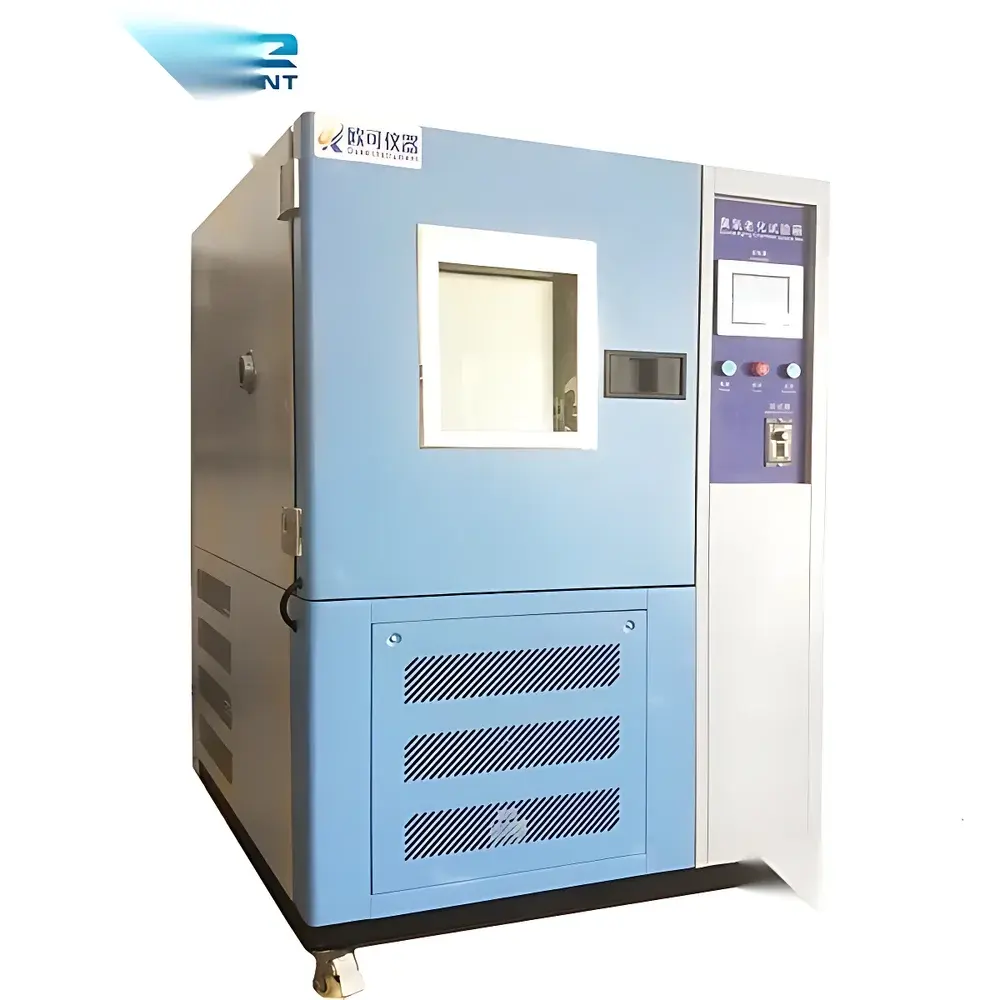
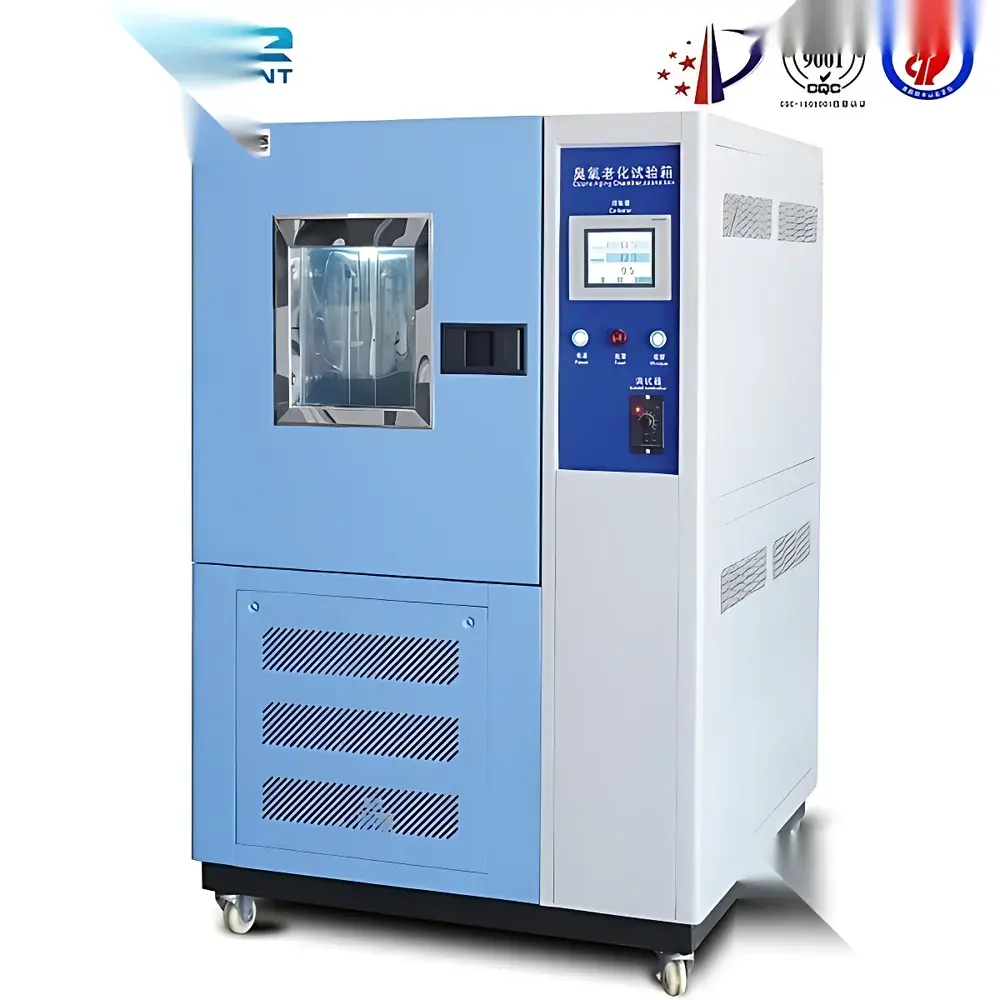
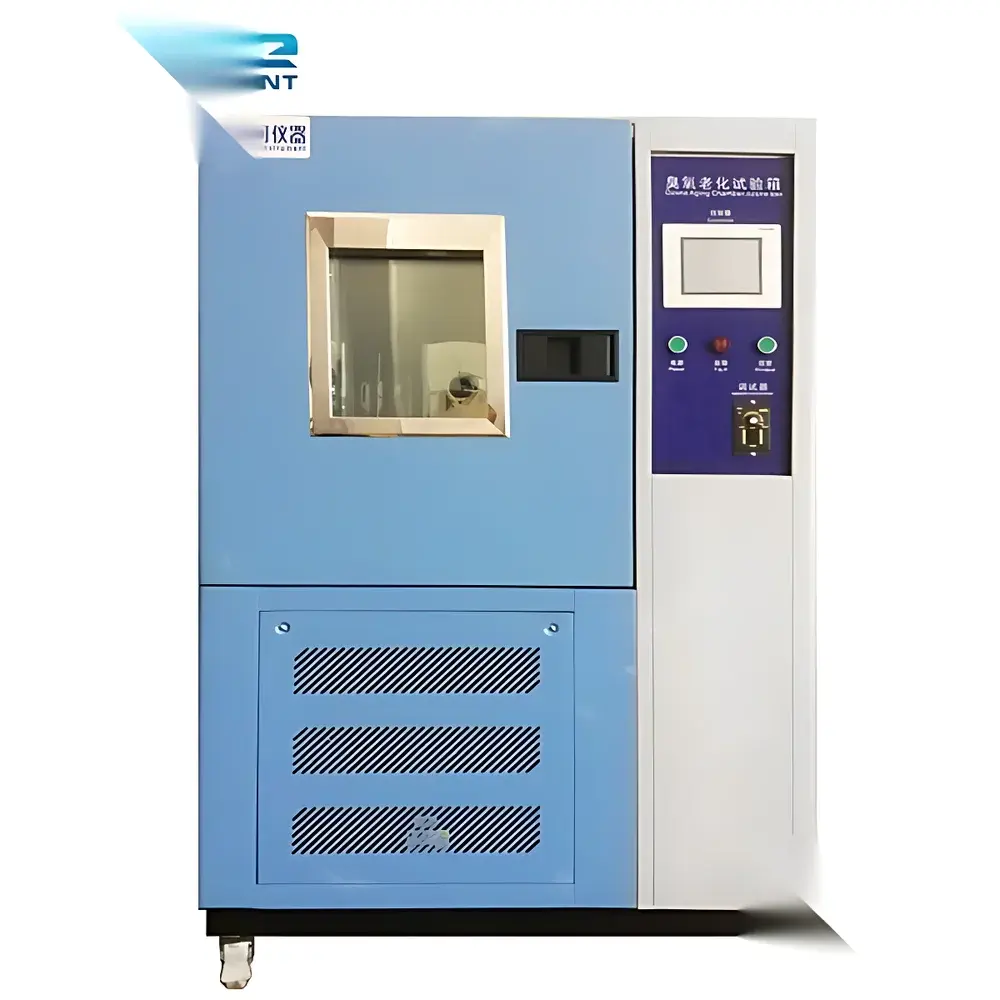
Ozone Aging Test Chamber – QY Series (Customizable Volume Models: QY-80 to QY-1000)
| Key Features | Stainless steel test chamber |
|---|
Overview
The Ozone Aging Test Chamber – QY Series is an engineered environmental test system designed to accelerate and quantify ozone-induced degradation in elastomeric materials under controlled, reproducible conditions. Based on the well-established principle of ozone cracking—where atmospheric ozone (O₃) selectively attacks unsaturated carbon–carbon double bonds in natural rubber, SBR, NBR, and other diene-based polymers—the chamber replicates and intensifies real-world oxidative stress mechanisms. Unlike general-purpose environmental chambers, this instrument integrates a precision ozone generation and monitoring subsystem with tightly regulated thermal and humidity parameters, enabling standardized evaluation of material resistance to ozone aging per internationally recognized test protocols. Its sealed gas recirculation architecture ensures operator safety while maintaining stable, traceable ozone concentrations throughout extended exposure cycles—critical for GLP-compliant material qualification and formulation development.
Key Features
- Corrosion-resistant 316 stainless steel test chamber with full gasket sealing and interlocked access door for operational integrity and personnel safety.
- Silent discharge ozone generator using high-efficiency ceramic dielectric tubes, delivering stable output across the full 50–1500 ppm (pphm) range without nitrogen purge requirements.
- Non-dispersive ultraviolet (ND-UV) ozone analyzer with dual-beam optical path; factory-calibrated, drift-compensated, and rated for ≥5 years continuous operation with minimal maintenance.
- Dynamic sample rack driven by brushless DC motor: precisely controlled at 1 rpm with mechanical linkage engineered to produce true cycloidal motion—ensuring uniform strain distribution during static or dynamic stretching per ISO 1431-1.
- Integrated climate control system: German Siemens S7-1200 PLC paired with Weinview 7-inch color touchscreen HMI; supports auto-tuning PID loops for temperature (25–40 °C) and relative humidity (30–65% RH).
- Comprehensive safety architecture: redundant overtemperature cutoff, ozone leak detection via pressure differential monitoring, motor thermal overload protection, and ground-fault interrupter (GFI) on AC input.
- Calibration-ready design: dedicated metrology port enables third-party verification of ozone concentration and temperature uniformity per ISO/IEC 17025 requirements.
Sample Compatibility & Compliance
The QY Series accommodates standard ASTM D1149 and ISO 1431-1 test specimens—including dumbbell-shaped tensile strips, molded rings, and extruded profiles—mounted on adjustable fixtures compatible with both static extension (e.g., 20% strain) and dynamic flexing modes. Chamber internal dimensions are modularly scalable (QY-80 to QY-1000), allowing validation of large-format components such as automotive hoses, conveyor belts, or cable jackets. The system fully complies with GB/T 7762–2003, GB/T 2951.21–2008, GB/T 11206–2009, and ISO 1431-1:2004. All electrical and gas-handling subsystems meet IEC 61000-6-2 (EMC immunity) and IEC 61000-6-4 (EMC emissions) standards. Optional documentation packages support FDA 21 CFR Part 11 audit trails and GMP-aligned validation protocols (IQ/OQ/PQ).
Software & Data Management
The embedded control firmware logs all critical process variables—including real-time ozone concentration (pphm), chamber temperature (°C), relative humidity (%RH), elapsed test time, and rack position—at user-configurable intervals (1 s to 10 min). Data export is supported via USB mass storage or RS232 serial link in CSV format, compatible with LIMS integration and statistical analysis tools (e.g., JMP, Minitab). The HMI interface provides graphical trend displays with zoom/pan functionality, alarm history with timestamped event codes, and password-protected parameter lockout for SOP enforcement. Firmware updates are performed offline via SD card to maintain regulatory compliance continuity.
Applications
This chamber serves laboratories engaged in polymer R&D, quality assurance, and regulatory submission support. Typical use cases include: comparative screening of antiozonant additives (e.g., p-phenylenediamine derivatives); lifetime prediction modeling for rubber seals in aerospace hydraulics; validation of vulcanization recipes for EPDM roofing membranes; failure analysis of cracked tire sidewalls; and accelerated aging studies supporting ISO 13443 certification for medical-grade elastomers. Its ability to decouple ozone dose from thermal/humidity variables makes it indispensable for mechanistic studies of oxidative chain scission kinetics.
FAQ
What ozone concentration accuracy is achievable across the 50–1500 ppm range?
The ND-UV sensor maintains ±3% full-scale accuracy after initial calibration; daily zero checks using ambient air are recommended for long-term stability.
Can the chamber be validated for ISO/IEC 17025 accreditation?
Yes—its metrology port, documented uncertainty budget (available upon request), and traceable calibration certificates enable third-party validation per ISO/IEC 17025 clause 6.4.
Is dynamic testing compliant with ISO 1431-1 Annex A?
Affirmative—the cycloidal motion profile and 1 rpm rotational speed satisfy the kinematic requirements specified in Annex A for dynamic ozone exposure.
Does the system support unattended operation for 72+ hour tests?
Yes—integrated watchdog timers, battery-backed real-time clock, and non-volatile data logging ensure uninterrupted execution and data integrity over multi-day cycles.
Are spare parts and service support available outside China?
Global technical support and certified spare modules (ozone sensor, discharge tube, PLC I/O cards) are distributed through authorized partners in EU, NA, and APAC regions under 24-month warranty coverage.



