
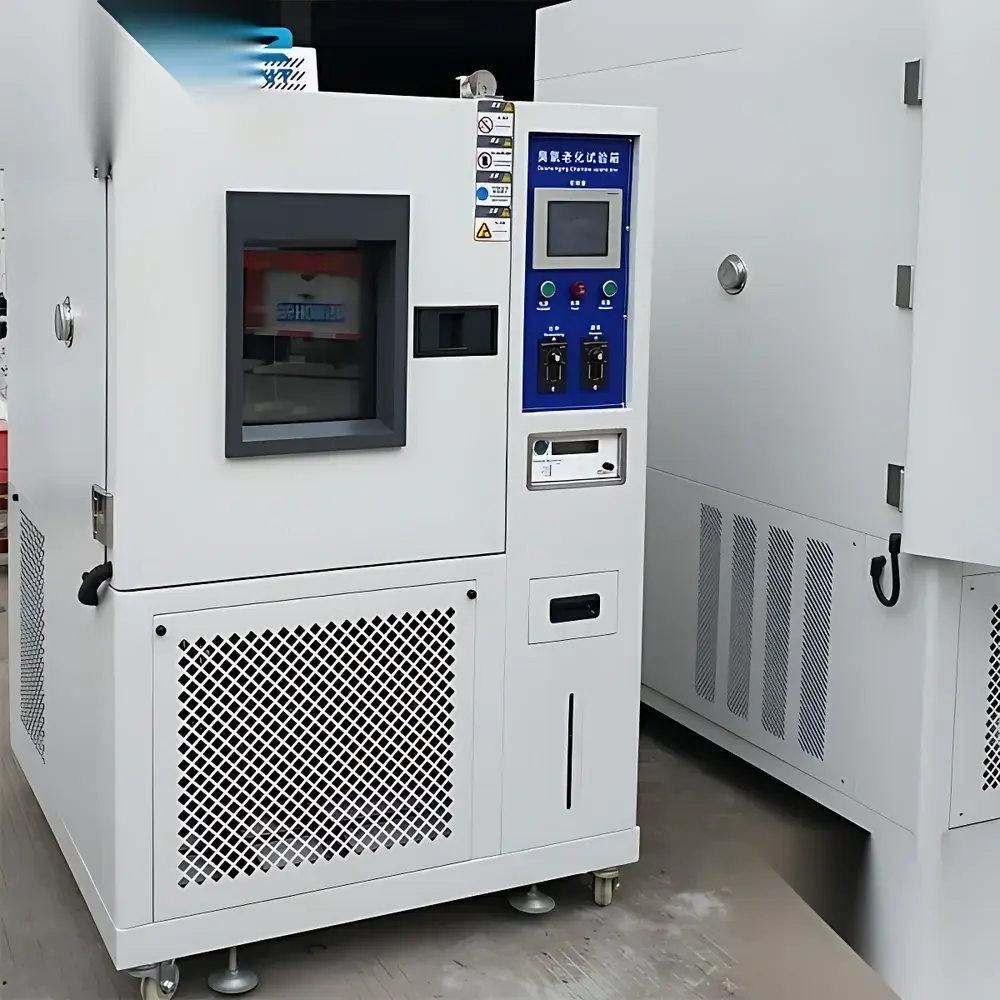
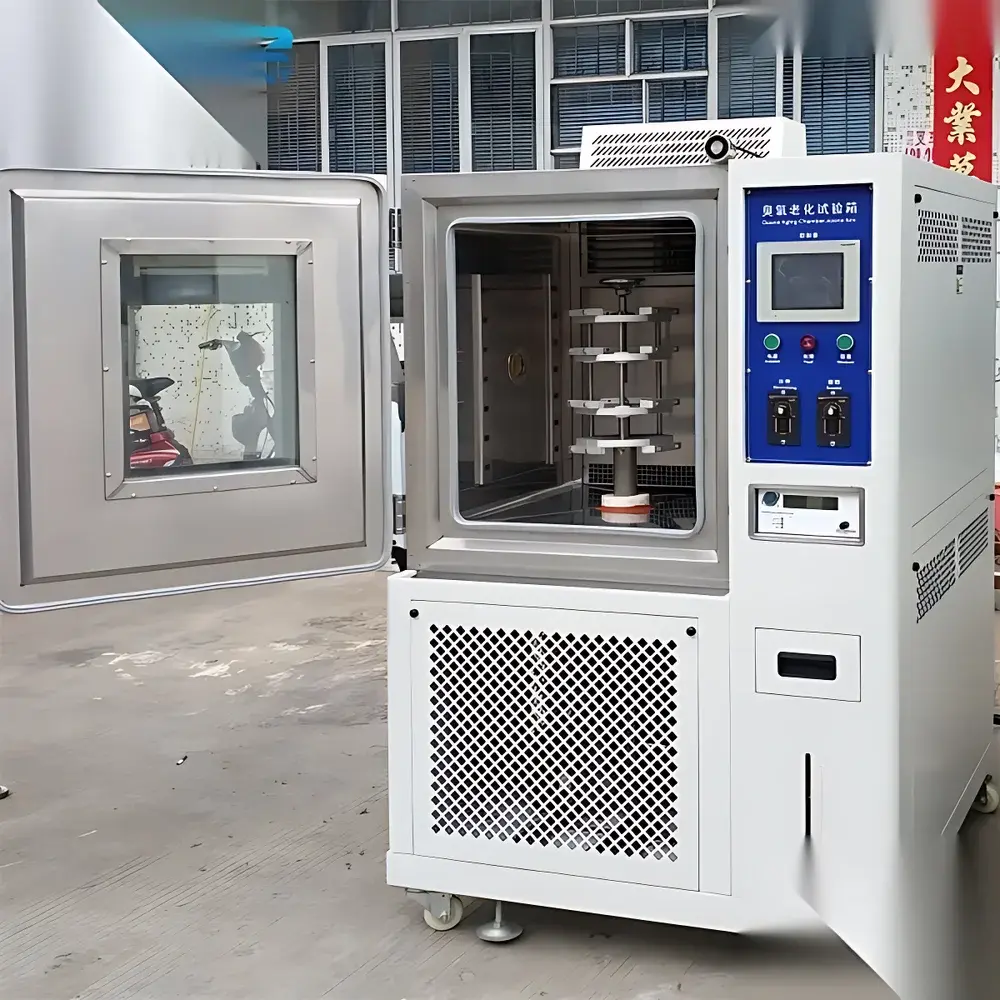
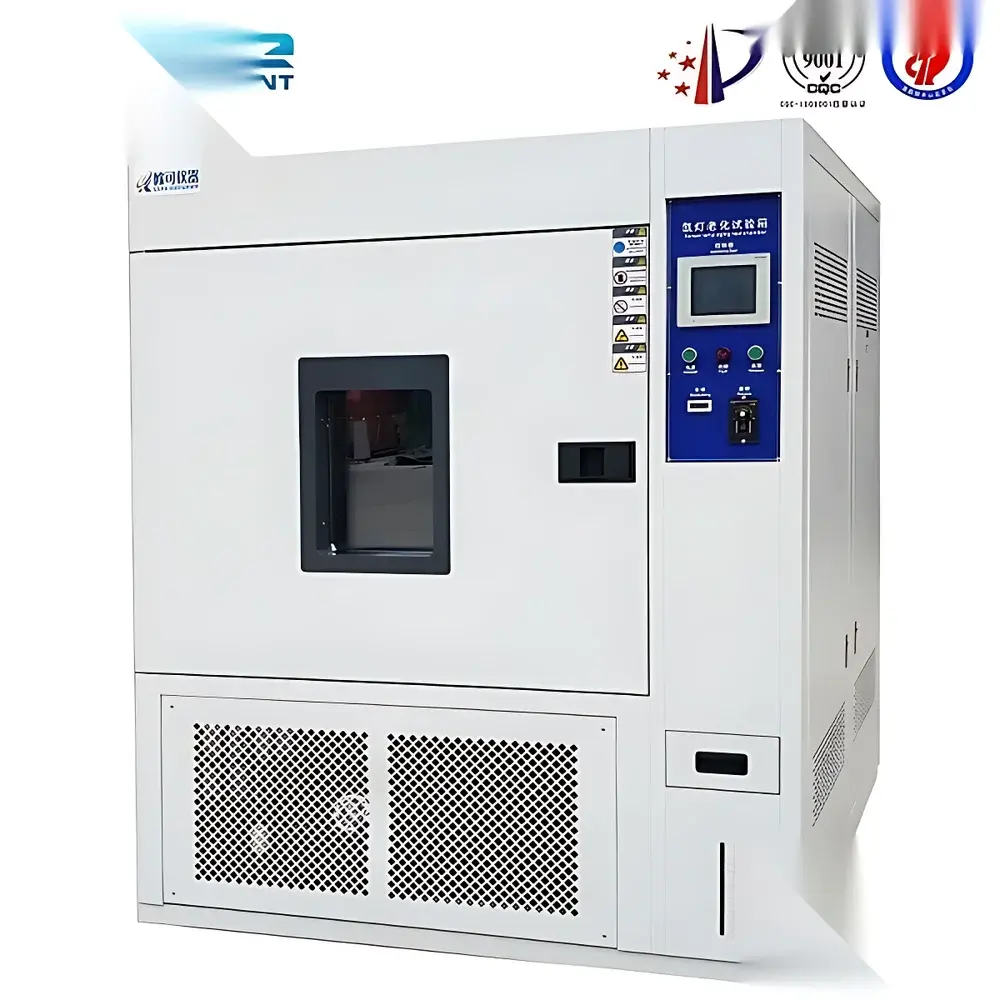
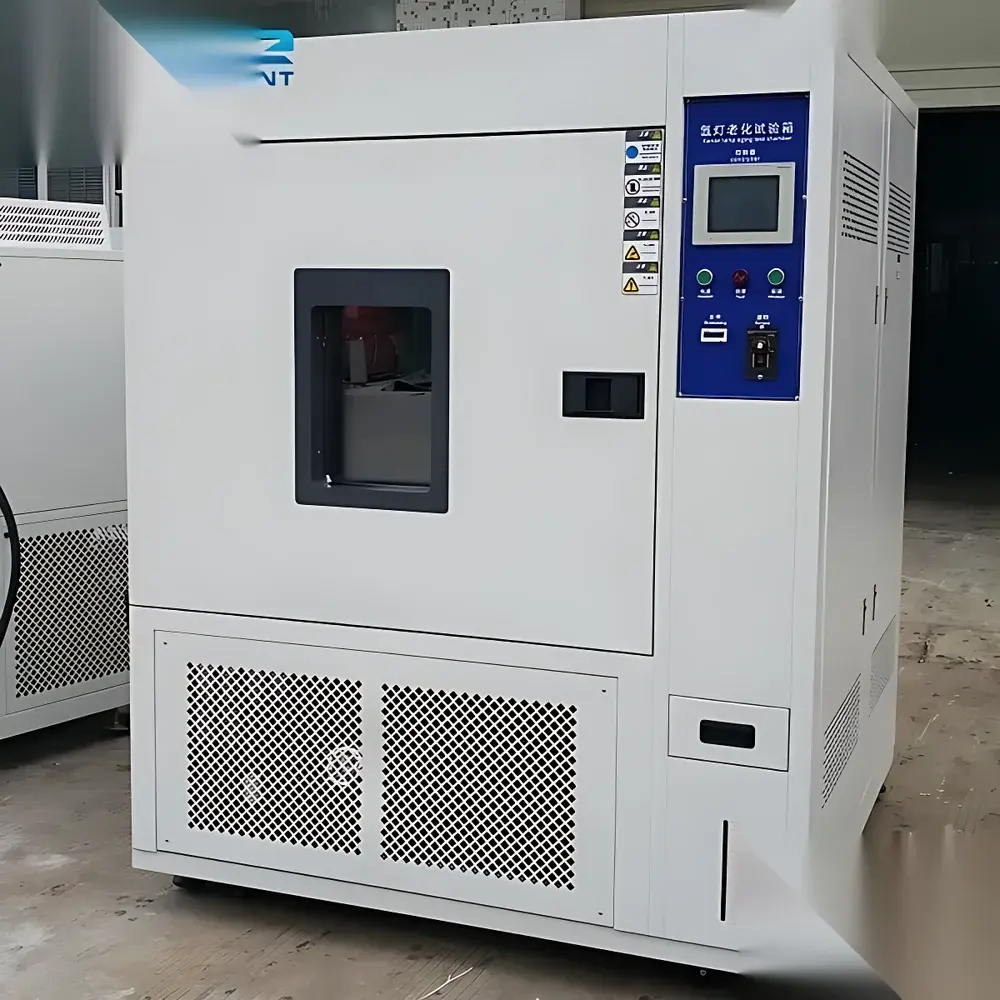
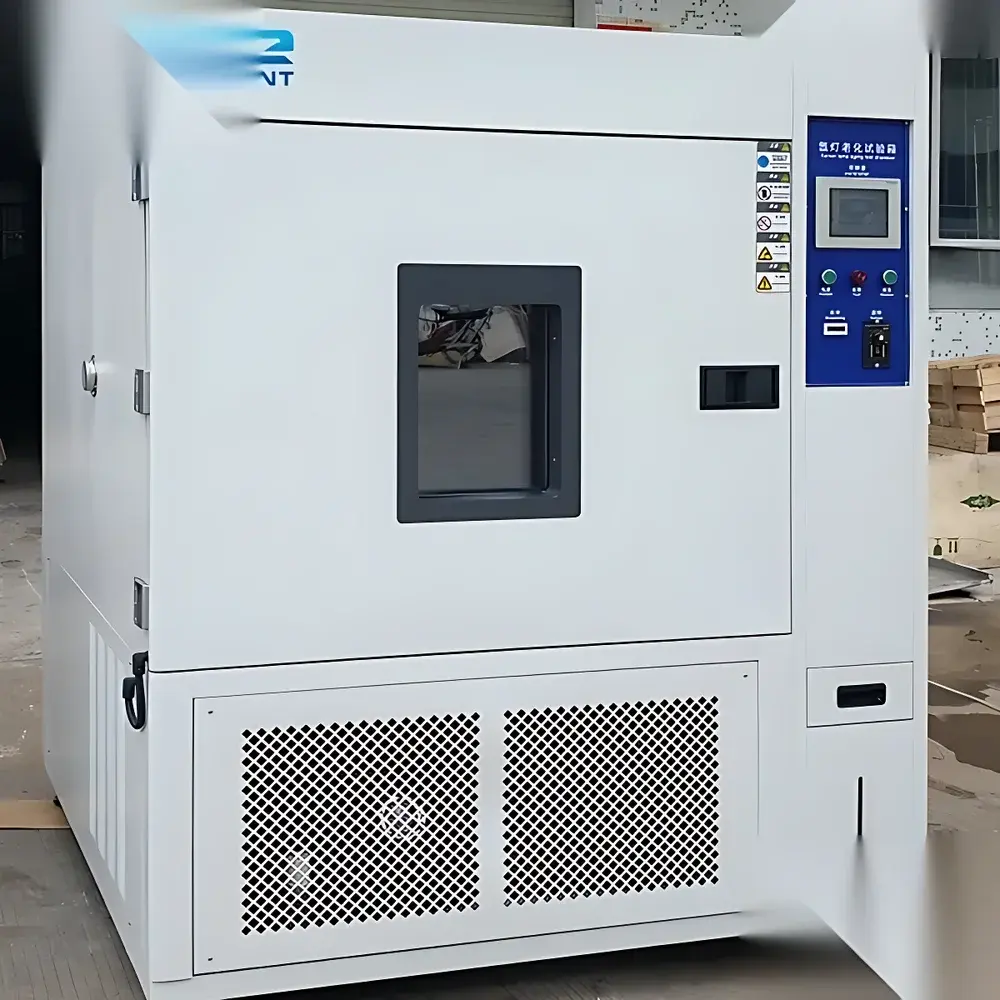
Ozone Aging Test Chamber QY-Series – Environmental Test Chamber for Rubber & Elastomer Durability Assessment
| Key | Brand: OEM / Custom-Built |
|---|---|
| Origin | Imported |
| Manufacturer Type | Authorized Distributor |
| Price | USD 6,300 (FOB) |
| Chamber Volume | 80 L / 225 L / 500 L / 1000 L |
| Internal Dimensions (W×H×D, cm) | 40×50×40 |
| External Dimensions (W×H×D, cm) | 100×170×90 |
| Temperature Range | 25–40 °C |
| Temp. Uniformity | ±0.5 °C |
| Humidity Range | 30–65 % RH |
| Ozone Concentration Range | 50–1500 pphm |
| Ozone Generation Method | Silent Discharge Tube |
| Ozone Monitoring | Imported UV Absorption Analyzer with 4–20 mA Output & RS232 Interface |
| Sample Rack | Motor-Driven, 360° Continuous Rotation (1 rpm), Cycloidal Trajectory Compliance |
| Gas Flow Velocity | 8–16 mm/s |
| Control System | Weintek Color Touchscreen + Siemens S7-1200 PLC |
| Safety Protections | Leakage Current, Short-Circuit, Over-Temperature, Motor Overheat, Over-Current |
| Power Supply | AC 380 V ±5 %, 50 Hz ±0.5 Hz |
Overview
The QY-Series Ozone Aging Test Chamber is an engineered environmental test system designed to accelerate and quantify ozone-induced degradation in rubber compounds, elastomers, and polymer-based seals, gaskets, and insulation materials. It operates on the principle of controlled atmospheric simulation—generating precise, stable ozone concentrations (50–1500 pphm) within a sealed stainless-steel reaction chamber while maintaining tightly regulated temperature (25–40 °C) and relative humidity (30–65 % RH). Unlike ambient exposure testing—which may require months or years—the QY chamber enables accelerated aging under standardized conditions aligned with ASTM D1149, ISO 1431-1, and GB/T 7762. The system employs silent discharge ozone generation, eliminating nitrogen oxide byproducts and ensuring chemical fidelity in oxidative stress simulation. Its closed-loop gas circulation architecture prevents operator exposure and supports repeatable, traceable test execution—critical for QC laboratories operating under GLP or ISO/IEC 17025 frameworks.
Key Features
- Stainless-steel test chamber with full-seal gas recirculation path, compliant with ISO 1431-1 chamber integrity requirements
- Precision ozone concentration control via imported UV absorption analyzer (4–20 mA analog output + RS232 digital interface) enabling real-time logging and external SCADA integration
- Motor-driven sample rack with programmable 360° continuous rotation at 1 rpm, engineered to replicate cycloidal motion per ASTM D1149 Annex A2 for dynamic strain application
- Integrated PID auto-tuning temperature/humidity controller using Siemens S7-1200 PLC and Weintek color touchscreen HMI—supporting multi-step profile programming and password-protected parameter access
- Dedicated metrology port for third-party calibration verification; all ozone generation, distribution, and decomposition occur within the sealed loop—no venting or ambient bleed required
- Comprehensive safety architecture including earth-leakage protection, thermal cutoffs at critical nodes (chamber wall, ozone generator, motor driver), and overcurrent monitoring on all high-voltage circuits
Sample Compatibility & Compliance
The QY-Series accommodates standard dumbbell specimens (ASTM D412), ring-shaped elastomer samples (ISO 1431-1), and custom-sized components up to 100 cm × 100 cm × 100 cm (QY-1000 model). Chamber geometry ensures uniform ozone distribution (validated via tracer gas mapping per ISO 1431-2 Annex B) and laminar flow across specimen surfaces. All models are supplied with CE-marked electrical systems and conform to IEC 61000-6-2 (immunity) and IEC 61000-6-4 (emissions). Optional validation packages include IQ/OQ documentation templates compliant with FDA 21 CFR Part 11 electronic record requirements, supporting audit readiness for pharmaceutical packaging or automotive Tier-1 supplier labs.
Software & Data Management
No proprietary cloud platform is embedded. Instead, the system outputs time-synchronized analog (4–20 mA) and digital (RS232 ASCII protocol) signals for ozone concentration, temperature, humidity, and elapsed test time—compatible with LabVIEW, MATLAB, or enterprise LIMS via standard serial-to-Ethernet gateways. On-device data logging retains 30 days of 1-second interval records (configurable), accessible via USB export. Audit trails—including user login events, setpoint changes, and alarm triggers—are timestamped and non-erasable per GLP Annex 11 principles. Calibration certificates for ozone sensor and PT100 probes are provided with NIST-traceable references.
Applications
- Accelerated evaluation of antiozonant efficacy in natural rubber (NR), styrene-butadiene rubber (SBR), and ethylene propylene diene monomer (EPDM)
- Qualification of rubber seals used in aerospace hydraulic systems per SAE AS5678
- Comparative aging studies for medical device tubing (ISO 10993-12) and cable jacketing (IEC 60811-501)
- Validation of vulcanization process stability across production batches
- Supporting root-cause analysis of field failures linked to ozone cracking in automotive weatherstripping
FAQ
What ozone concentration accuracy is guaranteed across the 50–1500 pphm range?
The UV absorption analyzer delivers ±5 pphm absolute accuracy at low concentrations (≤200 pphm) and ±3 % of reading above 200 pphm, verified annually per ISO/IEC 17025-accredited calibration procedures.
Can the chamber operate continuously for extended validation runs (e.g., 168 hours)?
Yes—thermal management and ozone generator duty cycle are engineered for uninterrupted operation at 40 °C / 1500 pphm for ≥200 hours, with automatic shutdown triggered only upon safety interlock activation.
Is static strain testing supported without sample rotation?
Static mode is available as factory-configurable firmware option; users may disable motor drive and fix specimens on stationary racks meeting ISO 1431-1 mounting specifications.
How is ozone decommissioned after testing?
Residual ozone is catalytically decomposed inline via heated manganese dioxide beds before gas re-entry into the circulation loop—no external scrubbers or exhaust ducting required.
Do you supply installation and operational qualification (IQ/OQ) support?
Yes—qualified field engineers provide on-site mechanical commissioning, sensor verification, and protocol execution per user-defined SOPs; documentation aligns with EU GMP Annex 15 and ASTM E2500-13 guidelines.



