
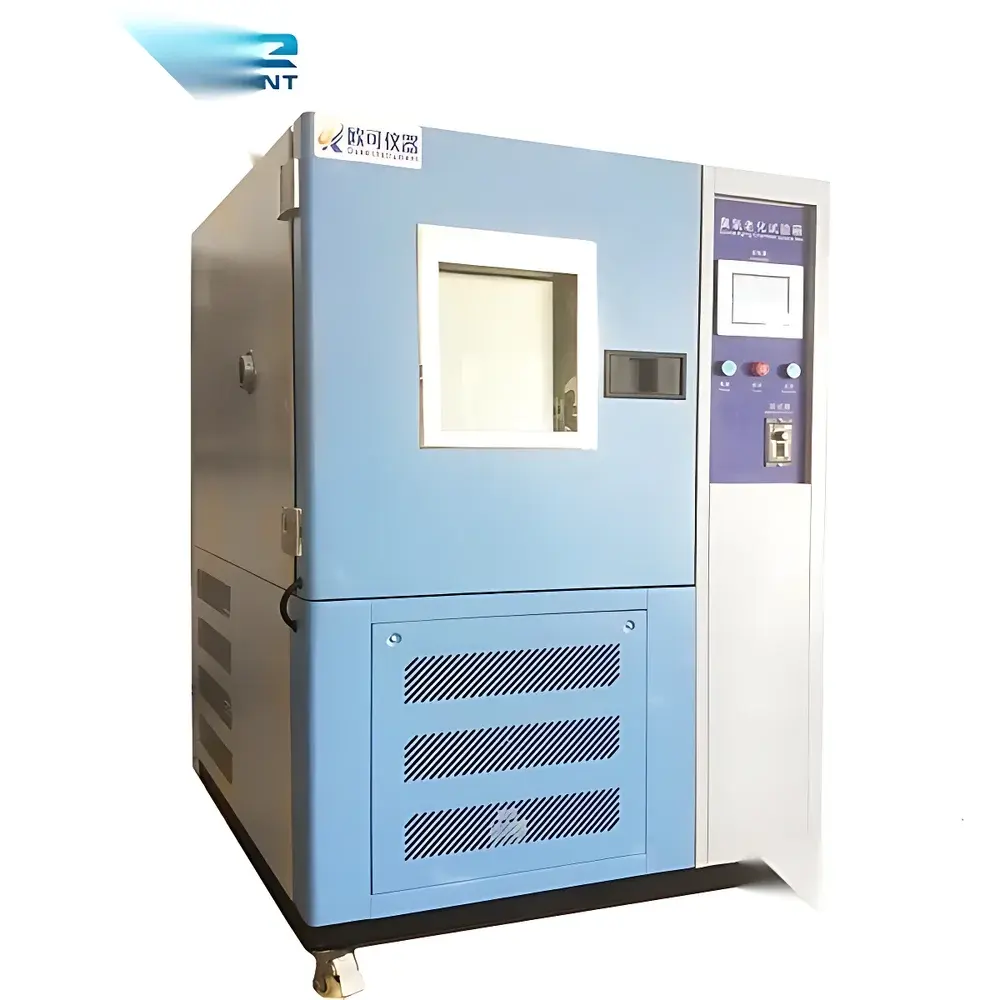
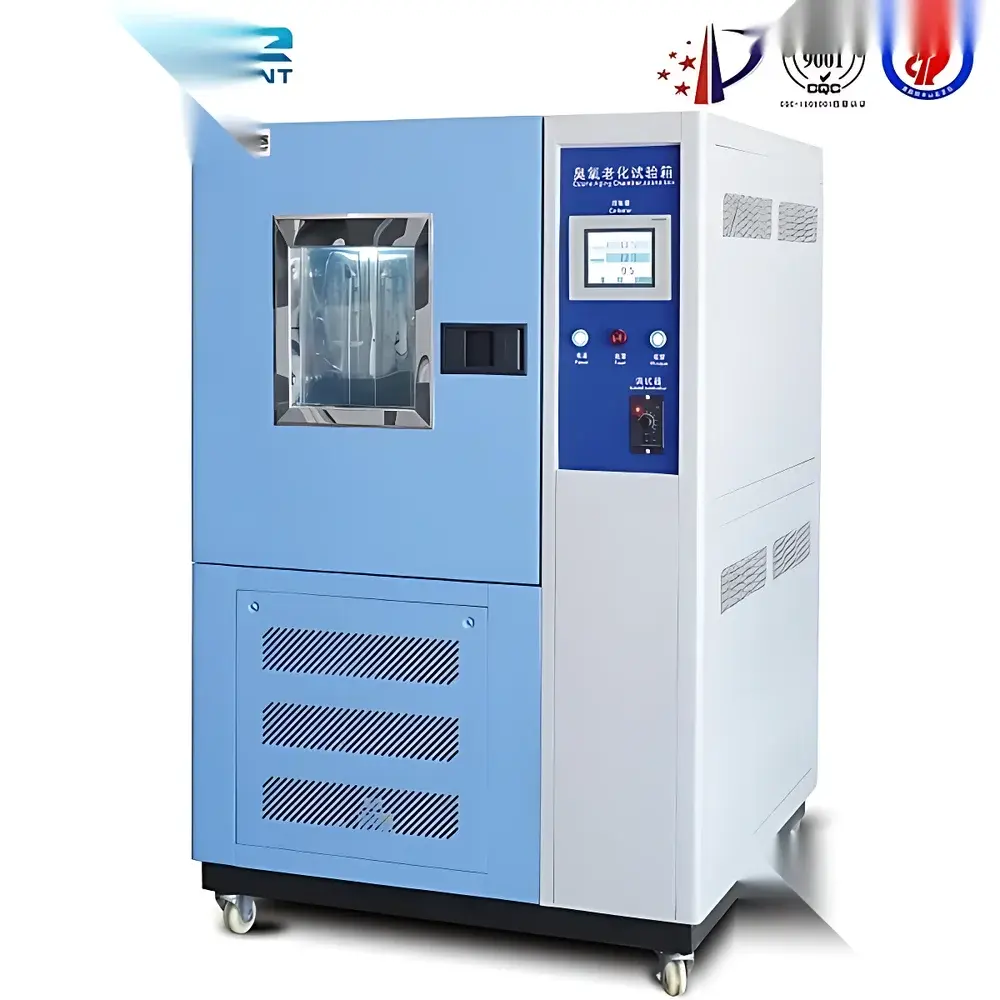
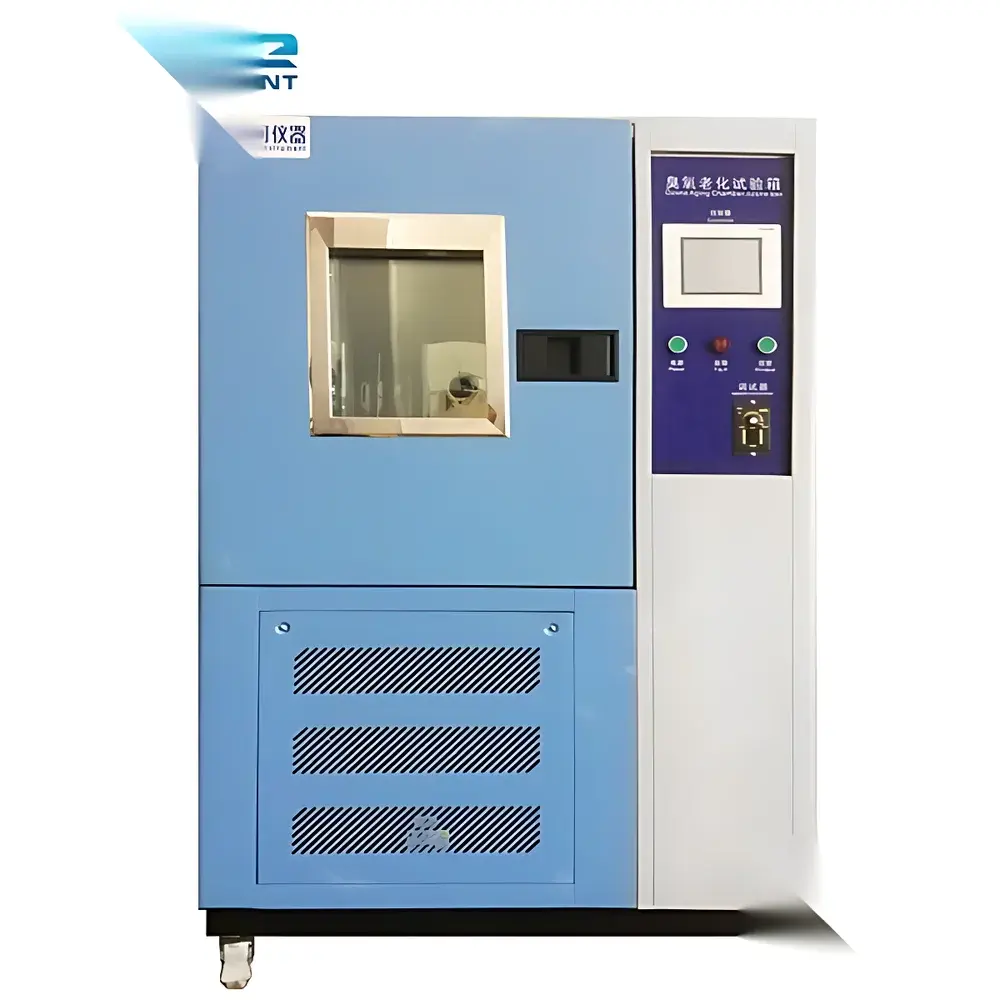
Ozone Aging Test Chamber – QY Series (Static & Dynamic Stretching Mode) with Rotating Sample Rack
| Key Features | Stainless steel test chamber |
|---|---|
| Humidity control | 30–65% RH |
| Rotating sample rack | 1 rpm, 360° continuous rotation |
| Gas flow velocity | 8–16 mm/s |
| Compliant with GB/T 7762-2003, GB/T 2951.21-2008, GB/T 11206-2009, ISO 1431-1 | 2004 |
| Electrical supply | AC 380 V ±5%, 50 Hz ±0.5 Hz |
Overview
The QY Series Ozone Aging Test Chamber is an engineered environmental simulation system designed to evaluate the resistance of elastomeric materials—particularly vulcanized rubber compounds—to oxidative degradation induced by atmospheric ozone. Unlike general-purpose climate chambers, this instrument implements a closed-loop, recirculating gas circuit that generates and maintains precise ozone concentrations (50–1500 ppm) via silent discharge technology, eliminating external ozone leakage and ensuring operator safety. The chamber integrates both static tensile stress application and dynamic rotational stretching modes, enabling standardized evaluation per ASTM D1149 (equivalent to ISO 1431-1), where specimens are subjected to controlled mechanical strain while exposed to defined ozone environments. This dual-mode capability supports accelerated aging protocols essential for R&D labs, quality assurance departments, and compound formulators seeking quantitative correlation between material composition, protective additive efficacy (e.g., antiozonants), and service life prediction under real-world atmospheric exposure.
Key Features
- Hermetically sealed stainless-steel test chamber compliant with ISO 1431-1:2004 dimensional and sealing requirements.
- Silent discharge ozone generator with stable output across full concentration range; no consumables or replacement lamps required.
- Non-dispersive ultraviolet (NDUV) ozone analyzer with onboard zero/span calibration function and ≥5-year operational lifetime—certified for continuous in-situ monitoring.
- Rotating sample rack driven by precision AC servo motor (1 rpm, 360° continuous rotation), engineered to replicate cycloidal motion profiles as specified in GB/T 7762-2003 for dynamic testing.
- Independent PID-controlled temperature regulation (25–40 °C, ±0.5 °C uniformity) and humidity management (30–65% RH) using calibrated capacitive sensors.
- Weinview color touchscreen HMI paired with Siemens S7-1200 PLC for deterministic logic execution, data logging, and multi-parameter setpoint synchronization.
- Integrated metrology interface for third-party traceable calibration; all ozone generation, distribution, and sensing occurs within a fully enclosed, leak-tested loop.
Sample Compatibility & Compliance
The QY chamber accommodates standard dumbbell-shaped specimens (Type 1 or Type 2 per ISO 37), strip samples (up to 100 cm length), and molded parts mounted on custom fixtures. Static tensile loading utilizes calibrated spring-loaded clamps delivering fixed elongation (typically 10–30%), while dynamic mode employs synchronized rotation to induce cyclic surface strain without slippage. All configurations meet mandatory safety provisions of IEC 61000-6-2 (EMC immunity) and EN 61000-6-4 (emission limits). Regulatory alignment includes full documentation support for GLP-compliant laboratories: audit trails, user access levels, electronic signatures, and 21 CFR Part 11–ready data export (CSV/Excel) with timestamped metadata. Validation packages—including IQ/OQ protocols and as-built schematics—are available upon request.
Software & Data Management
Control firmware supports real-time plotting of ozone concentration, temperature, humidity, and elapsed test time. Historical datasets are stored locally on industrial-grade SD card (16 GB) with automatic rollover and password-protected archive encryption. Remote monitoring is enabled via Modbus TCP over Ethernet or optional Wi-Fi module. Exported logs include raw sensor values, control algorithm outputs (e.g., PID error terms), and alarm event timestamps—structured for direct ingestion into LIMS or statistical process control (SPC) platforms. Firmware updates are performed via USB stick with SHA-256 signature verification to ensure integrity.
Applications
- Accelerated evaluation of antiozonant performance in NR, SBR, BR, and EPDM formulations.
- Qualification of rubber seals, gaskets, and vibration isolators for automotive and aerospace OEMs.
- Comparative screening of sulfur-cured vs. peroxide-cured elastomers under identical ozone stress conditions.
- Correlation studies linking laboratory aging results to field failure data using Arrhenius-type models.
- Support for ISO 1431-2 (crack growth rate measurement) when coupled with optical crack detection accessories.
FAQ
What standards does this chamber validate against?
It fully satisfies the physical configuration, ozone generation method, and test condition requirements of ISO 1431-1:2004, GB/T 7762-2003, GB/T 2951.21-2008, and GB/T 11206-2009.
Can the chamber operate in static-only mode?
Yes—rotational drive can be disabled via software; static clamping fixtures are included as standard equipment.
Is ozone concentration traceably calibrated?
The NDUV sensor features a dedicated calibration port compatible with NIST-traceable ozone transfer standards; full calibration certificates are issued with each unit.
What maintenance intervals are recommended?
Ozone generator electrodes require cleaning every 6 months; UV lamp replacement is not applicable—the solid-state NDUV detector has no consumable optical components.
Does the system support automated pass/fail reporting?
Yes—user-defined crack thresholds (e.g., “first visible crack after 24 h at 200 ppm”) can trigger email/SMS alerts and generate PDF compliance reports with digital signature fields.



