
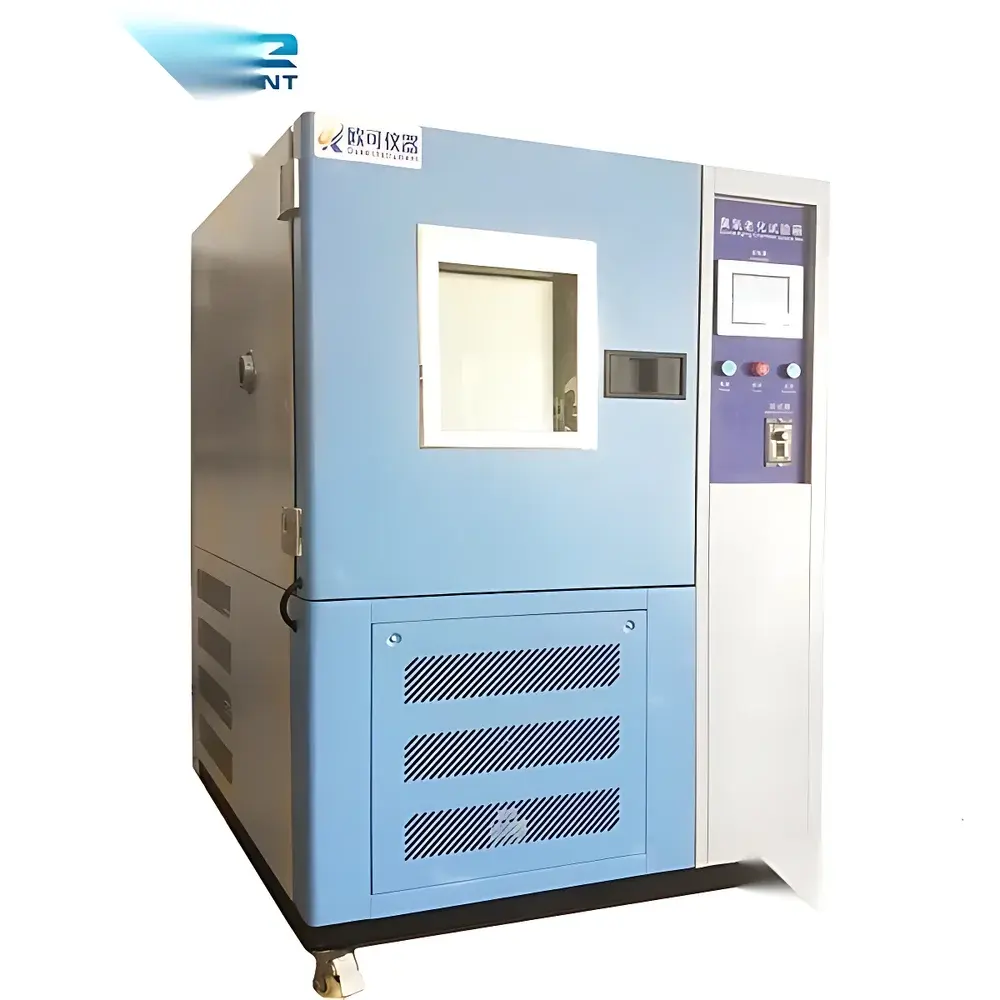
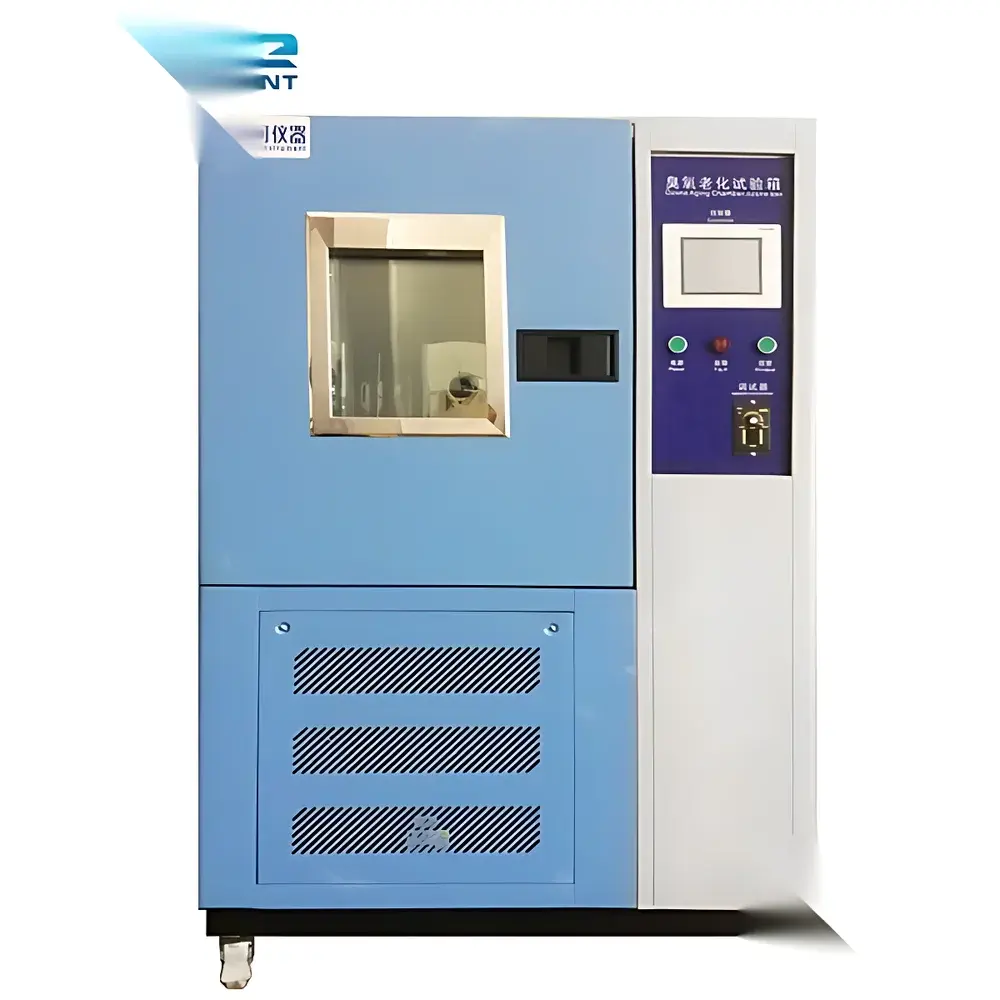
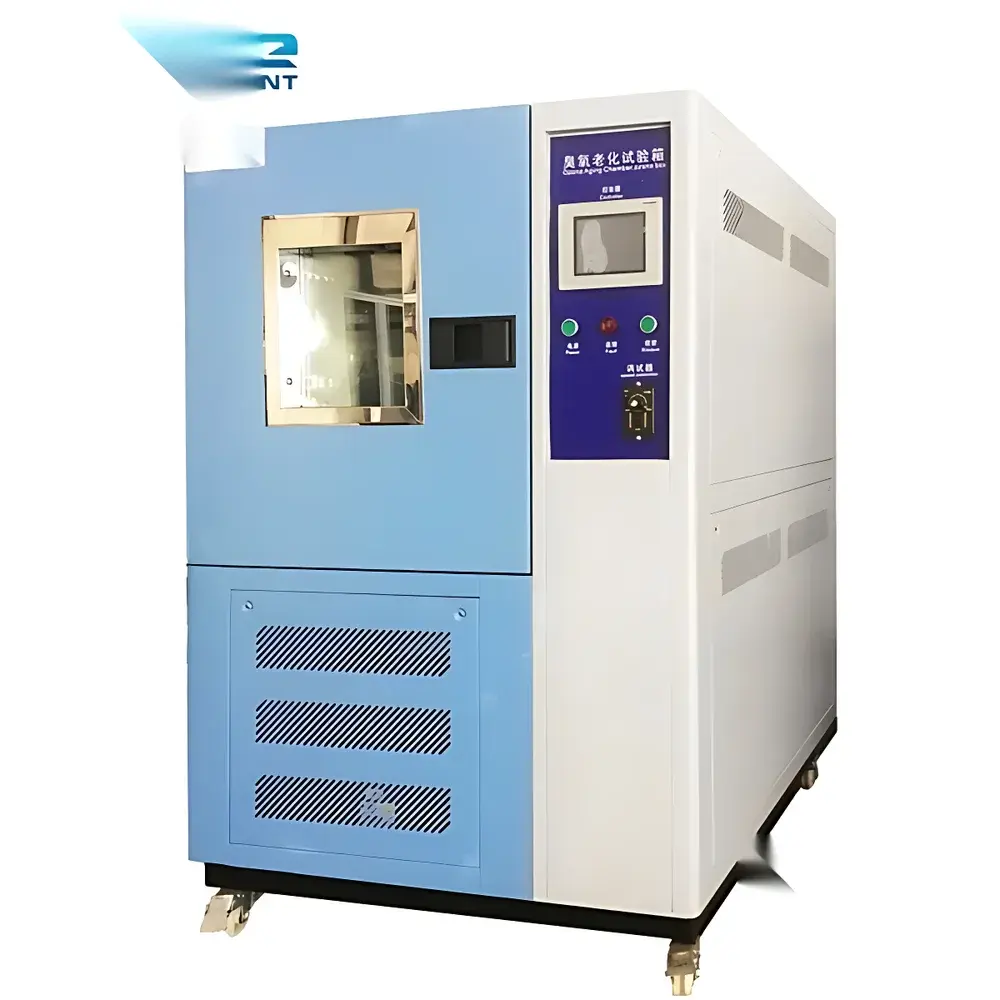
Ozone Aging Test Chamber for Rubber Cracking and Degradation Evaluation
| Brand | OEM / Custom Brand |
|---|---|
| Origin | Imported |
| Manufacturer Type | Authorized Distributor |
| Temperature Range | 25–40 °C |
| Humidity Range | 30–65 % RH |
| Ozone Concentration Range | 50–1500 pphm |
| Temperature Uniformity | ±0.5 °C |
| Sample Rack | 360° continuous rotation at 1 rpm |
| Gas Flow Velocity | 8–16 mm/s |
| Control System | Siemens PLC + Weintek color touchscreen HMI |
| Ozone Generation | Silent discharge tube |
| Ozone Detection | Non-dispersive UV absorption analyzer (≥5-year service life) |
| Compliance Standards | GB/T 7762–2003, GB/T 2951.21–2008, GB/T 11206–2009, ISO 1431-1:2004 |
Overview
The Ozone Aging Test Chamber for Rubber Cracking and Degradation Evaluation is a precision-engineered environmental test system designed to accelerate and quantify ozone-induced surface cracking in elastomeric materials under controlled atmospheric conditions. Ozone—though present at trace levels in ambient air (<0.1 ppm)—exerts disproportionate oxidative stress on unsaturated rubber polymers (e.g., natural rubber, SBR, BR), initiating chain scission and microcrack propagation perpendicular to applied strain. This chamber replicates and intensifies real-world ozone exposure by generating stable, traceable concentrations (50–1500 pphm) within a sealed stainless-steel reaction chamber, enabling standardized assessment of material resistance per internationally recognized test protocols. Its architecture integrates thermohygrometric control with dynamic mechanical conditioning—supporting both static tensile and rotating dynamic exposure modes—to differentiate between inherent polymer stability and the efficacy of antiozonant additives (e.g., p-phenylenediamine derivatives). The system is engineered for reproducibility, long-term calibration stability, and operator safety through fully enclosed gas circulation and fail-safe interlocks.
Key Features
- Electropolished 316 stainless-steel test chamber with hermetic sealing and zero external ozone leakage—validated via EN 14181-compliant containment verification.
- Silent discharge ozone generator with integrated cooling and lifetime monitoring; output stability maintained ±2% over 1,000-hour operation.
- Non-dispersive ultraviolet (UV) ozone analyzer with dual-beam optical path—provides continuous, drift-free concentration measurement (resolution: 1 pphm) and complies with ISO 1431-2 calibration traceability requirements.
- Dynamic sample rack driven by precision stepper motor: 360° continuous rotation at 1 rpm (±0.1 rpm), ensuring uniform angular exposure and eliminating preferential crack orientation bias.
- Siemens S7-1200 PLC paired with Weintek MT8071iE touchscreen HMI—enabling PID auto-tuning for temperature/humidity, real-time ozone setpoint ramping, and event-triggered data logging.
- Dedicated metrology port for third-party NIST-traceable calibration; RS232 and 4–20 mA analog outputs support integration into centralized lab data acquisition systems.
Sample Compatibility & Compliance
The chamber accommodates standard dumbbell-shaped specimens (ASTM D1149, ISO 1431-1), vulcanized sheet samples, and molded components up to 100 cm × 100 cm × 100 cm (QY-1000 model). All internal surfaces are passivated to prevent catalytic ozone decomposition. Compliance extends beyond referenced national standards: the system’s closed-loop gas management satisfies OSHA 29 CFR 1910.1200 (Hazard Communication) and EU Directive 2004/10/EC (Good Laboratory Practice). Optional GMP audit trails—including user login logs, parameter change history, and electronic signatures—meet FDA 21 CFR Part 11 requirements for regulated quality control environments.
Software & Data Management
Embedded firmware supports time-stamped storage of all process variables (ozone concentration, chamber T/RH, rack position, alarm status) at user-defined intervals (1–600 seconds). Data export formats include CSV and XML, compatible with LIMS platforms (e.g., LabWare, Thermo Fisher SampleManager). Optional PC-based software provides statistical analysis tools: crack density quantification via image thresholding (post-test optical inspection), Arrhenius-based lifetime extrapolation, and comparative dose–response curve fitting across multiple antiozonant formulations.
Applications
- Accelerated aging validation of automotive tire treads, engine mounts, and hose assemblies exposed to urban ozone-rich atmospheres.
- Formulation screening of antiozonants and waxes in synthetic rubber compounds (EPDM, CR, NBR) per ASTM D1149 test matrix.
- Quality assurance testing for medical-grade elastomers (e.g., silicone tubing, stoppers) where surface integrity directly impacts biocompatibility.
- Research into ozone degradation kinetics of sustainable bio-elastomers (e.g., guayule rubber, epoxidized natural rubber) under variable humidity gradients.
- Supporting ISO 1431-1:2004 Clause 7.2 compliance audits for ISO 9001-certified rubber manufacturers.
FAQ
What ozone concentration accuracy is guaranteed across the 50–1500 pphm range?
The UV analyzer maintains ±3 pphm absolute accuracy below 200 pphm and ±1.5% of reading above 200 pphm, verified annually using NIST-traceable ozone calibrators.
Can the chamber operate continuously for extended validation studies (e.g., 1,000-hour tests)?
Yes—continuous operation is supported by redundant thermal fuses, ozone generator duty-cycle modulation, and automatic condensate evacuation; mean time between failures (MTBF) exceeds 8,000 hours.
Is dynamic rotation mandatory, or can static tensile fixtures be installed?
Both configurations are supported: static fixtures comply with ISO 1431-1 Method A; dynamic rotation aligns with Method B. Fixture kits are available as optional accessories.
How is ozone safely decommissioned after testing?
An integrated catalytic ozone destruct unit (MnO₂-coated ceramic honeycomb) reduces residual ozone to <0.05 ppm prior to exhaust venting—meeting OSHA PEL and WHO air quality guidelines.
Does the system support remote monitoring via Ethernet or cloud platforms?
Standard RS232/4–20 mA interfaces enable SCADA integration; optional Ethernet/IP module (IEC 61158) enables secure remote access and alarm notifications via TLS 1.2 encrypted channels.



