
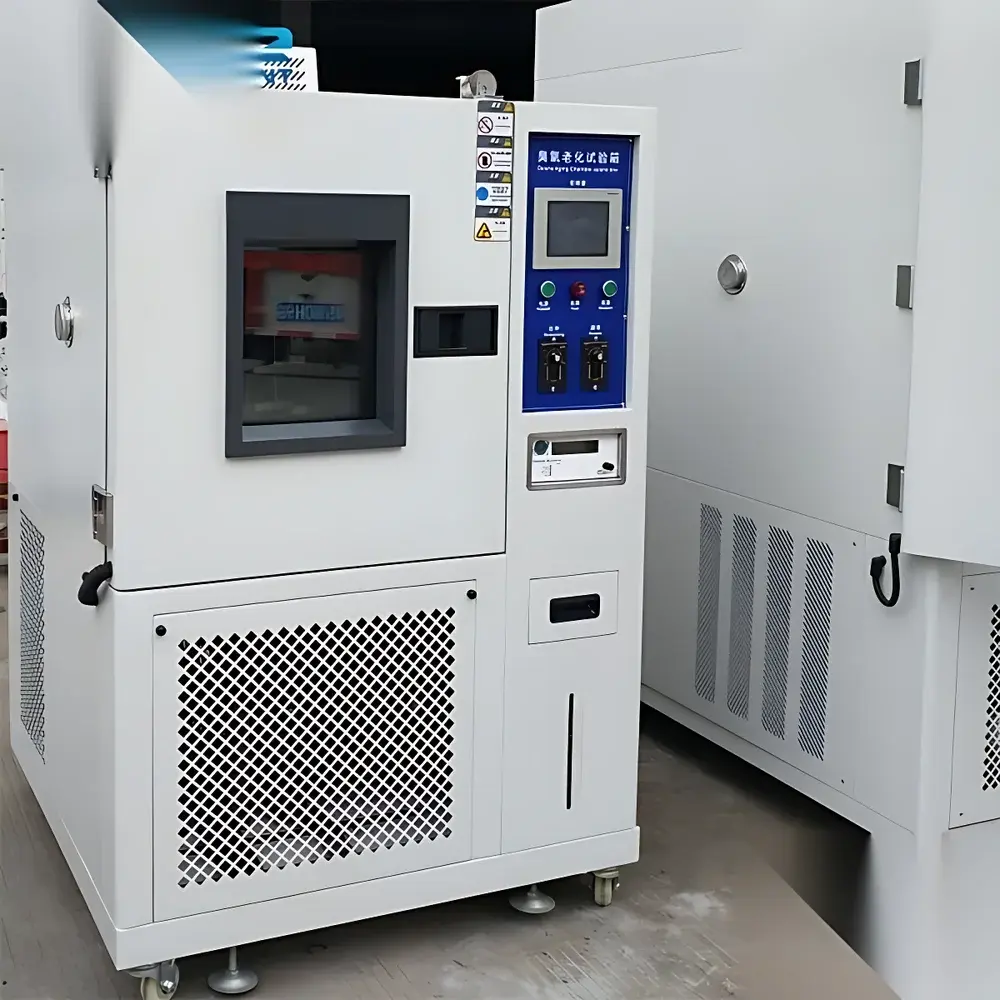
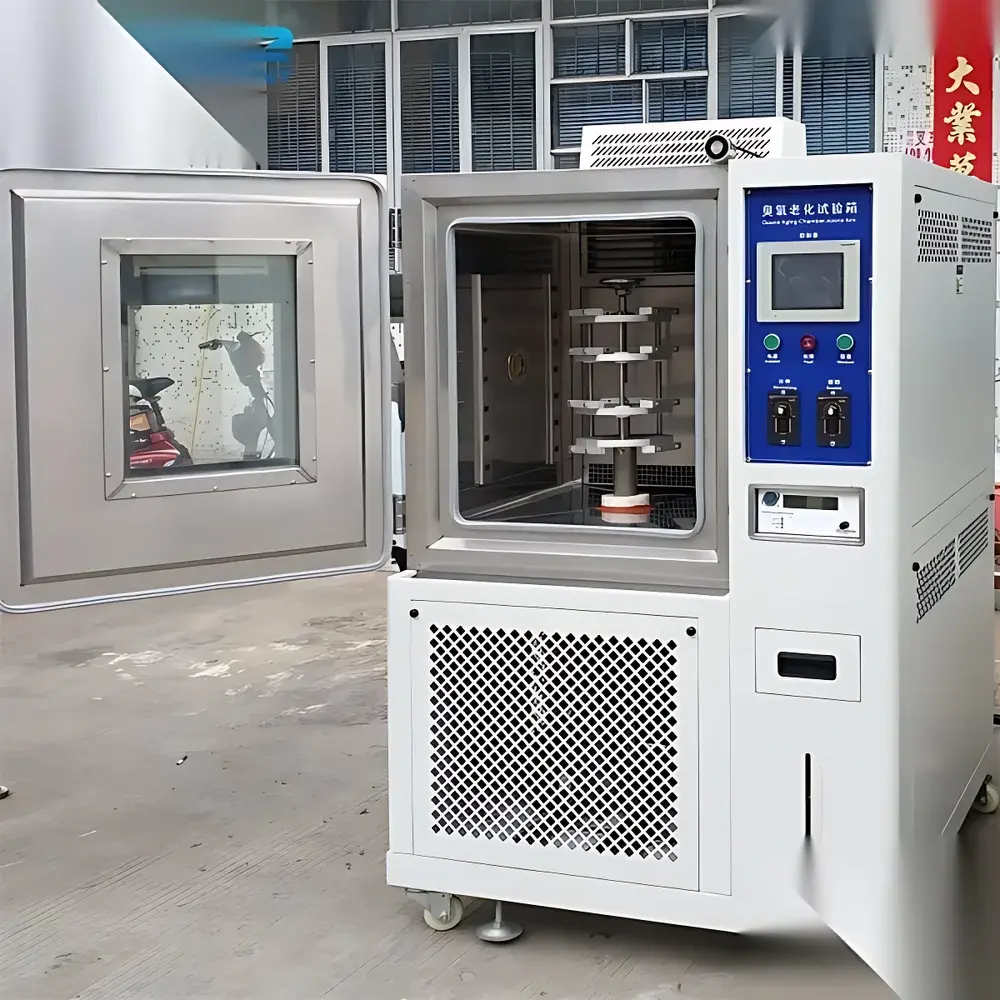
Ozone Aging Test Chamber for Rubber Insoles – QY Series (Customizable Volume)
| Key | Brand: Other Brands |
|---|---|
| Origin | Imported |
| Manufacturer Type | Authorized Distributor |
| Ozone Concentration Range | 50–1500 ppm (pphm) |
| Temperature Range | 25–40 °C |
| Humidity Range | 30–65 % RH |
| Temp. Uniformity | ±0.5 °C |
| Sample Rotation Speed | 1 rpm (360° continuous rotation) |
| Gas Flow Velocity | 8–16 mm/s |
| Control System | Siemens PLC + Weintek Color Touchscreen HMI |
| Ozone Generation | Silent Discharge Tube |
| Ozone Detection | Non-Dispersive UV Absorption Analyzer (≥5 yr service life) |
| Compliance | GB/T 7762–2003, GB/T 2951.21–2008, GB/T 11206–2009, ISO 1431-1:2004 |
| Safety Features | Leakage/short-circuit/overheat/motor-overcurrent protection |
| Interface | 4–20 mA analog output, RS232 communication port |
| Calibration Port | Integrated metrology interface |
Overview
The Ozone Aging Test Chamber for Rubber Insoles (QY Series) is an engineered environmental test system designed to evaluate the resistance of elastomeric materials—particularly rubber-based footwear components—to oxidative degradation induced by atmospheric ozone. Ozone (O₃), though present in trace concentrations (<0.1 ppm) in ambient air, accelerates chain scission and surface microcracking in unsaturated rubbers (e.g., natural rubber, SBR, NBR) via electrophilic addition across C=C bonds. This chamber replicates and intensifies controlled ozone exposure under standardized thermo-hygrometric conditions, enabling accelerated aging protocols that correlate with real-world service life. It operates on the principle of dynamic or static exposure within a sealed, recirculating gas loop, where ozone is generated *in situ* via silent discharge and continuously monitored using non-dispersive ultraviolet (UV) absorption spectroscopy—a method recognized for its linearity, long-term stability, and minimal interference from humidity or other atmospheric gases.
Key Features
- Stainless steel test chamber conforming to ISO 1431-1:2004 dimensional and material specifications, ensuring corrosion resistance and ozone containment integrity.
- Adjustable ozone concentration range of 50–1500 ppm (pphm), digitally regulated via PID-controlled silent discharge ozone generator with automatic feedback compensation.
- Dual-mode sample mounting: static fixture for fixed-strain evaluation (per ASTM D1149 and GB/T 7762) and dynamic rotating rack (1 rpm, full 360° revolution) generating cycloidal strain profiles to simulate flexural fatigue in insole applications.
- Integrated non-dispersive UV ozone analyzer with ≥5-year operational lifetime, factory-calibrated traceability, and real-time digital display; includes dedicated metrology port for third-party verification per ISO/IEC 17025 requirements.
- Climate control subsystem maintaining temperature (25–40 °C, ±0.5 °C uniformity) and relative humidity (30–65 % RH) independently via Siemens S7-1200 PLC and Weintek MT8071iE touchscreen HMI with auto-tuning PID algorithms.
- Fail-safe architecture including overtemperature cutoff, motor thermal overload protection, ozone leak detection interlock, and grounded high-voltage isolation for the discharge tube assembly—fully compliant with IEC 61000-6-2 EMC and IEC 61010-1 safety standards.
Sample Compatibility & Compliance
The QY-series chamber accommodates specimens up to 100 × 100 × 100 cm (QY-1000 model), supporting standard dumbbell strips (ISO 37), curved tensile specimens (ISO 1431-1), and finished rubber insoles mounted on articulated mandrels. All models are validated against internationally harmonized test methods, including GB/T 7762–2003 (Chinese national standard equivalent to ISO 1431-1), GB/T 2951.21–2008 (for cable insulation), and GB/T 11206–2009 (rubber physical property aging). The closed-loop gas circulation design eliminates ambient air ingress, ensuring reproducible exposure kinetics and eliminating operator exposure risk—meeting OSHA PEL (0.1 ppm TWA) and EU Directive 2004/37/EC occupational safety thresholds. Full documentation packages support GLP-compliant validation (IQ/OQ/PQ) and FDA 21 CFR Part 11–ready audit trails when paired with optional data logging firmware.
Software & Data Management
Embedded control firmware supports time-stamped logging of ozone concentration, chamber temperature, humidity, and elapsed test duration at user-defined intervals (1 s to 60 min resolution). Data export is available via USB mass storage or RS232 serial interface in CSV format, compatible with LIMS integration and statistical process control (SPC) platforms. The Weintek HMI provides intuitive navigation through multi-level menus for parameter setup, real-time trend visualization, alarm history review, and calibration log access. Optional Ethernet module enables remote monitoring and secure HTTP-based status queries—facilitating centralized lab management across multi-chamber installations without proprietary software dependencies.
Applications
- Accelerated evaluation of anti-ozonant efficacy (e.g., wax bloom, p-phenylenediamine derivatives) in rubber compound development.
- Quality assurance testing of molded EVA, TPU, and natural rubber insoles prior to footwear assembly.
- Comparative lifecycle assessment of vulcanization systems (sulfur vs. peroxide cure) under oxidative stress.
- Validation of protective coatings and barrier laminates used in premium athletic footwear.
- Research into synergistic degradation mechanisms involving ozone, UV radiation, and mechanical flexing—when integrated with external UV sources or servo-driven flex testers.
FAQ
What ozone concentration units does this chamber use, and how do they relate to international standards?
The chamber displays and controls ozone in parts per hundred million (pphm), which is equivalent to 0.01 ppm. This unit aligns with ISO 1431-1 and GB/T 7762 conventions for rubber aging tests, ensuring direct comparability with published literature and regulatory submissions.
Can the chamber operate continuously for extended test durations (e.g., 168+ hours)?
Yes—the silent discharge ozone generator, UV sensor, and cooling system are rated for uninterrupted operation up to 30 days, supported by redundant thermal fusing and self-diagnostic firmware alerts.
Is third-party calibration certification included with delivery?
A NIST-traceable ozone calibration certificate (covering 50–1500 pphm range) and temperature/humidity verification report are provided with each unit; annual recalibration services are available under ISO/IEC 17025-accredited procedures.
Does the system meet requirements for GMP-regulated environments?
When equipped with optional electronic signature and audit trail modules, the controller complies with FDA 21 CFR Part 11 Annex 11 (EU) and PIC/S GMP Annex 11 for computerized system validation in pharmaceutical-grade elastomer testing.
How is gas flow velocity verified and maintained across different chamber volumes?
Gas velocity (8–16 mm/s) is empirically calibrated using hot-wire anemometry at multiple points within the recirculation duct; flow remains consistent across QY-80 to QY-1000 models due to variable-frequency drive control of the circulation blower.



