
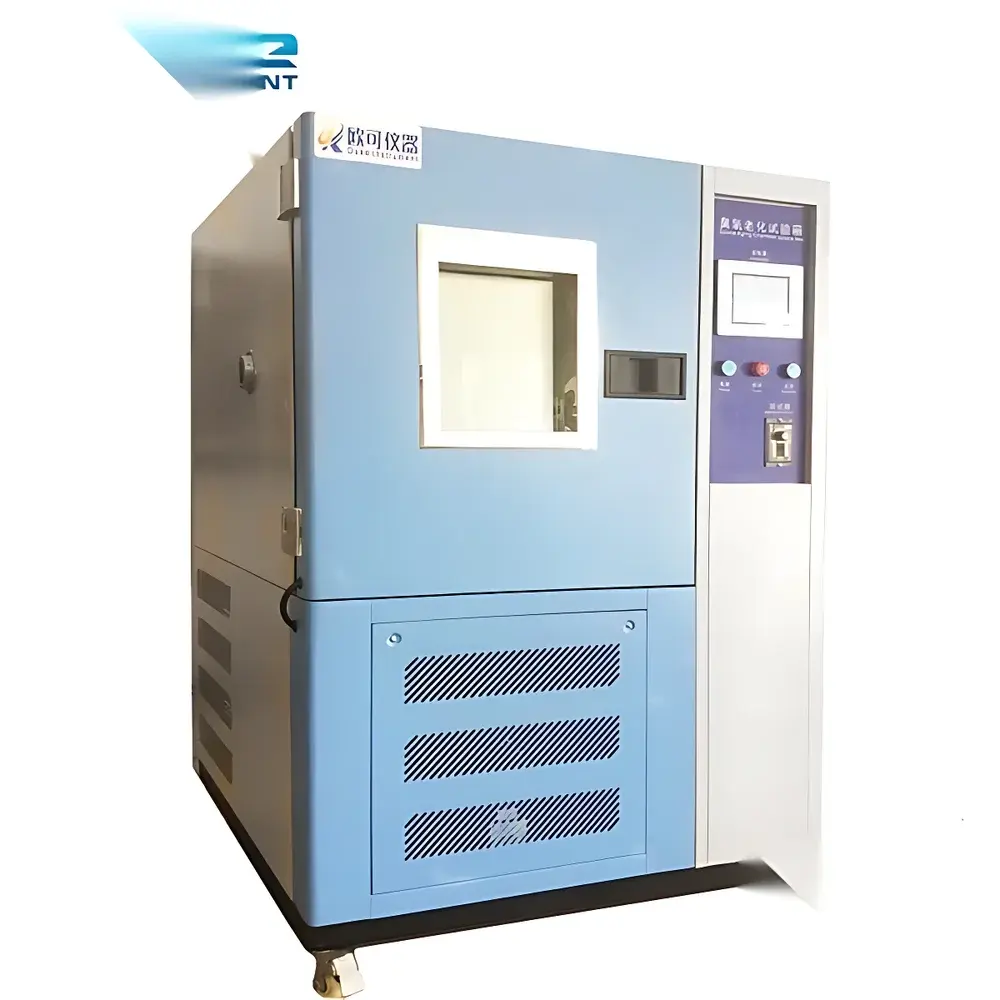
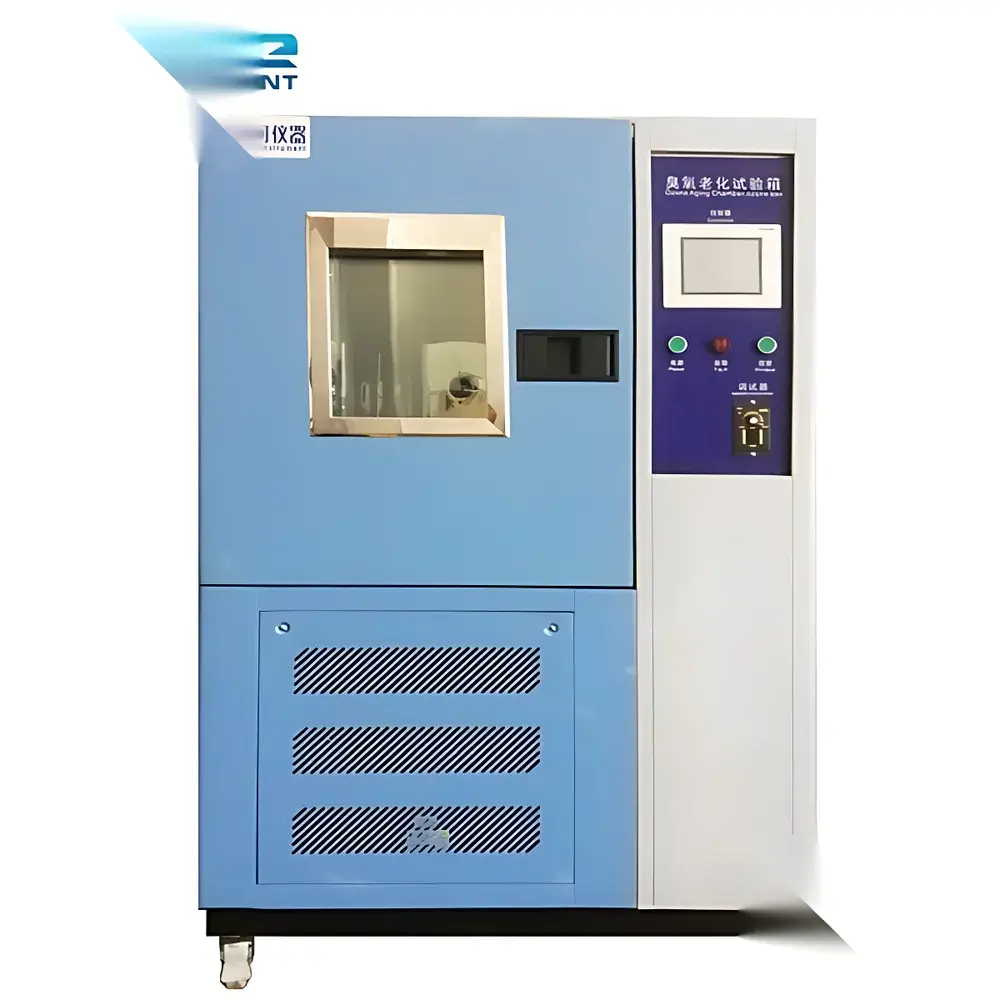
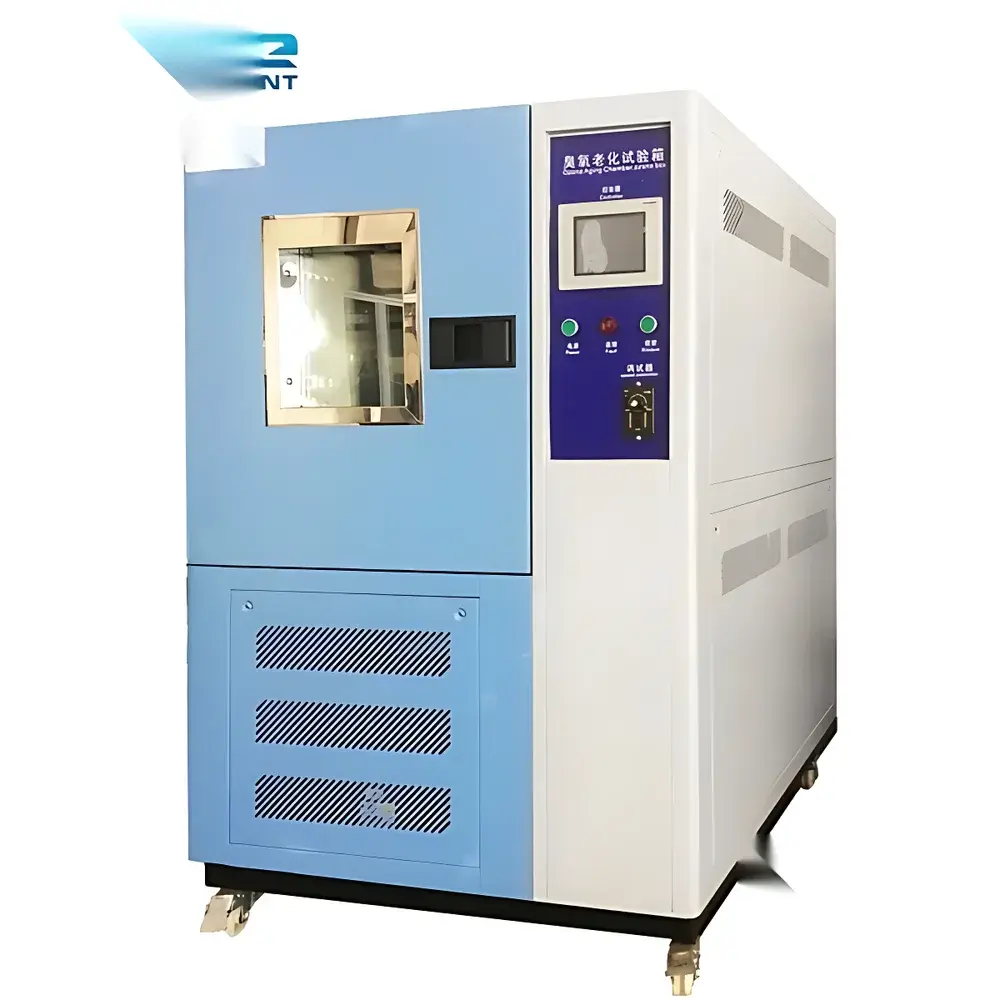
Ozone Aging Test Chamber for Wires and Cables
| Brand | OEM |
|---|---|
| Origin | Imported |
| Manufacturer Type | Authorized Distributor |
| Price | USD 6,200 (FOB Shanghai, ex-works reference only) |
| Compliance | GB/T 7762–2003, GB/T 2951.21–2008, GB/T 11206–2009, ISO 1431-1:2004 |
| Chamber Volume Options | 80 L / 225 L / 500 L / 1000 L |
| Temperature Range | 25–40 °C |
| Temp. Uniformity | ±0.5 °C |
| Humidity Range | 30–65 % RH |
| Ozone Concentration Range | 50–1500 pphm |
| Ozone Generation Method | Silent Discharge Tube |
| Ozone Monitoring | Non-Dispersive UV Absorption Analyzer (Lifespan ≥5 years) |
| Sample Rotation | 360° motorized turntable, 1 rpm (static/dynamic test modes optional) |
| Gas Flow Velocity | 8–16 mm/s |
| Control System | Weilun color touchscreen + Siemens S7-1200 PLC |
| Communication Interface | RS232, 4–20 mA analog output |
| Safety Protections | Leakage current, short-circuit, overtemperature, motor overheat, overcurrent |
| Power Supply | AC 380 V ±5 %, 50 Hz ±0.5 Hz |
Overview
The Ozone Aging Test Chamber for Wires and Cables is an engineered environmental simulation system designed to evaluate the resistance of elastomeric insulation and jacketing materials—particularly those used in power, communication, and automotive cables—to oxidative degradation induced by atmospheric ozone. Ozone (O₃), though present at trace concentrations (typically <0.1 ppm) in ambient air, initiates chain scission in unsaturated polymer backbones (e.g., natural rubber, SBR, NBR), leading to surface cracking under strain. This chamber replicates accelerated aging conditions per internationally recognized standards, enabling quantitative assessment of material durability, formulation efficacy (e.g., antiozonant additives), and service life prediction under controlled ozone exposure. Unlike general-purpose climate chambers, this instrument integrates a closed-loop, leak-tight ozone generation and monitoring architecture—critical for maintaining stable, trace-level O₃ concentrations while ensuring operator safety and measurement repeatability.
Key Features
- Stainless steel test chamber conforming to ISO 1431-1:2004 dimensional and material requirements, with fully sealed gas circulation path to prevent ambient dilution and operator exposure.
- Precision silent discharge ozone generator with adjustable output, enabling stable concentration control across the full operational range (50–1500 pphm) without catalyst degradation or nitrogen oxide byproducts.
- Non-dispersive ultraviolet (UV) absorption ozone analyzer—calibrated traceably to NIST-traceable standards—with real-time digital display, continuous online monitoring, and ≥5-year service life under routine operation.
- Motor-driven sample rotation mechanism (1 rpm, 360° continuous) compliant with static and dynamic test configurations per GB/T 7762–2003; motion profile adheres to cycloidal trajectory principles to ensure uniform strain distribution on elongated specimens.
- Integrated environmental control: dual-channel PID auto-tuning for simultaneous regulation of temperature (25–40 °C, ±0.5 °C stability) and relative humidity (30–65 % RH), with independent sensor feedback loops.
- Industrial-grade control architecture featuring Weilun 7-inch color touchscreen HMI and Siemens S7-1200 PLC, supporting data logging, alarm history, parameter locking, and user-access level management.
- Dedicated metrology interface for third-party calibration verification; all ozone generation, distribution, and sensing components reside within a physically isolated, grounded loop meeting IEC 61000-6-2 EMC immunity requirements.
Sample Compatibility & Compliance
This chamber accommodates standard wire and cable specimens—including flat, round, and stranded configurations—mounted on calibrated tension fixtures or mandrels per ISO 1431-1 Annex A. Test specimen dimensions are configurable to match industry-standard cross-sections (e.g., 2–25 mm diameter cables, up to 300 mm gauge length). The system satisfies mandatory compliance requirements for quality assurance in regulated sectors: it supports audit-ready documentation for GLP environments, includes timestamped event logs required under FDA 21 CFR Part 11 (when paired with validated software), and delivers data integrity consistent with ISO/IEC 17025 clause 7.7. All electrical safety design complies with IEC 61010-1:2010 for laboratory equipment, including reinforced insulation, earth leakage protection (<30 mA), and thermal cutouts on ozone generator and heating elements.
Software & Data Management
The embedded control firmware records time-synchronized ozone concentration, temperature, humidity, and elapsed test duration at user-defined intervals (1–60 s). Exportable CSV files include raw sensor values, setpoint deviations, and system status flags (e.g., “O₃ stabilizing”, “temp overshoot”). Optional PC-based software (sold separately) enables automated report generation per ASTM D1149 or ISO 1431 templates, statistical analysis of crack onset time (COT), and trend visualization of concentration drift over extended validation runs. Audit trails retain operator ID, parameter changes, and calibration events—fully traceable for GMP-regulated cable manufacturing facilities subject to IATF 16949 or UL certification audits.
Applications
- Evaluation of halogen-free flame-retardant (HFFR) compounds used in low-smoke zero-halogen (LSZH) cables exposed to outdoor or high-ozone urban environments.
- Comparative testing of antiozonant packages (e.g., p-phenylenediamine derivatives) in EPDM and CR insulation formulations.
- Validation of extrusion process parameters affecting crosslink density and ozone resistance in silicone rubber jacketing.
- Pre-compliance screening for UL 2556, CSA C22.2 No. 0.3, and EN 50363-2 certification protocols requiring ozone resistance evidence.
- Accelerated aging correlation studies linking lab-generated crack morphology (per ISO 1431-2 visual rating scale) to field failure data from utility grid deployments.
FAQ
What ozone concentration accuracy is guaranteed across the 50–1500 pphm range?
The UV absorption analyzer maintains ±5 pphm absolute accuracy at concentrations ≤200 pphm and ±3 % of reading above 200 pphm, verified annually per ISO/IEC 17025-accredited calibration procedures.
Can the chamber operate continuously for 1,000-hour qualification tests?
Yes—the ozone generator, cooling system, and PLC controller are rated for uninterrupted operation up to 2,000 hours; preventive maintenance intervals are specified at 500-hour increments in the technical manual.
Is dynamic testing (rotating samples under strain) supported out-of-the-box?
Static testing is standard; dynamic mode requires optional calibrated tensile fixtures and preloaded mandrel kits—configured during factory commissioning to meet GB/T 2951.21–2008 Clause 9 requirements.
Does the system include NIST-traceable calibration certificates?
A factory-issued certificate of conformance is provided; NIST-traceable ozone and temperature calibration certificates are available as optional add-ons with documented uncertainty budgets.
How is ozone destruct handled post-test to ensure safe chamber opening?
An integrated catalytic ozone destructor (MnO₂-based) automatically activates upon test completion, reducing residual O₃ to <0.05 ppm within 5 minutes—verified by built-in safety interlock before door release.



