
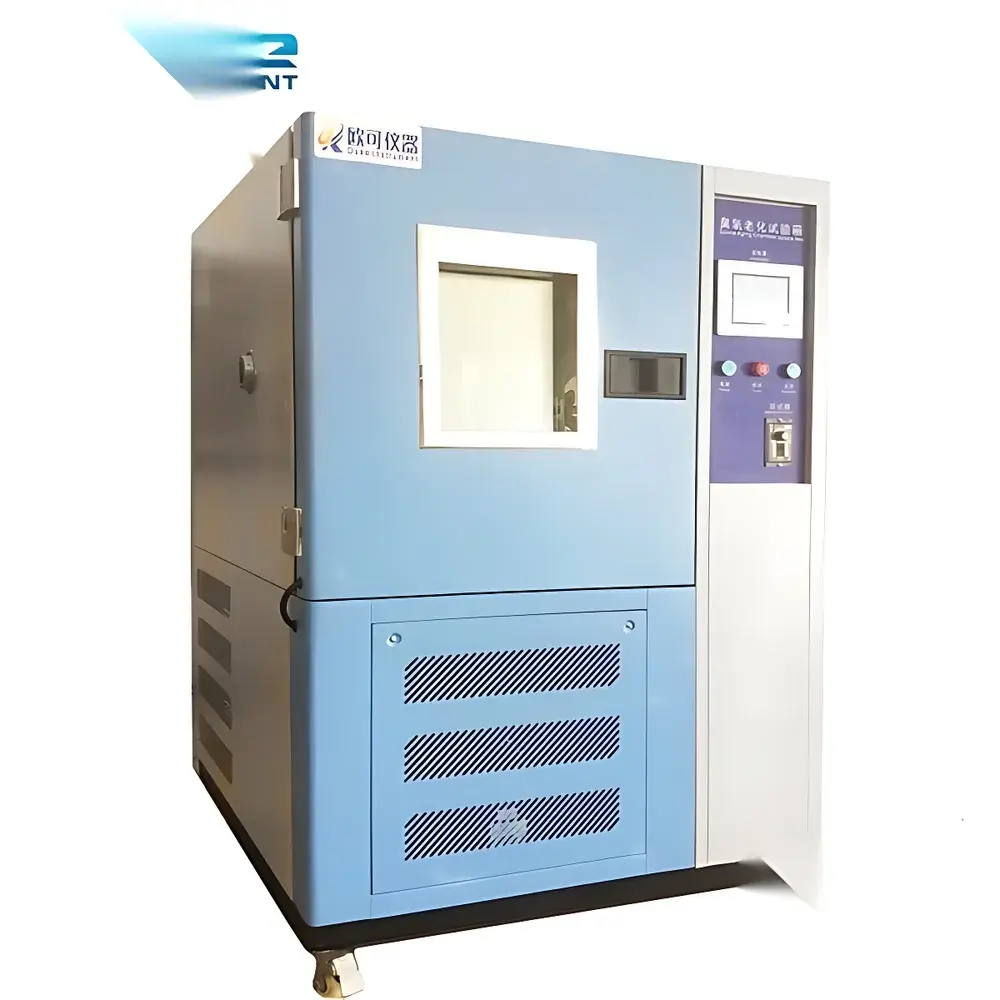
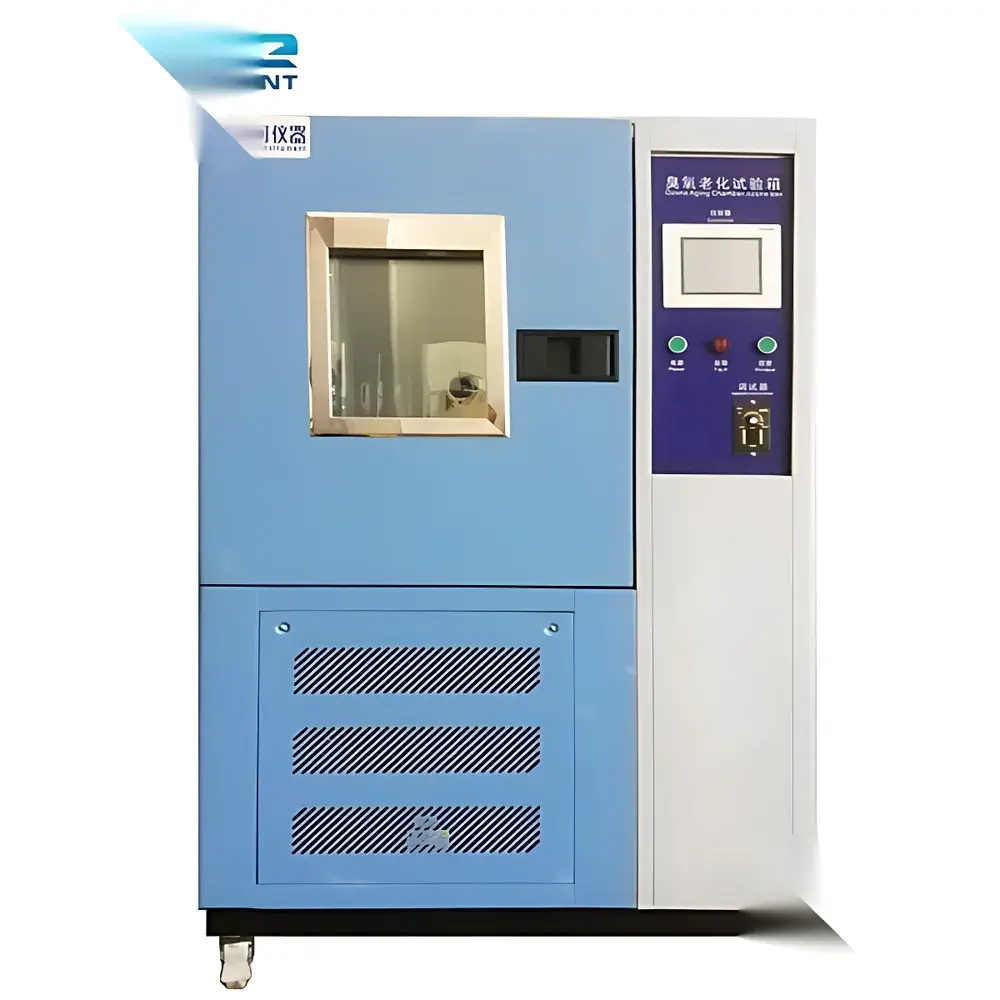
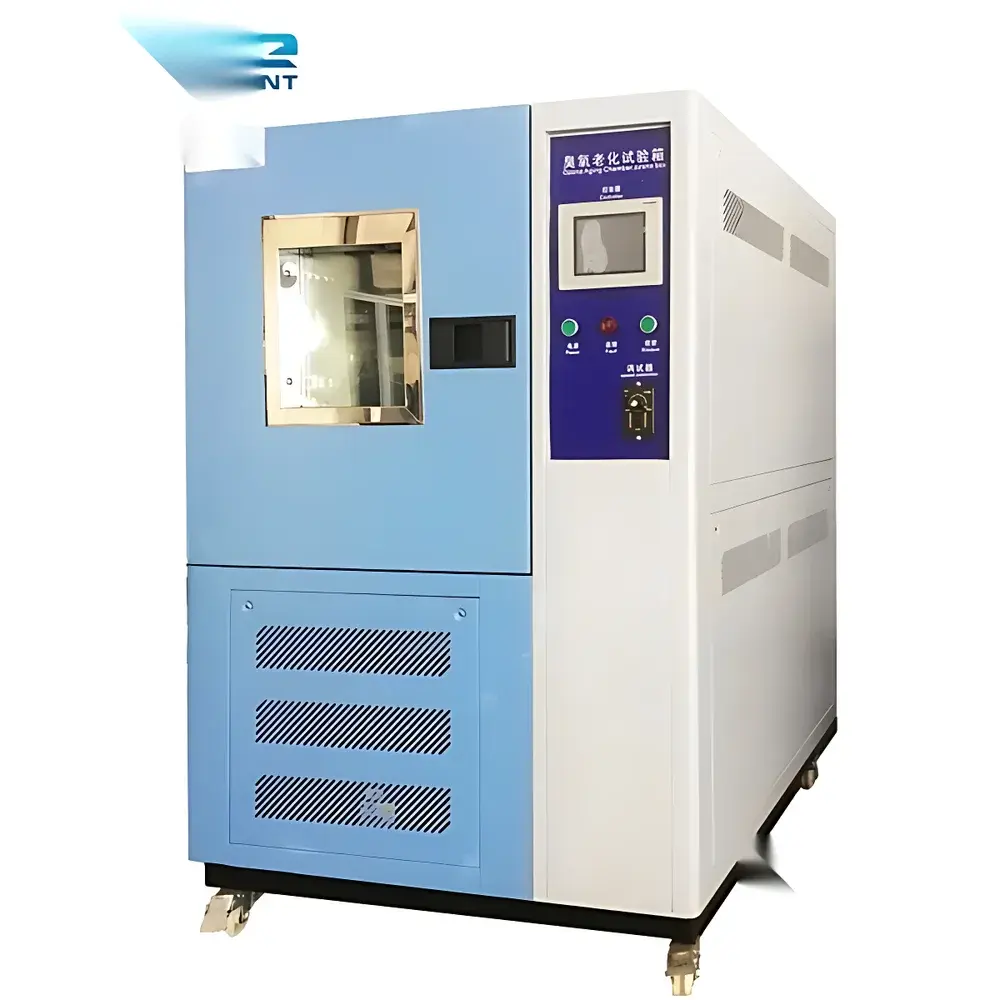
Ozone Aging Test Chamber with Dynamic Tensile Rotation – QY Series (QY-80 / QY-225 / QY-500 / QY-1000)
| Brand | OEM |
|---|---|
| Origin | Imported |
| Manufacturer Type | Authorized Distributor |
| Ozone Concentration Range | 50–1500 ppmv (pphm) |
| Temperature Range | 25–40 °C |
| Temperature Uniformity | ±0.5 °C |
| Humidity Range | 30–65 % RH |
| Sample Rack Rotation | 360° continuous, 1 rpm |
| Gas Flow Velocity | 8–16 mm/s |
| Ozone Generation Method | Silent Discharge Tube |
| Ozone Detection | Non-Dispersive UV Absorption Analyzer (≥5 yr service life) |
| Control System | Weilun Color Touchscreen + Siemens PLC |
| Compliance Standards | GB/T 7762–2003, GB/T 2951.21–2008, GB/T 11206–2009, ISO 1431-1:2004 |
Overview
The Ozone Aging Test Chamber with Dynamic Tensile Rotation (QY Series) is an engineered environmental test system designed to evaluate the ozone resistance of elastomeric materials under controlled, accelerated aging conditions. Based on the fundamental principle that ozone-induced surface cracking in rubber compounds occurs via direct oxidative cleavage of unsaturated carbon–carbon bonds—especially at points of mechanical strain—this chamber integrates precise ozone generation, real-time concentration monitoring, and programmable dynamic tensile motion to replicate field-relevant degradation mechanisms. Unlike static exposure chambers, the QY Series incorporates a motor-driven, continuously rotating sample rack operating at 1 rpm, ensuring uniform circumferential strain distribution across specimens while maintaining compliance with the摆线轨迹 (cycloidal trajectory) requirement defined in ISO 1431-1:2004 for dynamic testing. The sealed, closed-loop gas circulation system eliminates ambient air ingress and operator exposure risk, making it suitable for routine QC labs, R&D centers, and certification testing facilities requiring GLP-aligned operational traceability.
Key Features
- Hermetically sealed stainless-steel test chamber with full-circuit ozone recirculation and silent discharge ozone generator—no external venting or scrubbing required.
- Non-dispersive ultraviolet (UV) ozone analyzer with auto-calibration capability; provides continuous, drift-compensated measurement with ≥5-year sensor lifetime and 4–20 mA analog output plus RS232 digital interface.
- Dynamic tensile rotation mechanism: precision-engineered cycloidal-motion sample holder ensures consistent strain amplitude and directional alternation per ASTM D1149 and ISO 1431-1 protocols.
- Intelligent control architecture integrating Weilun color touchscreen HMI and Siemens S7-1200 PLC for synchronized regulation of ozone concentration, temperature, humidity, and rotation timing.
- PID auto-tuning temperature/humidity controllers with ±0.5 °C stability and 30–65 % RH range; independent ozone setpoint control from 50 to 1500 ppmv in 1-ppmv increments.
- Integrated metrology port compliant with national calibration standards (e.g., JJG 1041–2008), enabling third-party verification of ozone concentration accuracy without system disassembly.
Sample Compatibility & Compliance
The QY Series accommodates standard dumbbell-shaped, ring, or strip specimens per ISO 1431-1, GB/T 7762, and ASTM D1149. Optional fixtures support multi-specimen parallel testing with individual strain adjustment. All models meet structural and safety requirements of IEC 61000-6-2 (EMC immunity) and IEC 61000-6-4 (EMC emission). The closed-loop ozone delivery system complies with OSHA 29 CFR 1910.1200 (HCS) and EU Directive 2004/37/EC (carcinogen exposure limits), ensuring workplace safety during extended operation. Full documentation packages—including factory calibration certificates, electrical safety reports, and software validation summaries—are provided for GMP/GLP audit readiness.
Software & Data Management
Data acquisition is handled via embedded PLC logic with timestamped logging of ozone concentration (ppmv), chamber temperature (°C), relative humidity (% RH), elapsed test time (hh:mm:ss), and rack rotational status. Export formats include CSV and PDF reports compatible with LIMS integration. Optional PC-based software enables remote monitoring, multi-chamber fleet management, alarm history review, and 21 CFR Part 11-compliant electronic signatures for audit trails. All control parameters are password-protected with role-based access levels (Operator, Technician, Administrator) to maintain data integrity and procedural accountability.
Applications
- Accelerated evaluation of natural rubber (NR), styrene–butadiene rubber (SBR), nitrile rubber (NBR), and ethylene propylene diene monomer (EPDM) formulations.
- Screening of antiozonant additives (e.g., p-phenylenediamine derivatives) and comparative assessment of protective efficacy under dynamic strain.
- Qualification testing for automotive seals, tire sidewalls, conveyor belts, and aerospace elastomeric components exposed to outdoor service environments.
- Supporting material selection and design validation in accordance with ISO/TS 22196, SAE J2236, and MIL-STD-810H Method 507.6 (ozone exposure).
- Research into ozone–temperature–humidity interaction effects on crack initiation kinetics using multi-variable test profiles.
FAQ
What standards does this chamber validate against?
It is fully aligned with GB/T 7762–2003, GB/T 2951.21–2008, GB/T 11206–2009, and ISO 1431-1:2004 for both static and dynamic ozone aging tests.
Can the chamber operate without dynamic rotation?
Yes—static mode is supported via rack lockout function, enabling compliance with ISO 1431-1 Annex A for non-rotating specimen evaluation.
Is ozone concentration calibration traceable to NIST or equivalent national standards?
The integrated UV analyzer includes a certified calibration certificate traceable to China National Institute of Metrology (NIM); optional NIST-traceable recalibration kits are available upon request.
What maintenance intervals are recommended for the ozone generator and sensor?
Silent discharge tubes require replacement every 12–18 months under continuous operation; UV sensor cleaning and zero-check are recommended quarterly, with full recalibration annually.
Does the system support automated pass/fail reporting based on crack assessment criteria?
While visual crack evaluation remains manual per standard methods, the system logs all exposure parameters required for post-test analysis per ISO 1431-2, and optional digital microscope integration can feed image metadata into custom reporting templates.



