
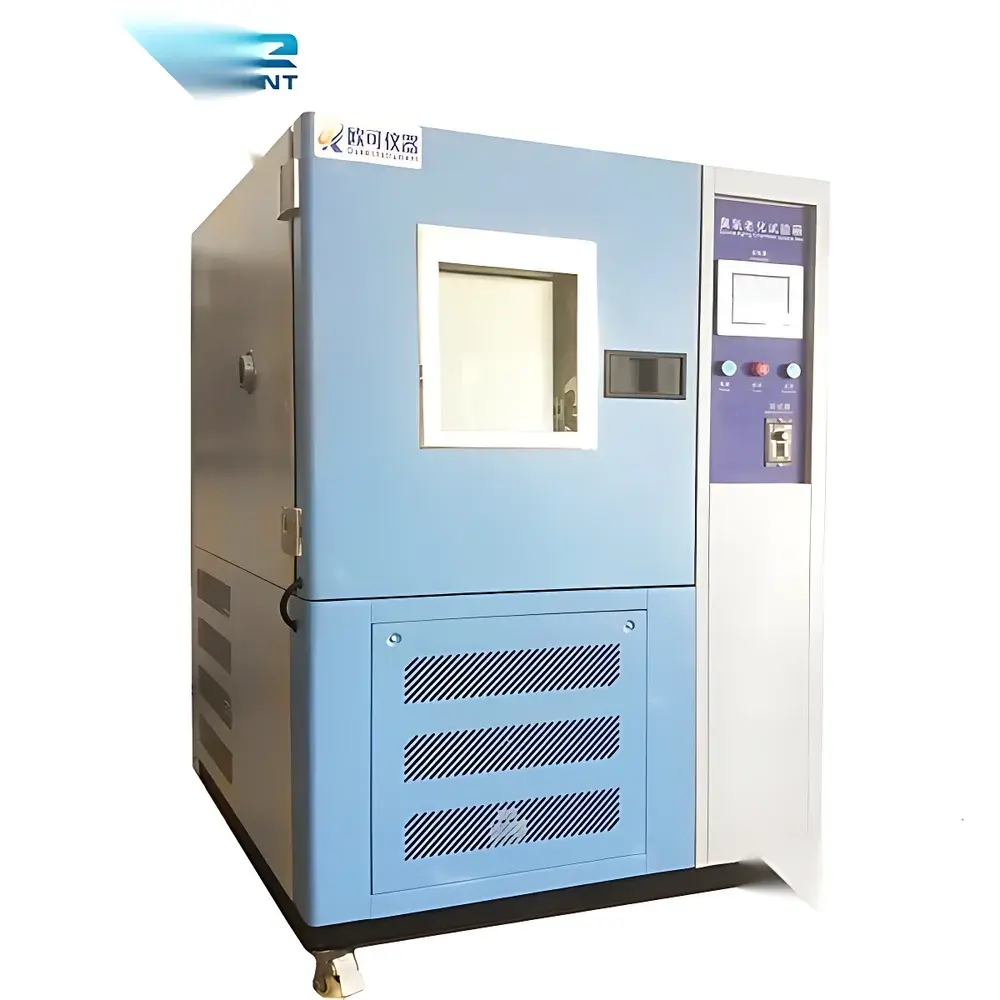
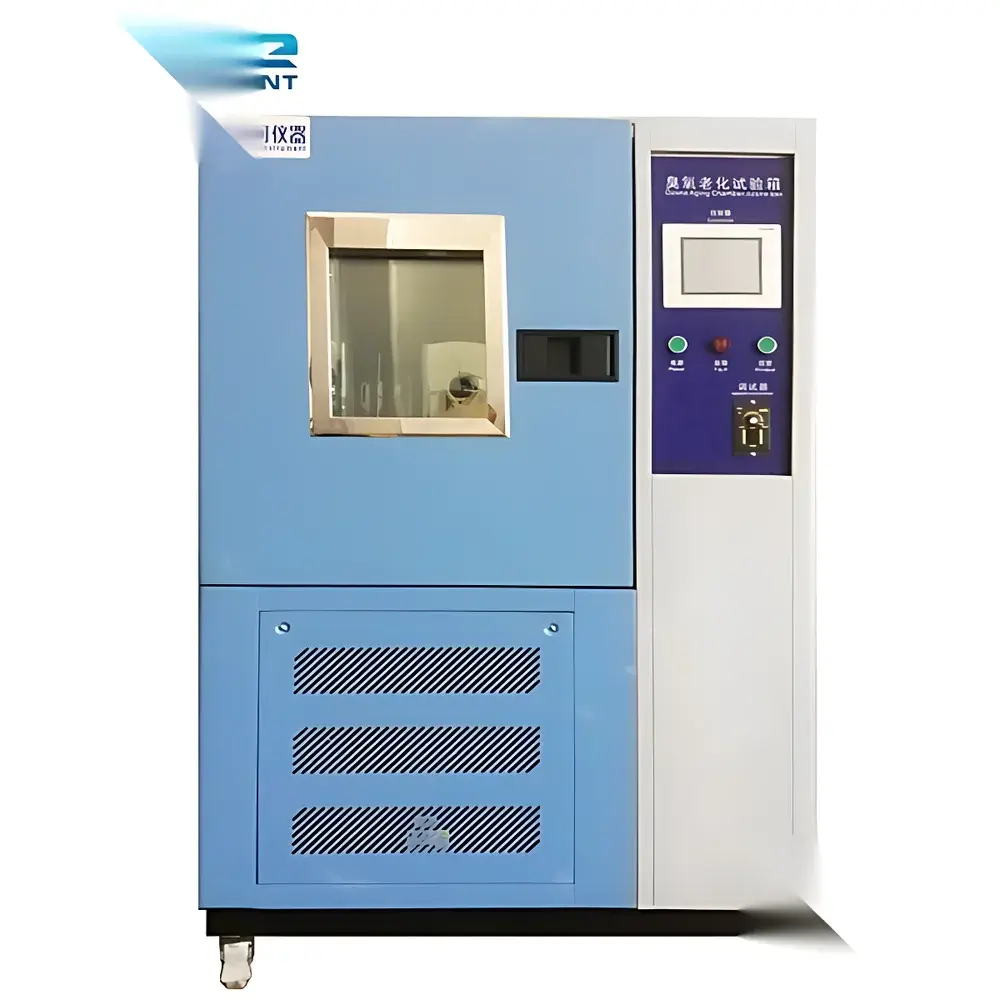
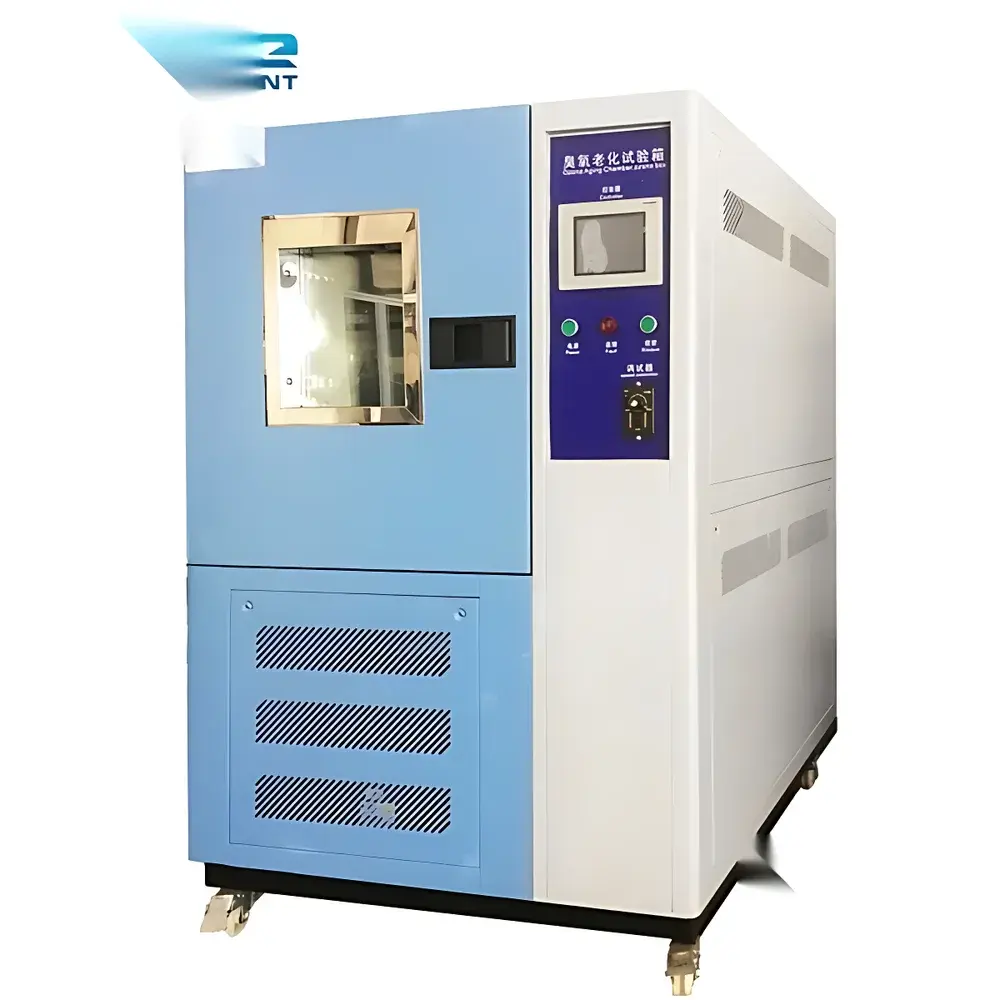
Ozone Cracking Test Chamber for Rubber Industry
| Brand | OEM |
|---|---|
| Origin | Imported |
| Manufacturer Type | Authorized Distributor |
| Price | USD 6,300 (FOB) |
| Standards Compliance | GB/T 7762–2003, GB/T 2951.21–2008, GB/T 11206–2009, ISO 1431-1:2004 |
| Chamber Volume Options | 80 L / 225 L / 500 L / 1000 L |
| Temperature Range | 25–40 °C |
| Humidity Range | 30–65 %RH |
| Ozone Concentration Range | 50–1500 pphm |
| Temp. Uniformity | ±0.5 °C |
| Ozone Generation | Silent Discharge Tube |
| Ozone Detection | Non-Dispersive UV Absorption Analyzer (Lifespan ≥5 yr) |
| Sample Rotation | 360° motorized rack, 1 rpm |
| Gas Flow Velocity | 8–16 mm/s |
| Control System | Weilun color touchscreen + Siemens S7-1200 PLC |
| Safety Protections | Leakage, short-circuit, over-temperature, motor overheat, over-current |
Overview
The Ozone Cracking Test Chamber for Rubber Industry is an engineered environmental test system designed to accelerate and quantify ozone-induced surface degradation in elastomeric materials. Based on the fundamental principle of ozone oxidation—where ground-level ozone (O3) reacts selectively with unsaturated carbon–carbon double bonds in natural rubber, SBR, NBR, and other diene-based polymers—the chamber replicates and intensifies real-world atmospheric aging conditions under tightly controlled parameters. Unlike general-purpose climate chambers, this instrument integrates a closed-loop ozone generation, distribution, and monitoring architecture compliant with internationally recognized accelerated aging protocols. It enables laboratories to assess crack initiation time, crack growth rate, and protective efficacy of antiozonants—critical data inputs for material formulation, quality control release testing, and service life prediction in automotive tires, seals, hoses, and vibration isolators.
Key Features
- Sealed stainless-steel test chamber with full-circuit ozone recirculation, eliminating ambient air ingress and ensuring operator safety and measurement integrity.
- Precision silent discharge ozone generator capable of stable output across 50–1500 pphm, calibrated traceably to NIST-traceable reference standards.
- Non-dispersive ultraviolet (UV) absorption ozone analyzer with continuous real-time monitoring, factory-calibrated and field-verifiable via built-in metrology port.
- Motor-driven sample rotation system delivering true cycloidal motion at 1 rpm—mechanically optimized to satisfy static and dynamic stretch configurations per ISO 1431-1:2004 Annex A and GB/T 7762–2003 Clause 6.2.
- Integrated dual-parameter control: independent PID-regulated temperature (25–40 °C, ±0.5 °C uniformity) and relative humidity (30–65 %RH), both auto-tuned and logged with timestamped setpoint history.
- Industrial-grade automation stack: Weilun 7-inch color HMI touchscreen interface coupled with Siemens S7-1200 PLC for deterministic logic execution, alarm event logging, and audit-ready operation records.
- Comprehensive electrical safety architecture including earth leakage protection, thermal cutouts on heating elements and drive motors, and redundant overcurrent interrupters on all high-voltage ozone supply lines.
Sample Compatibility & Compliance
This chamber accommodates standardized dumbbell specimens (e.g., ISO 527 Type 1A, ASTM D412 C), ring-shaped samples, and custom-profile extrusions up to 1000 L chamber volume. All mechanical fixtures—including tension clamps, rotating mandrels, and static extension frames—are fabricated from ozone-resistant 316 stainless steel or anodized aluminum to prevent catalytic decomposition. The system meets full technical alignment with GB/T 7762–2003 (determination of resistance to ozone cracking—static strain method), ISO 1431-1:2004 (rubber—resistance to ozone cracking—part 1: static strain), and supplementary clauses in IEC 60811-501 and UL 1581 for wire & cable compound qualification. Calibration documentation supports GLP-compliant validation, and the 4–20 mA analog output enables integration into centralized LIMS or MES platforms for automated data ingestion.
Software & Data Management
No proprietary cloud software is required. All operational data—including ozone concentration (pphm), chamber temperature (°C), RH (%), elapsed test time (h:min:s), and alarm status—is stored locally on the PLC’s non-volatile memory with cyclic overwrite protection. The HMI provides on-screen trend graphs (up to 72 h history), exportable CSV reports via USB flash drive, and configurable print-to-PDF functionality. For regulated environments, optional firmware upgrade enables 21 CFR Part 11-compliant electronic signatures, user access levels (admin/operator/auditor), and immutable audit trails—including operator ID, parameter change timestamps, and calibration event logs. Raw sensor outputs are accessible via RS232 serial protocol for third-party SCADA or LabVIEW integration without middleware dependency.
Applications
- Accelerated evaluation of antiozonant package performance (e.g., p-phenylenediamine derivatives) in tire tread compounds.
- Comparative ranking of vulcanization systems (sulfur vs. peroxide) for ozone resistance in EPDM roofing membranes.
- Validation of extrusion die design effects on near-surface crosslink density and subsequent ozone susceptibility.
- QC release testing for rubber-to-metal bonded components used in HVAC expansion joints and rail suspension bushings.
- Supporting ISO 14001 environmental compliance by quantifying service life extension attributable to sustainable polymer modifications.
FAQ
What ozone concentration accuracy is guaranteed across the 50–1500 pphm range?
The UV absorption analyzer maintains ±5 pphm absolute accuracy at concentrations ≤200 pphm and ±2.5% of reading above 200 pphm, verified annually using certified ozone standard gas (NIST SRM 2690).
Can the chamber operate continuously for 1000-hour tests without maintenance?
Yes—provided ambient intake air is filtered to ISO 8573-1 Class 3 (≤0.1 µm particles, dew point −20 °C), the silent discharge tube and UV lamp require no scheduled replacement within 5,000 operating hours; preventive maintenance checklist is provided in the technical manual.
Is dynamic stretching supported for all chamber volumes?
Dynamic mode (rotating sample under constant strain) is standard on all models; static tensile fixtures are included as accessories and configurable per specimen geometry without tooling changes.
How is ozone destruct handled during chamber purge cycles?
An integrated catalytic ozone destructor (MnO2/Al2O3 monolith) thermally decomposes residual O3 to O2 prior to exhaust, achieving >99.9% conversion efficiency—verified per EN 14175-5 requirements.



