
Paeonia Innovations Paeonia IR Online Mid-Infrared Spectrometer
| Brand | Paeonia Innovations |
|---|---|
| Origin | Singapore |
| Manufacturer Type | Authorized Distributor |
| Origin Category | Imported |
| Model | Paeonia IR |
| Instrument Type | Online |
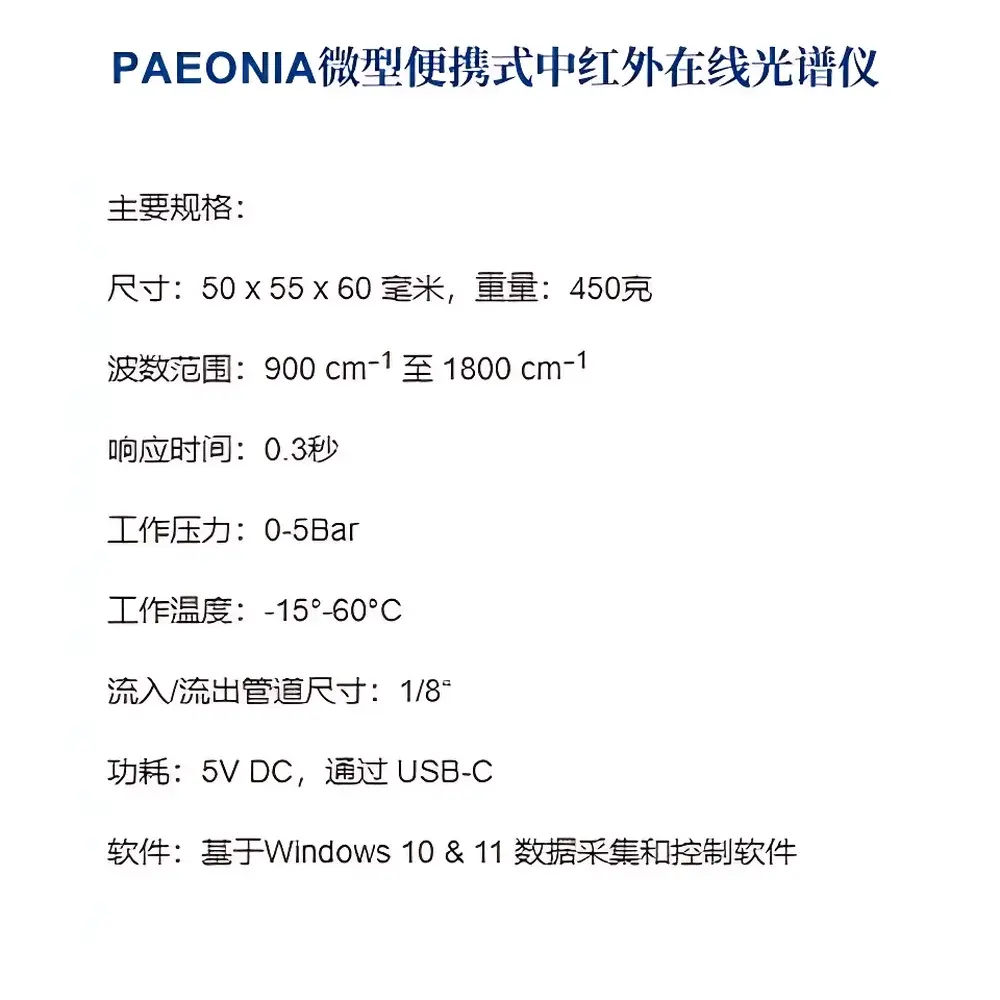
| Wavenumber Range | 900–1800 cm⁻¹ |
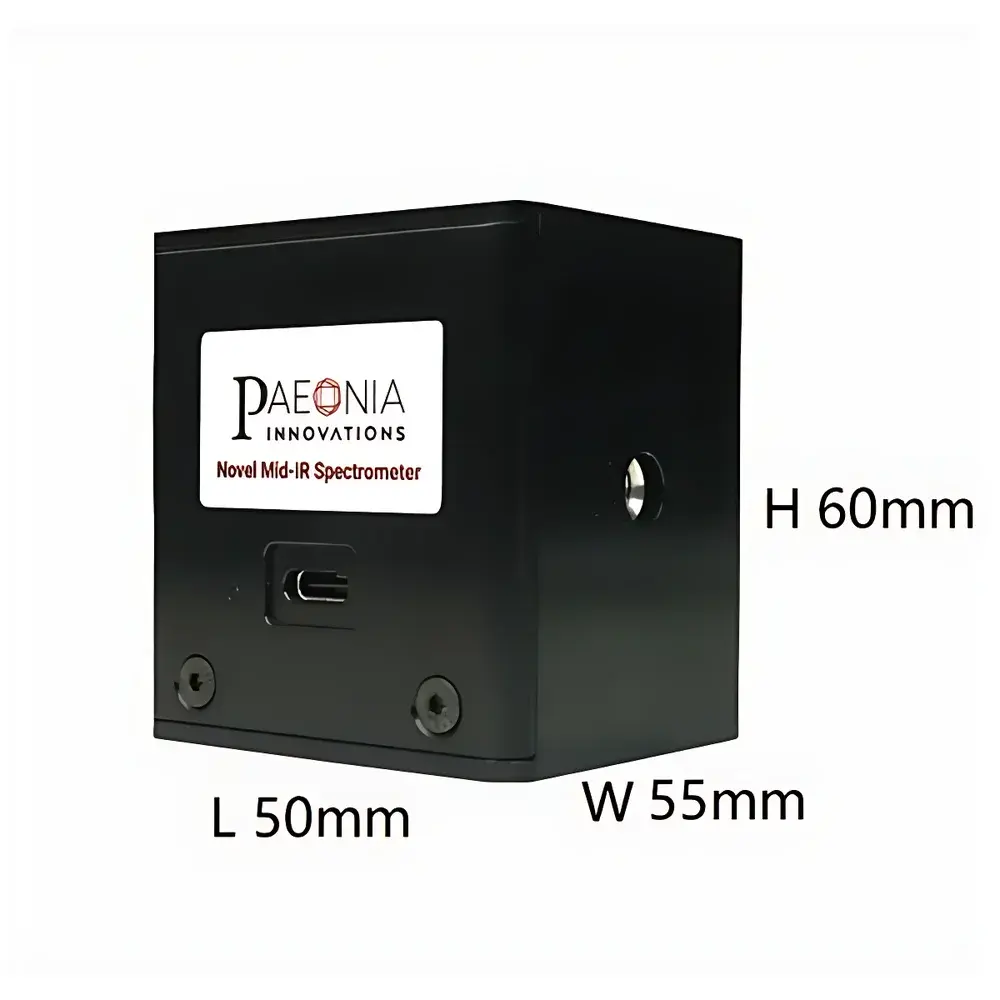
| Dimensions | 50 × 55 × 60 mm |
| Weight | 450 g |
| Response Time | 0.3 s |
| Operating Pressure | 0–5 bar |
| Operating Temperature | −15 °C to +60 °C |
| Flow Path Fitting | 1/8″ NPT or Swagelok |
| Power Supply | 5 V DC via USB-C |
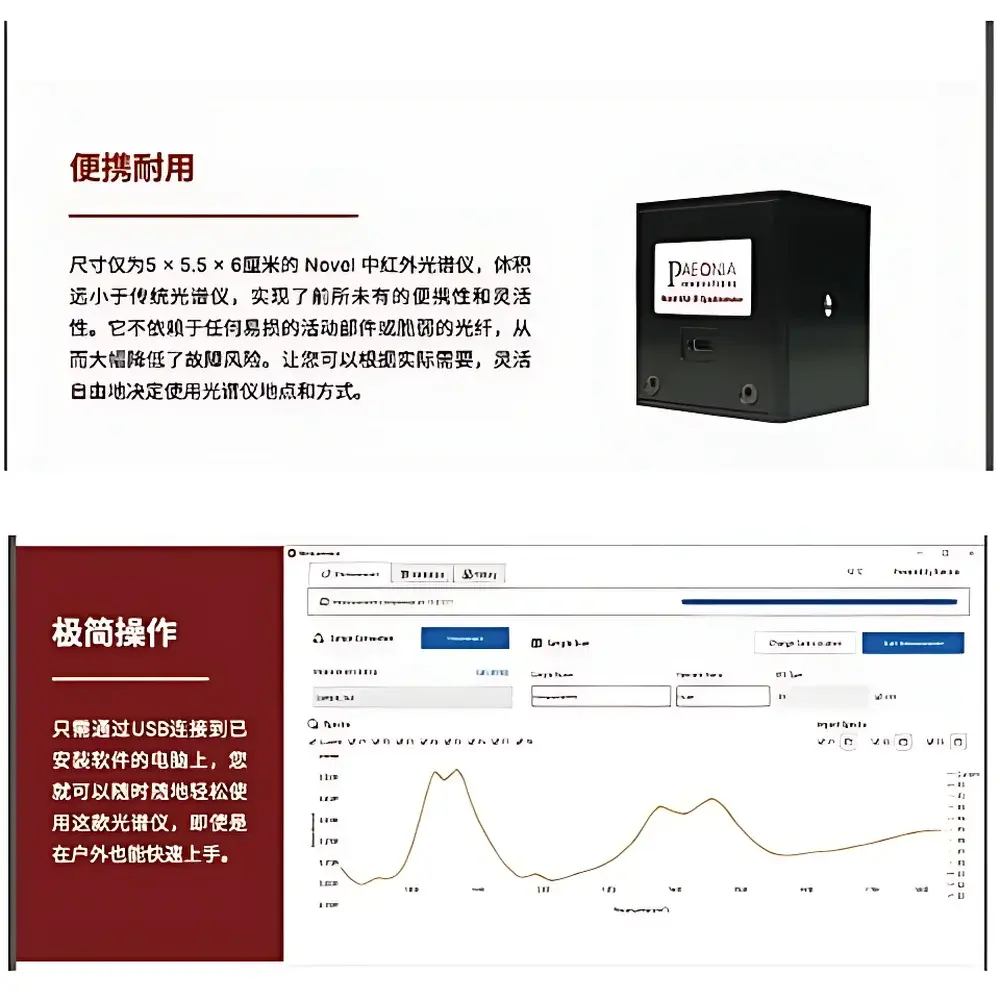
| Software Platform | Windows 10 & 11 Native Application for Real-Time Data Acquisition and Instrument Control |
Overview
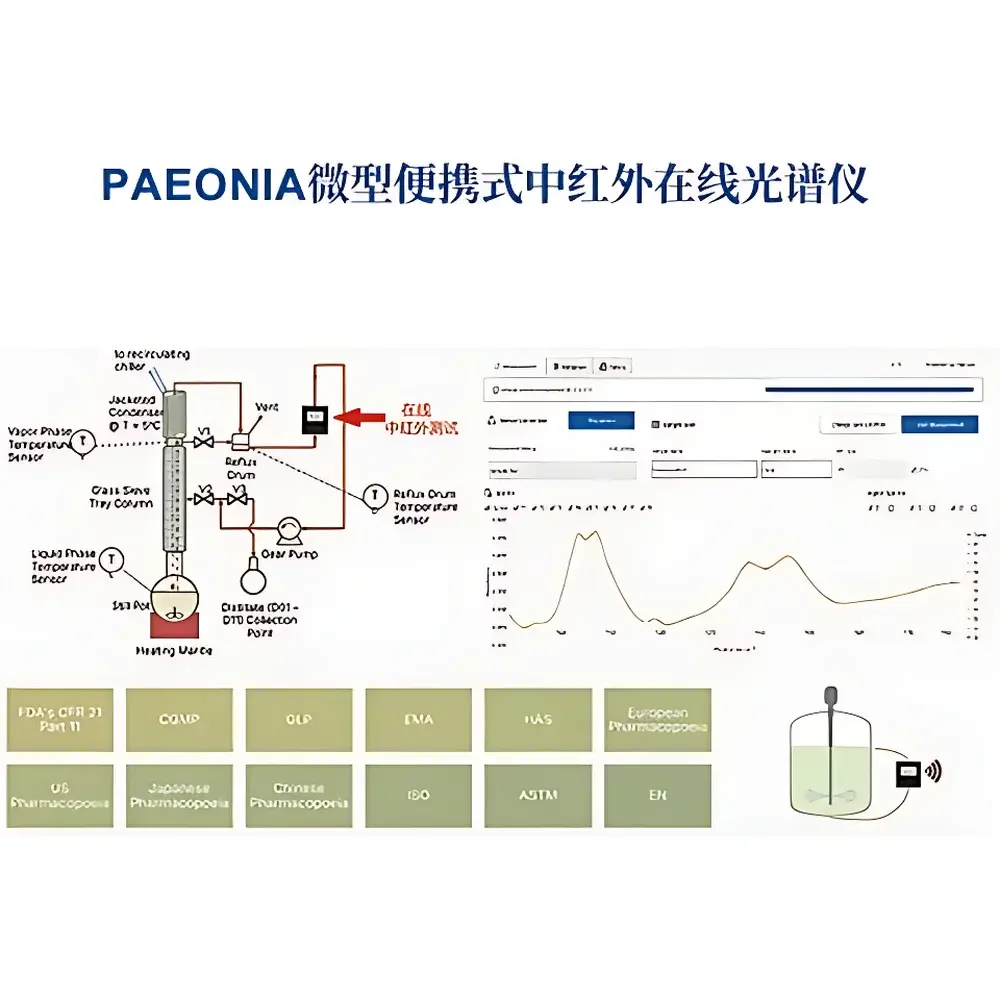
The Paeonia Innovations Paeonia IR is an online mid-infrared (MIR) spectrometer engineered for continuous, real-time molecular analysis in process environments. Utilizing attenuated total reflectance (ATR) or transmission-based optical configurations—depending on the integrated flow cell—it operates across a scientifically selective wavenumber range of 900–1800 cm⁻¹, covering key functional group absorption bands including C=O (1650–1750 cm⁻¹), C–O (1000–1300 cm⁻¹), N–H (1500–1600 cm⁻¹), and C–H (2800–3000 cm⁻¹, though partially outside its nominal range due to detector cutoff). Its core measurement principle relies on Fourier-transform-free, direct-absorption spectroscopy with a thermoelectrically stabilized micro-bolometer array detector and MEMS-tuned quantum cascade light source, enabling high signal-to-noise ratio (SNR) at sub-second temporal resolution. Designed for integration into chemical synthesis reactors, catalytic test benches, and continuous manufacturing lines, the Paeonia IR delivers non-destructive, reagent-free compositional tracking without sampling delays or offline calibration drift.
Key Features
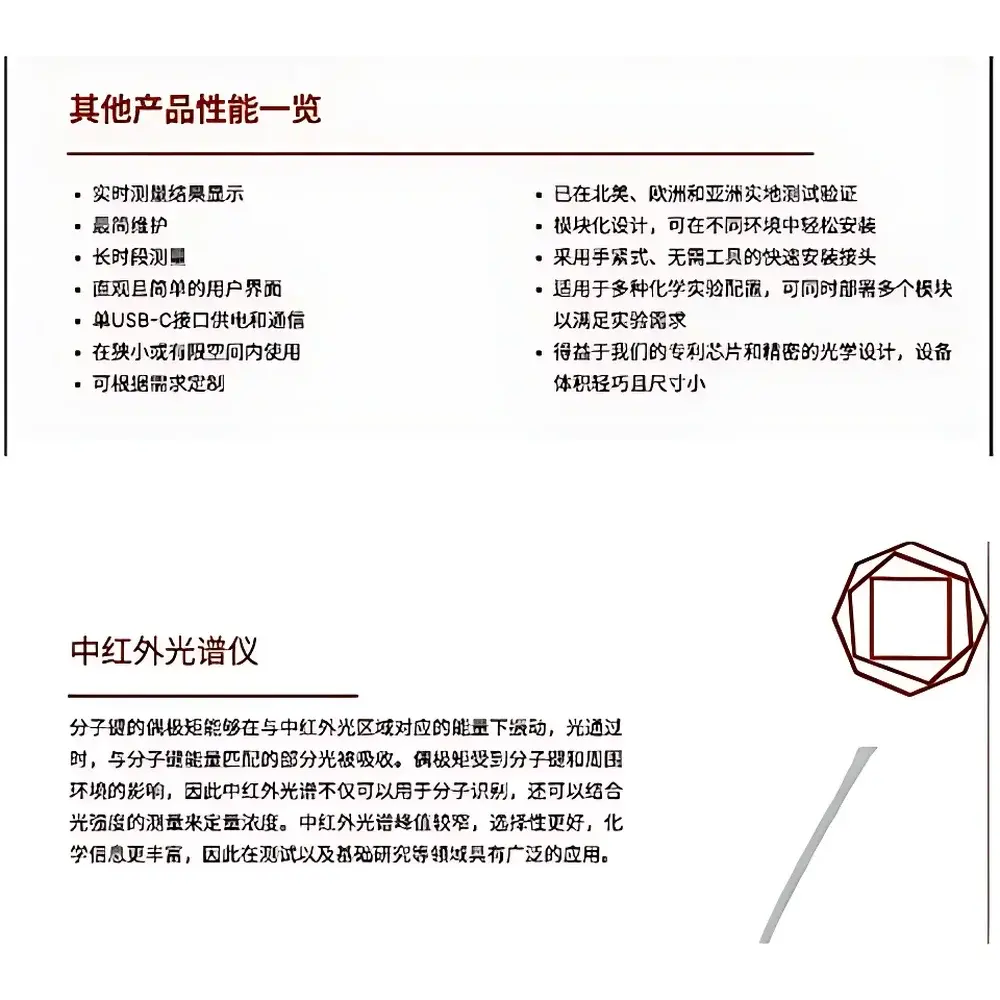
- Compact form factor (50 × 55 × 60 mm, 450 g) enables direct mounting onto reactor manifolds, glovebox ports, or inline tubing assemblies.
- Sub-300 ms spectral acquisition cycle supports kinetic profiling of fast reactions, including exothermic catalytic oxidations and polymerization initiation events.
- Robust mechanical architecture rated for operation under variable pressure (0–5 bar) and ambient thermal gradients (−15 °C to +60 °C), with IP54-rated enclosure for industrial lab use.
- USB-C powered interface eliminates need for external power supplies; compatible with standard industrial PCs and embedded controllers running Windows 10/11 LTSB editions.
- Optical path includes anti-fouling sapphire windows and configurable pathlength flow cells (0.1–1.0 mm) for liquid, vapor, or multiphase stream analysis.
- Firmware supports user-defined spectral averaging, baseline correction algorithms (e.g., asymmetric least squares), and real-time peak area integration per selected band.
Sample Compatibility & Compliance
The Paeonia IR is validated for direct analysis of organic solvents (e.g., THF, toluene, ethanol), aqueous electrolytes, hydrocarbon streams, and low-viscosity monomer mixtures. It is not intended for highly scattering colloids, opaque slurries, or corrosive halogenated media without optional quartz or Hastelloy-wetted-path accessories. The instrument complies with IEC 61326-1 (EMC for laboratory equipment), CE marking requirements, and RoHS 2015/863/EU. When deployed in GMP-regulated environments, its software supports audit-trail-enabled operation per FDA 21 CFR Part 11 (with optional electronic signature module), and raw spectral data files adhere to ASTM E131-22 (Standard Terminology Relating to Molecular Spectroscopy) metadata conventions.
Software & Data Management
The native Windows application provides synchronized time-stamped spectral acquisition, multi-channel process variable logging (via OPC UA or Modbus TCP integration), and embedded chemometric preprocessing. Users may define custom calibration models using partial least squares (PLS) regression trained on reference NIR/MIR cross-correlated datasets. All spectra are saved in vendor-neutral HDF5 format with embedded instrument metadata (wavenumber calibration coefficients, temperature logs, pressure timestamps). Batch export supports CSV (peak intensities), JCAMP-DX (for third-party spectral libraries), and MATLAB .mat compatibility. Remote monitoring is enabled via secure TLS-encrypted API endpoints for integration into MES or SCADA platforms.
Applications
- Real-time monitoring of esterification, amidation, and hydrogenation reactions in flow chemistry systems.
- In situ quantification of residual solvent content during API crystallization and lyophilization cycles.
- Catalyst deactivation tracking via carbonyl band evolution in supported metal oxide systems.
- Endpoint detection in enzymatic synthesis by monitoring amide bond formation kinetics.
- Quality-by-Design (QbD) support for continuous pharmaceutical manufacturing per ICH Q8(R2) and Q13 guidelines.
- Teaching laboratory deployment for undergraduate physical chemistry labs focusing on reaction coordinate mapping.
FAQ
Is the Paeonia IR suitable for gas-phase analysis?
Yes — when paired with a heated, pressure-regulated gas cell and optional moisture-scavenging inlet filter, it supports quantitative analysis of volatile organics and CO₂-rich streams within its 900–1800 cm⁻¹ window.
Can it be integrated with PLC-controlled reactors?
Yes — the USB-C interface supports virtual COM port emulation; analog/digital I/O triggers and process variable synchronization are implemented via included DLLs and documented RESTful API.
Does the system require routine optical alignment or lamp replacement?
No — the solid-state quantum cascade emitter and micro-bolometer detector are alignment-free and rated for >20,000 hours of continuous operation without recalibration.
What spectral resolution is achievable?
The native resolution is 4 cm⁻¹ (unapodized), optimized for robustness in field deployment; higher resolution modes (2 cm⁻¹) are available via firmware update upon request and validation.
Is method transfer possible between different Paeonia IR units?
Yes — inter-unit spectral reproducibility is maintained within ±0.5 cm⁻¹ wavenumber shift and ±2% absorbance deviation under identical environmental conditions, enabling validated method portability across sites.





