
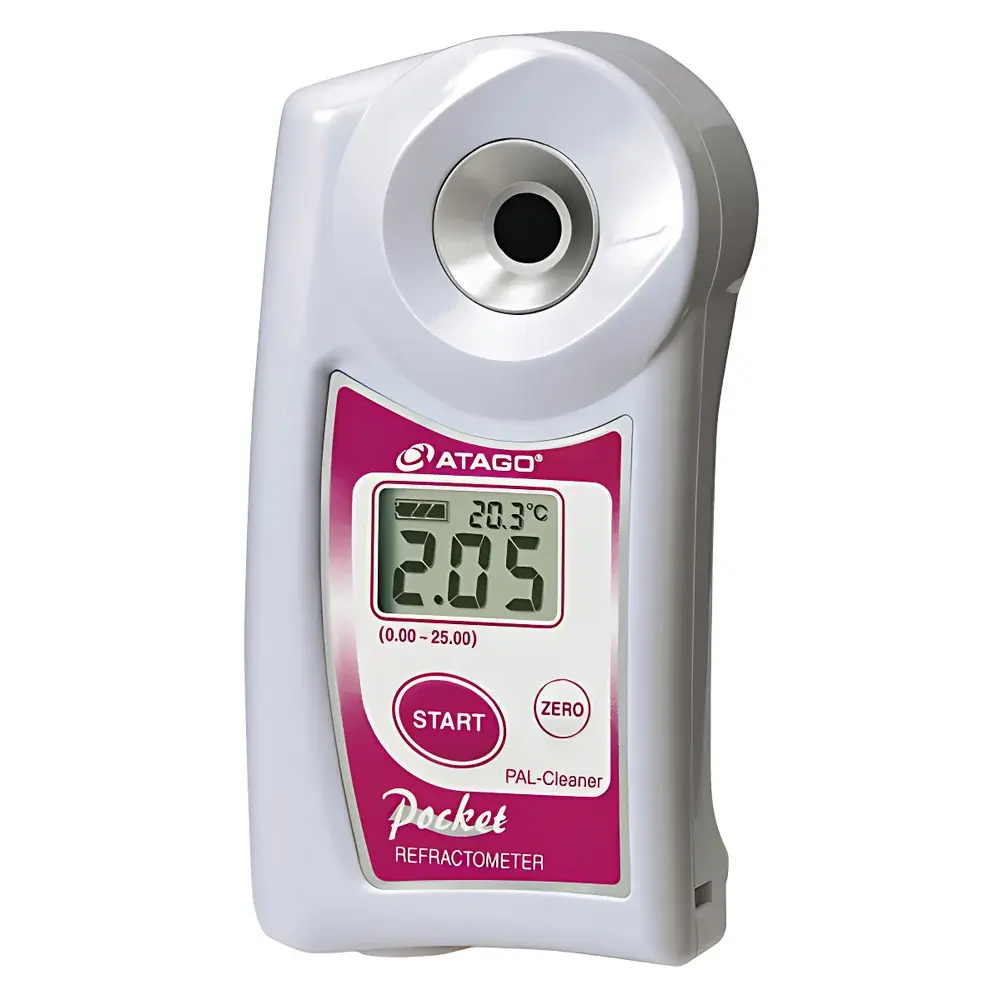
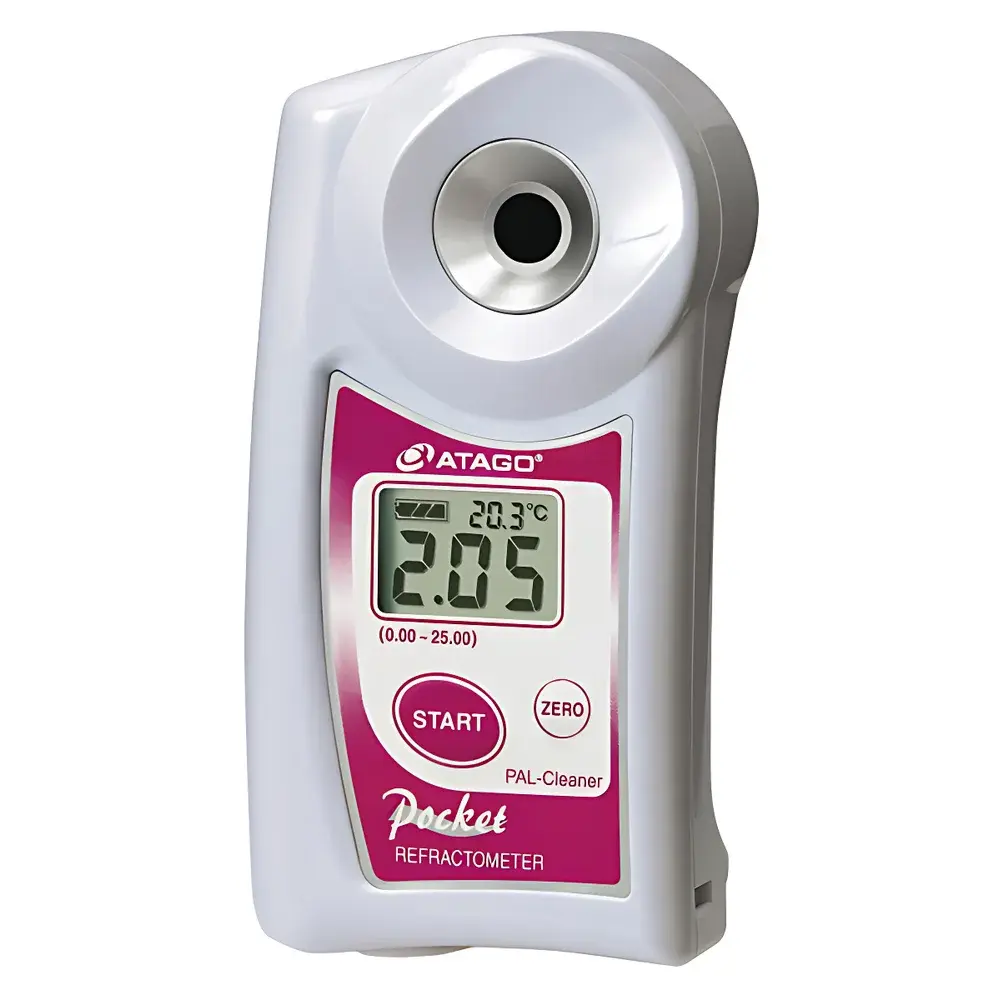
PAL-Cleaner Handheld Refractometer
| Origin | Japan |
|---|---|
| Manufacturer Type | Distributor |
| Origin Category | Imported |
| Model | PAL-Cleaner |
| Product Type | Handheld Refractometer |
| Temperature Control | None |
| Digital Display | Yes |
| Measurement Range | 0.00–25.00% (w/w) |
| Accuracy | ±0.10% (refractive index equivalent) |
| Temperature Accuracy | ±1°C |
| Operating Temperature Range | 10–100°C |
| Dimensions | 55(W) × 31(D) × 109(H) mm |
| Weight | 100 g (body only) |
| IP Rating | IP65 |
| Resolution | 0.01% (0.00–1.99%), 0.10% (2.00–25.00%) |
Overview
The PAL-Cleaner Handheld Refractometer is a precision optical instrument engineered for rapid, on-site quantification of aqueous cleaning solution concentration—primarily alkaline, acidic, or neutral detergent formulations used in industrial parts cleaning, semiconductor wafer rinsing, medical device reprocessing, and pharmaceutical equipment validation. It operates on the fundamental principle of critical-angle refractometry: light passing from a high-refractive-index prism into the sample undergoes total internal reflection at a boundary angle directly correlated to the solution’s solute concentration. Calibrated against standard sucrose or sodium hydroxide reference solutions traceable to NIST-certified materials, the PAL-Cleaner delivers repeatable, temperature-compensated readings without external calibration fluids. Its compact, ergonomic design enables single-hand operation in production lines, cleanrooms (ISO Class 5–8), and field maintenance environments where portability, contamination control, and immediate feedback are essential.
Key Features
- High-resolution digital LCD display with automatic backlight for low-light conditions and gloved operation
- Temperature-compensated measurement algorithm (ATC) covering 10–100°C, minimizing drift caused by ambient or sample thermal variance
- IP65-rated enclosure ensuring full protection against dust ingress and low-pressure water jets—suitable for wet-process zones and wash-down facilities
- Stainless-steel sample stage and optical prism optimized for chemical resistance against common caustics (e.g., NaOH ≤ 5%), citric acid, and surfactant blends
- Zero-adjustment function via built-in distilled water calibration mode, eliminating reliance on proprietary calibration kits
- Auto-power-off after 3 minutes of inactivity to extend battery life; powered by two AAA alkaline batteries (included)
Sample Compatibility & Compliance
The PAL-Cleaner is validated for use with transparent, non-viscous aqueous cleaning agents—including sodium carbonate, sodium metasilicate, tri-sodium phosphate (TSP), phosphoric acid, and low-foaming nonionic surfactants—provided turbidity remains below 5 NTU and suspended solids are absent. It is not suitable for emulsions, glycol-based coolants, or highly viscous alkaline pastes (>500 mPa·s). While not certified to ISO/IEC 17025 as a standalone metrological device, its measurement traceability aligns with ASTM D115–22 (Standard Test Methods for Refractive Index of Industrial Chemicals) and supports GLP-compliant documentation when integrated into validated cleaning process records. The absence of active temperature control limits its use in applications requiring strict thermal stabilization per USP , but its ±1°C thermal accuracy satisfies routine QC checks under ISO 15877 (plastic piping systems) and JIS K 0061 (chemical analysis standards).
Software & Data Management
The PAL-Cleaner operates as a standalone field instrument with no onboard data logging or Bluetooth/Wi-Fi connectivity. All measurements are displayed in real time and must be manually recorded or transcribed into LIMS, MES, or paper-based batch records. However, its consistent output format (numeric % w/w value + timestamped operator entry) facilitates structured data capture during cleaning validation protocols (e.g., IQ/OQ/PQ phases). For regulated environments subject to FDA 21 CFR Part 11, users may pair the device with compliant electronic notebooks (e.g., LabArchives, Veeva Vault) that enforce audit trails, electronic signatures, and version-controlled SOP adherence—though the instrument itself does not generate electronic records or require system validation.
Applications
- Real-time verification of detergent concentration in CIP (Clean-in-Place) rinse tanks prior to equipment sterilization
- Monitoring alkaline soak bath strength in automotive component manufacturing lines
- Final rinse water conductivity cross-check in medical device reprocessing per AAMI ST91
- Field verification of cleaning agent dilution ratios during HVAC coil maintenance
- Supporting ISO 14644-1 particle count correlation studies where residual surfactant levels affect airborne particulate generation
FAQ
Can the PAL-Cleaner measure ethanol or IPA-based cleaners?
No—it is calibrated exclusively for aqueous solutions with refractive index behavior matching standard detergent matrices. Alcohol-based solvents exhibit non-linear RI-concentration relationships and will yield inaccurate results.
Is temperature compensation linear across the full 10–100°C range?
Yes—the ATC algorithm applies a polynomial correction derived from empirical calibration curves across five temperature points (10, 25, 40, 60, and 100°C), ensuring <±0.15% deviation within specification bounds.
What maintenance is required to sustain accuracy?
Wipe the prism surface with lens tissue and isopropyl alcohol after each use; avoid abrasive cloths or acetone. Perform zero calibration weekly using certified distilled water (≤1 µS/cm conductivity) and verify against a NIST-traceable 5.00% NaOH standard quarterly.
Does the IP65 rating permit submersion or steam cleaning?
No—IP65 denotes protection against dust and water jets from any direction (6.3 mm nozzle, 30 kPa pressure, 3 min duration), not immersion (IP67/IP68) or autoclave exposure.



