
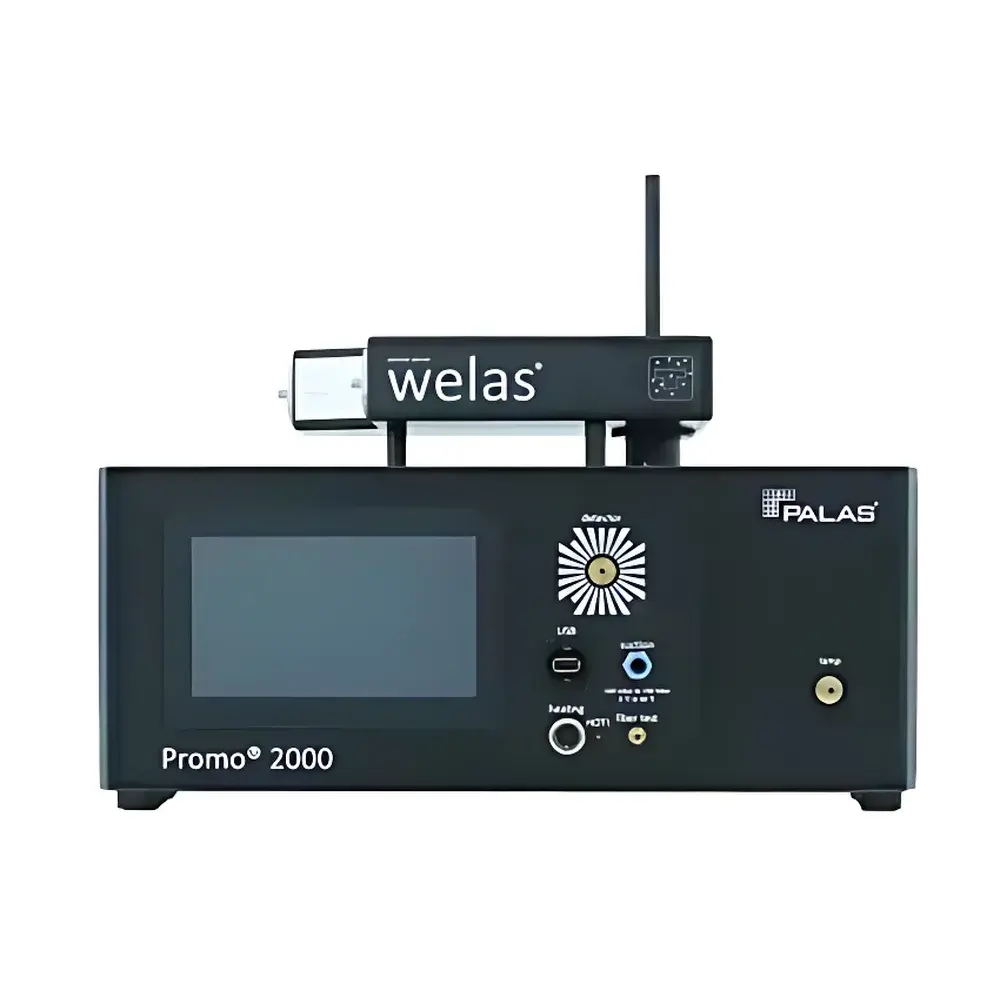
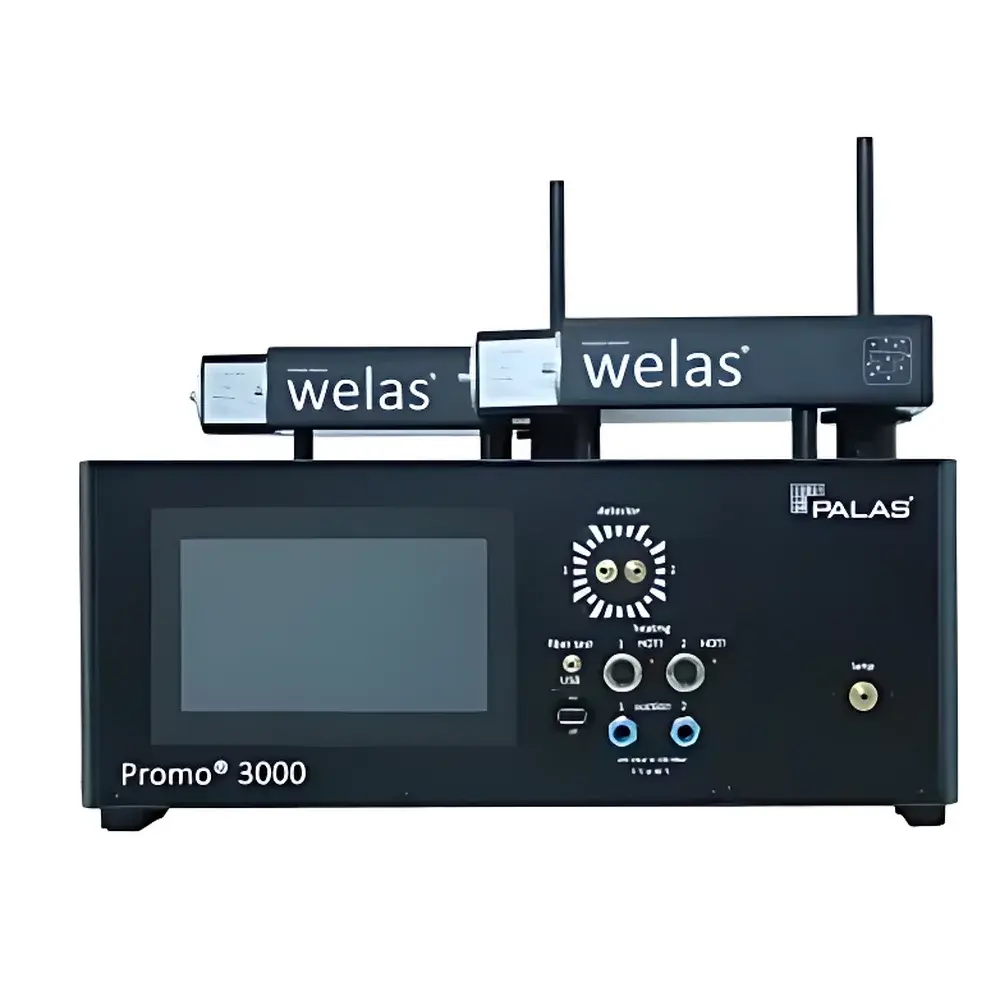
PALAS Promo Aerosol Particle Size Spectrometer
| Brand | PALAS |
|---|---|
| Origin | Germany |
| Model | Promo |
| Measurement Principle | Optical Light Scattering (90° detection angle) |
| Sampling Flow Rate | 5.0 L/min |
| Particle Size Range | 0.2–100 µm (optical equivalent diameter) |
| Maximum Concentration | 1×10⁶ particles/cm³ |
| Channel Resolution | 128 channels (32 per decade) |
| Sampling Duration | 1 s – 18 h |
| Operating Temperature Range | −90 °C to +120 °C |
| Fiber-Optic Sensor Cable Length | 3–300 m |
| Compliance | ISO 27498, ISO 16488 (aerosol instrumentation), ASTM D6625 (light scattering particle sizing) |
Overview
The PALAS® Promo Aerosol Particle Size Spectrometer is a high-precision optical instrument engineered for real-time, quantitative characterization of airborne particulate matter based on single-particle light scattering principles. It employs a stabilized xenon arc lamp as a broadband white-light source, illuminating aerosol-laden air flowing through a precisely defined sensing volume. Scattered light intensity at a fixed 90° detection angle is captured by a high-sensitivity photodetector array and converted into particle size information using rigorous Mie theory-based inversion algorithms implemented in firmware. This physics-driven approach ensures traceable, calibration-independent size assignment across the full 0.2–100 µm optical equivalent diameter range—covering ultrafine nuclei-mode particles through coarse inhalable fractions. Unlike time-of-flight or electrical mobility systems, the Promo delivers simultaneous number- and volume-weighted size distributions without cross-interference, enabling direct compliance assessment against regulatory thresholds (e.g., PM₁₀, PM₂.₅, and ultrafine particle metrics) and supporting fundamental aerosol process studies.
Key Features
- Patented T-shaped aperture sensor design eliminates edge diffraction artifacts and mitigates coincidence errors during high-concentration sampling—enabling accurate counting up to 1×10⁶ particles/cm³.
- 128-channel resolution (32 bins per decade) provides exceptional granularity in bimodal or polydisperse distributions, critical for source apportionment and coagulation modeling.
- Fiber-optic decoupling of sensor head and electronics unit allows physical separation up to 300 m, permitting deployment in extreme environments: cryogenic chambers (−90 °C), high-temperature ducts (+120 °C), explosive atmospheres (ATEX Zone 1 compatible with optional housing), and pressurized vessels.
- Stable 5.0 L/min volumetric flow control ensures reproducible sampling across variable backpressure conditions; integrated mass flow sensor and thermal compensation maintain accuracy within ±2% over ambient temperature fluctuations.
- Real-time data acquisition supports configurable integration times from 1 second to 18 hours, facilitating both transient event capture (e.g., combustion bursts) and long-term trend analysis.
Sample Compatibility & Compliance
The Promo spectrometer is validated for use with liquid, solid, and mixed-phase aerosols—including combustion soot, pharmaceutical powders, catalyst fines, sea spray, and engineered nanomaterials. Its optical detection principle imposes no charging or drying requirements, preserving native particle morphology and hygroscopic state. The system conforms to ISO 27498 (aerosol measurement terminology), ISO 16488 (performance testing of optical particle counters), and ASTM D6625 (standard practice for calibrating optical particle counters). When operated with certified reference aerosols (e.g., PSL, DEHS), it meets GLP data integrity requirements, including full audit trails, user access controls, and electronic signature support per FDA 21 CFR Part 11 when paired with optional PALAS DiSCmini software modules.
Software & Data Management
Data acquisition and analysis are managed via PALAS DiSCmini Control Software (v5.x), a Windows-based platform supporting multi-instrument synchronization, automated calibration logging, and batch processing of time-series distributions. Raw scatter pulse trains are stored in HDF5 format for post-acquisition reanalysis using alternative inversion kernels. Export options include CSV (for Excel/Python integration), XML (for LIMS ingestion), and PDF reports compliant with ISO/IEC 17025 documentation standards. Remote monitoring is enabled via TCP/IP interface; OPC UA support allows seamless integration into industrial SCADA and MES systems.
Applications
- Environmental monitoring: Ambient PM source profiling, urban roadside aerosol dynamics, and boundary layer transport studies.
- Occupational health & safety: Real-time exposure assessment in semiconductor cleanrooms, battery manufacturing, and welding fume monitoring.
- Pharmaceutical development: Dry powder inhaler (DPI) plume characterization, nasal spray droplet sizing, and sterile fill-finish environmental qualification.
- Energy & combustion research: Soot nucleation kinetics in gas turbines, biomass burner optimization, and diesel particulate filter (DPF) regeneration efficiency validation.
- Materials science: Nanoparticle synthesis reactor feedback control, aerosol-based thin-film deposition monitoring, and catalyst deactivation tracking.
FAQ
Does the Promo require periodic recalibration with reference particles?
Yes—annual verification using NIST-traceable polystyrene latex (PSL) standards is recommended; factory calibration certificates are provided with each instrument.
Can the sensor operate continuously in saturated humidity conditions?
The standard sensor housing is rated IP65; for condensing environments, optional heated inlet and hydrophobic membrane filters are available to prevent optical window fouling.
Is Mie theory inversion valid for non-spherical particles like ash or fibers?
Mie theory assumes spherical, homogeneous particles; for irregular morphologies, the output represents optical-equivalent diameter—interpreted as aerodynamic or mobility diameter only after empirical correlation with cascade impactor or DMA data.
What computing resources are required for real-time 128-channel processing?
A Windows 10/11 PC with ≥8 GB RAM, SSD storage, and Intel Core i5 or higher is sufficient; no GPU acceleration is required.
How is traceability maintained during fiber-optic transmission over 200 m?
PALAS uses multimode graded-index fiber with proprietary signal conditioning to preserve pulse rise time (<10 ns) and amplitude fidelity—verified per IEC 61290-1-3.







