
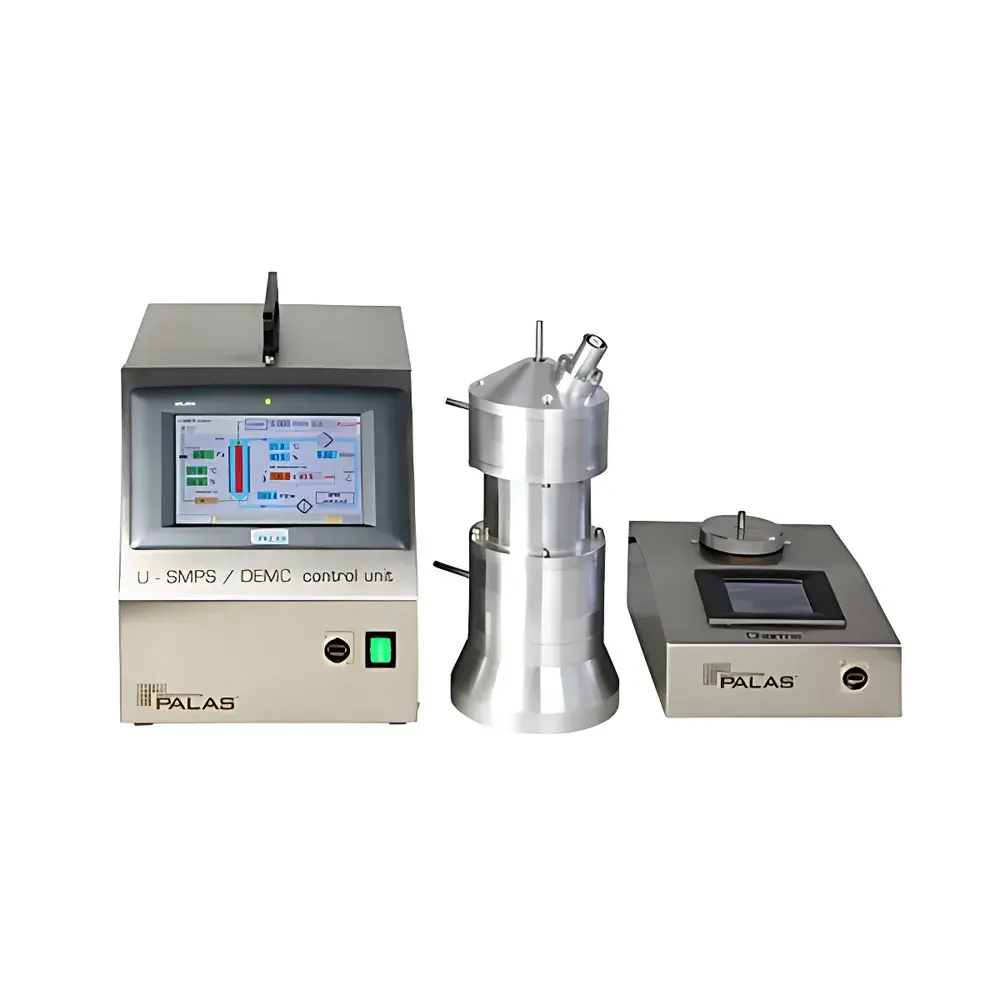
Palas U-SMPS 1700 Scanning Mobility Particle Sizer
| Brand | Palas |
|---|---|
| Origin | Germany |
| Model | U-SMPS 1700 |
| Particle Size Range | 2–400 nm |
| Particle Concentration Range | 0–10⁸ particles/cm³ |
| Classification Channels | Up to 128 (logarithmic or linear stepping) |
| Measurement Time per Scan | As low as 30 s |
| Compliance | ISO 15900 (Differential Mobility Analysis), EN 13274-6, ASTM F3233 |
| Interface Options | USB, LAN, WLAN, RS-232/485 |
| Display | 7-inch capacitive touchscreen GUI |
| Data Logging | Integrated high-resolution time-stamped recorder |
| Interoperability | Compatible with third-party DMAs, CPCs (e.g., TSI, Grimm), and electrometers |
Overview
The Palas U-SMPS 1700 Scanning Mobility Particle Sizer is a precision-engineered differential mobility analyzer system designed for high-fidelity, traceable measurement of aerosol particle size distributions in the sub-100 nm to 400 nm range. It operates on the physical principle of differential electrical mobility classification—defined in ISO 15900—as implemented via a compact, high-stability Differential Mobility Classifier (DMC), formerly known as a DMA. Charged aerosol particles are introduced into the classifier’s laminar sheath flow; under an applied electric field, particles with specific electrical mobilities migrate toward the central electrode and exit through a narrow slit. This mobility-to-diameter mapping is calibrated using NIST-traceable reference standards and validated against monodisperse aerosols generated by electrospray or nano-condensation nuclei generators. The classified particles are then quantified using a high-sensitivity Palas Charme aerosol electrometer, which directly measures total charge flux (in fA) and converts it to particle number concentration via Faraday’s law and known charge distribution models (e.g., Boltzmann equilibrium). Unlike optical or diffusion-based sizing techniques, this method provides absolute, calibration-free size assignment rooted in fundamental electrokinetic theory—making the U-SMPS 1700 a primary reference instrument for nanoparticle metrology, especially in regulatory and inter-laboratory comparison contexts.
Key Features
- High-resolution mobility scanning across up to 128 discrete size channels, configurable in linear or logarithmic voltage ramping modes
- Short-column DMC design optimized for 2–400 nm range, delivering enhanced classification resolution and reduced diffusion broadening
- Integrated 7-inch industrial-grade capacitive touchscreen GUI enabling fully autonomous operation without external PC
- Onboard data logger with timestamped, dual-format (linear & log-scale) real-time visualization and internal storage (≥16 GB)
- Multi-interface connectivity: USB 2.0, 10/100 Mbps Ethernet (TCP/IP), IEEE 802.11 b/g/n Wi-Fi, and isolated RS-232/485 for legacy integration
- Open architecture supporting interoperability with third-party DMAs (e.g., TSI 3081, Grimm 5.410), condensation particle counters (CPCs), and electrometers
- Robust mechanical construction compliant with DIN EN 61326-1 (EMC) and DIN EN 61000-6-2/6-4, suitable for laboratory, cleanroom, and mobile test-bench deployment
Sample Compatibility & Compliance
The U-SMPS 1700 is engineered for stable operation across aerosol concentrations from background levels (≤10² cm⁻³) up to 10⁸ cm⁻³—enabling direct analysis of undiluted combustion exhaust, nanoparticle synthesis reactors, and filter challenge tests. Its electrometer-based detection eliminates optical saturation effects and requires no refractive index assumptions. All critical components—including the DMC core, ion charger (X-ray or soft X-ray source, optional), and electrometer—are assembled and calibrated in Palas’ certified German production facility under ISO 9001:2015 and ISO/IEC 17025-accredited quality management systems. The system meets the metrological requirements of ISO 15900:2020 (Determination of particle size distribution — Electrical mobility analysis for particles in the nanometer size range), EN 13274-6 (Workplace atmospheres — Determination of particle size distribution — Electrical mobility spectrometry), and ASTM F3233-21 (Standard Practice for Calibration of Nanoparticle Sizing Instruments). Full audit trails, user access control, and electronic signature support align with GLP and FDA 21 CFR Part 11 readiness when paired with Palas Evaluation Software v4.x.
Software & Data Management
The included Palas Evaluation Software (v4.3+) runs on Windows 10/11 and provides comprehensive post-processing capabilities: multi-scan averaging, mobility-to-diameter conversion using Köhler theory and charge state deconvolution (up to 3 charge modes), statistical moment analysis (D₅₀, GSD, skewness), batch export in CSV, HDF5, and XML formats compatible with MATLAB, Python (pandas/h5py), and LabVIEW. Raw electrometer current traces, voltage ramp profiles, and environmental metadata (temperature, pressure, flow rates) are stored with microsecond time alignment. Remote monitoring and configuration are supported via HTTP API and Modbus TCP protocols. Data integrity safeguards include cyclic redundancy checks (CRC-32), write-once archive mode, and SHA-256 hash generation for exported datasets—ensuring full traceability for ISO/IEC 17025 audits.
Applications
- Primary calibration of ultrafine CPCs (e.g., TSI 3776, Palas UF-CPC) and optical particle sizers (OPS) in accredited metrology labs
- Real-time characterization of nanoparticle emissions from internal combustion engines, gas turbines, and 3D printing processes
- Aerosol filtration efficiency testing per ISO 16890, EN 1822, and ASHRAE 52.2—particularly for HEPA/ULPA media challenged with polydisperse nanoscale aerosols
- Inhalation toxicology studies requiring precise delivery of monodisperse or narrowly distributed nanoparticles to exposure chambers
- Process validation and release testing of nanomaterials in pharmaceutical (e.g., lipid nanoparticles, mRNA carriers) and semiconductor manufacturing environments
- Workplace exposure assessment in nanomaterial handling facilities, aligned with EU REACH and OSHA nanoparticle exposure guidelines
FAQ
What is the minimum detectable particle size, and how is it verified?
The lower detection limit is 2 nm, validated using tetracontane (C₄₀H₈₂) clusters and silver nanoparticles traceable to NIST SRM 1963. Verification includes mobility calibration with singly charged ions and zero-air background subtraction.
Can the U-SMPS 1700 operate unattended for extended periods?
Yes—integrated data logging, watchdog timers, automatic flow stabilization, and remote diagnostics enable continuous 24/7 operation for up to 30 days without manual intervention.
Is Zeta potential or molecular weight measurement supported?
No—U-SMPS is strictly a mobility-based size and number concentration analyzer. Zeta potential requires electrophoretic light scattering (e.g., Malvern Zetasizer); molecular weight determination falls outside its physical operating domain.
How does the system handle high-concentration aerosols without saturation?
The Charme electrometer employs a high-dynamic-range current-to-frequency converter (1 fA–100 nA) with auto-ranging and active baseline drift compensation, eliminating signal compression even at 10⁸ cm⁻³.
Does Palas provide installation qualification (IQ) and operational qualification (OQ) documentation?
Yes—factory-issued IQ/OQ protocols, calibration certificates (including DMC transfer function and electrometer linearity), and metrological uncertainty budgets are supplied with each unit.



