
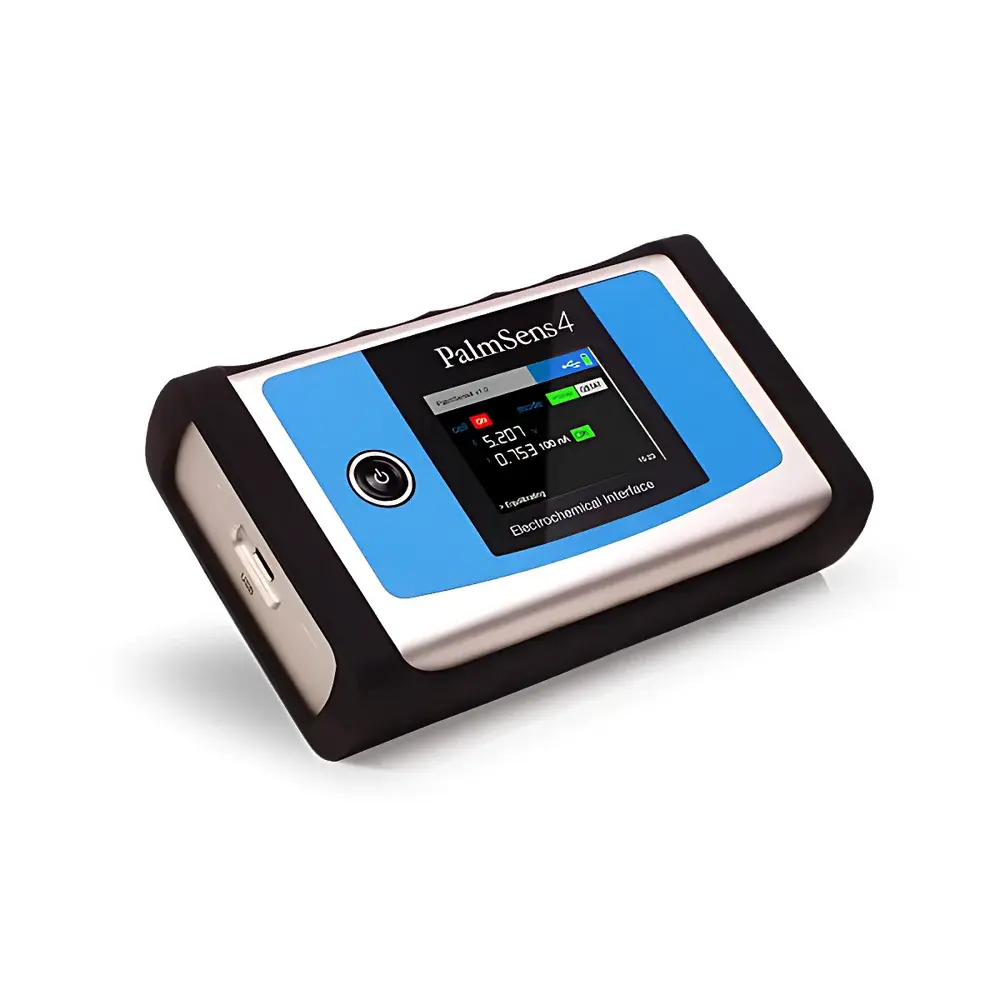
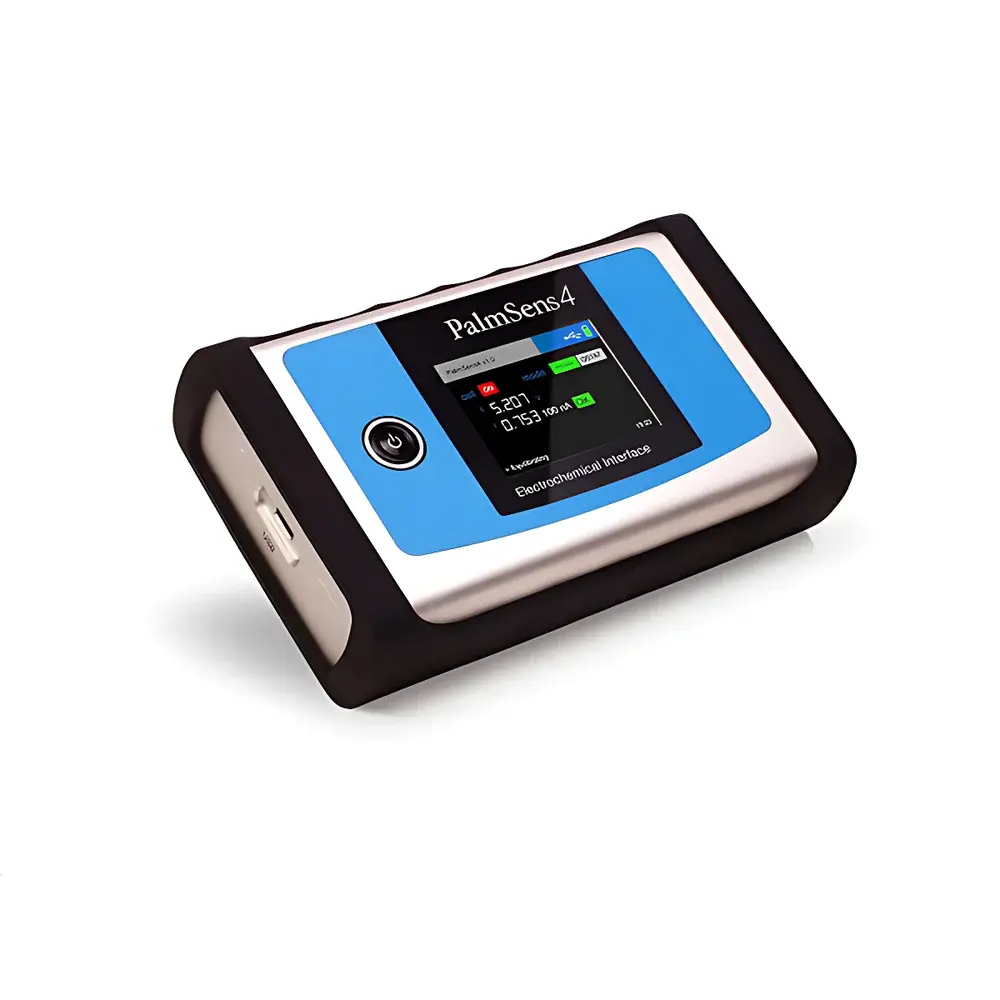
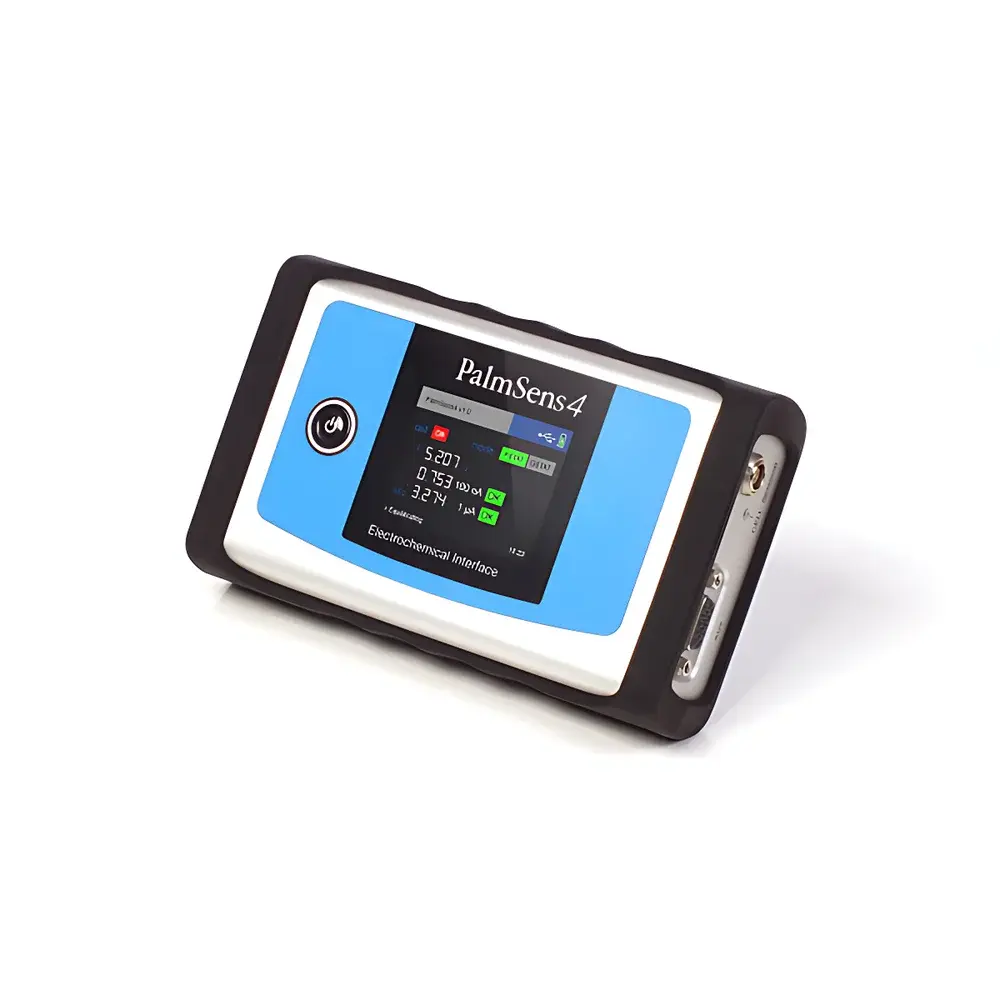
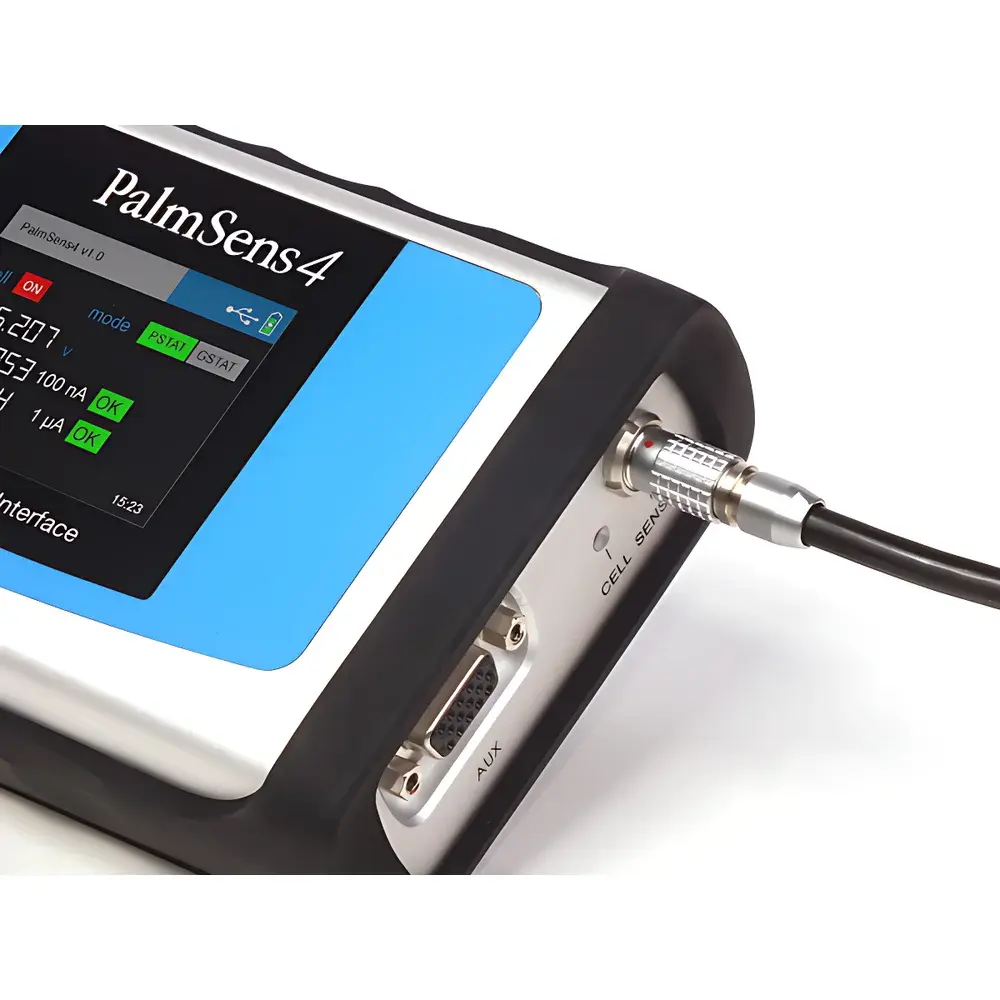
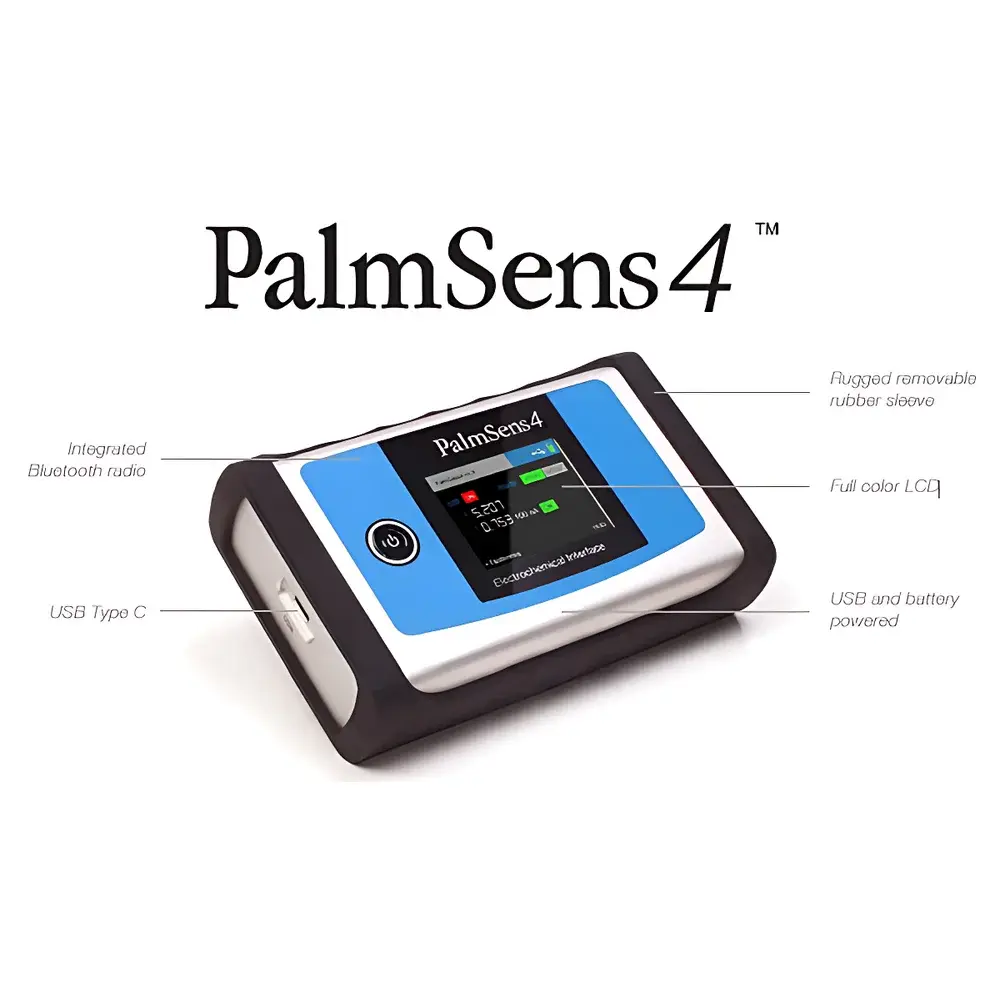
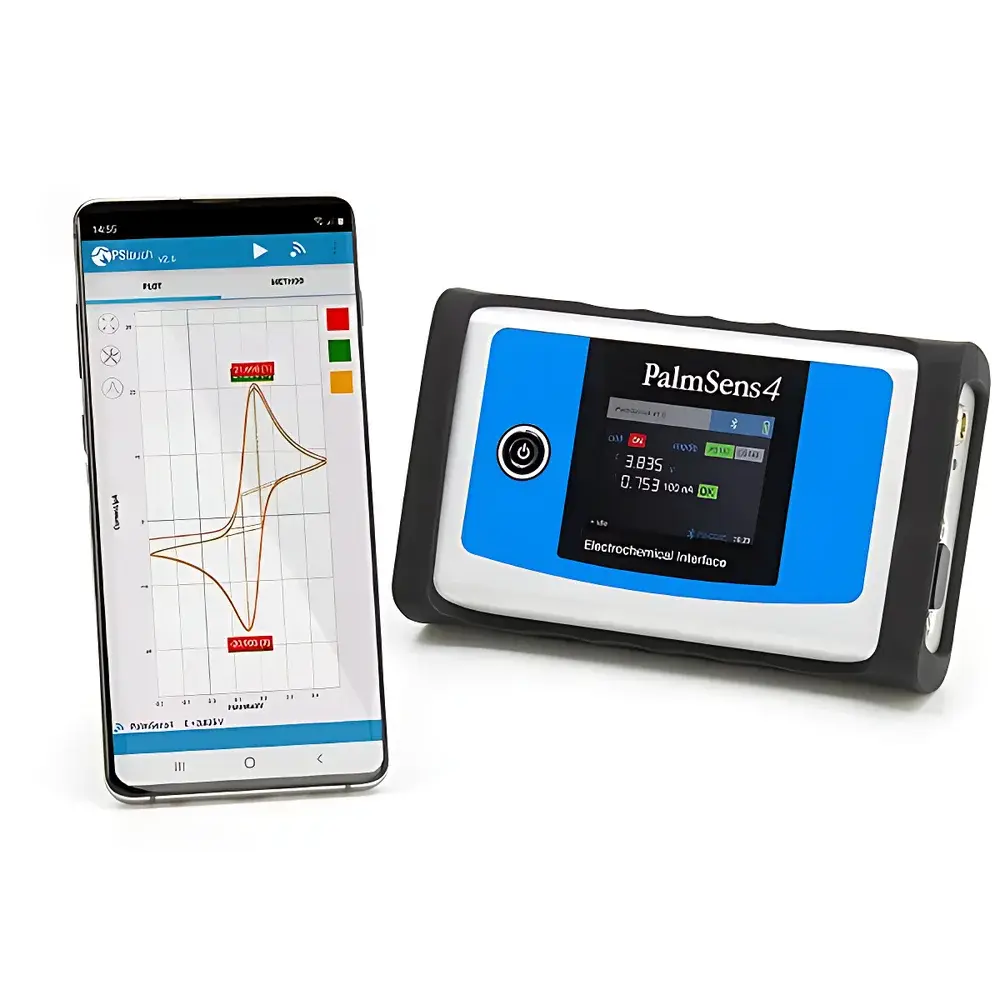
PalmSens4 Portable Electrochemical Workstation
| Brand | PalmSens |
|---|---|
| Origin | Netherlands |
| Model | PalmSens 4 |
| Instrument Type | Portable Electrochemical Workstation |
| Channel Count | Single-Channel |
| Current Range | 100 pA to 10 mA (9 ranges) |
| Current Accuracy | ≤ 0.1 % of Full-Scale Reading (FSR) |
| Potential Accuracy | ≤ 0.1 % of FSR |
| Potentiostatic Range | ±10.000 V |
| EIS Frequency Range | 10 µHz to 1 MHz |
Overview
The PalmSens4 Portable Electrochemical Workstation is a compact, battery- or USB-powered potentiostat/galvanostat engineered for high-fidelity electrochemical measurements in laboratory, field, and educational environments. Based on a 18-bit analog-to-digital architecture, it implements classical potentiostatic and galvanostatic control principles with precision voltage sourcing, low-noise current measurement, and real-time digital signal processing. Its design adheres to fundamental electrochemical instrumentation standards—including controlled-potential (potentiostatic), controlled-current (galvanostatic), and impedance spectroscopy (EIS) modalities—enabling quantitative analysis of electrode kinetics, interfacial capacitance, charge-transfer resistance, and diffusion-controlled processes. The device operates across a wide dynamic range (±10 V potential window, 100 pA–10 mA current), making it suitable for both ultra-trace sensing (e.g., heavy metal detection via anodic stripping voltammetry) and higher-current applications such as battery cycling or corrosion monitoring.
Key Features
- Single-channel portable workstation with integrated rechargeable Li-ion battery and USB-C connectivity for uninterrupted operation in remote or mobile settings
- High-resolution 18-bit ADC providing 76.3 µV potential resolution over ±10 V range and sub-femtoampere current resolution (5 fA on 100 pA range)
- Full EIS capability from 10 µHz to 1 MHz with programmable AC amplitude (1 mV–0.25 Vrms) and phase-sensitive detection
- Onboard 8 GB non-volatile memory enabling automatic real-time data logging without external PC dependency
- Dual software ecosystem: PSTrace (Windows-based, GLP-compliant with audit trail, method templates, and report export) and PStouch (Android app via Bluetooth 5.0 for field visualization and basic experiment initiation)
- Support for advanced electrochemical techniques including cyclic voltammetry (CV), differential pulse voltammetry (DPV), square-wave voltammetry (SWV), chronoamperometry (CA), chronopotentiometry (CP), open-circuit potential (OCP), and multi-step protocols
- Optional hardware modules: BiPot dual-potentiostat interface, IR compensation circuitry, MUX8/MUX16 multiplexer for sequential multi-electrode measurements, and differential electrometer amplifier (DEA) for high-impedance biosensor interfaces
Sample Compatibility & Compliance
The PalmSens4 interfaces with standard three-electrode electrochemical cells (working, reference, counter) using industry-standard BNC and banana-jack connectors. It supports conventional screen-printed electrodes (SPEs), rotating disk electrodes (RDEs), microelectrodes, and custom sensor arrays. Its electrical specifications comply with ISO/IEC 17025 calibration traceability requirements when used with NIST-traceable reference electrodes and certified resistors. For regulated environments, PSTrace software supports 21 CFR Part 11 compliance through user authentication, electronic signatures, and immutable audit trails—making it suitable for QC/QA workflows under GMP/GLP frameworks. All firmware and driver packages are CE-marked and RoHS-compliant.
Software & Data Management
PSTrace v6.x provides full experimental control, real-time plotting, automated parameter optimization, and post-acquisition analysis (e.g., peak integration, Nyquist/Bode fitting, equivalent circuit modeling). Data files are saved in open-format .psd (binary) and exportable CSV/PDF/TIFF formats. Version history, metadata tagging (operator, date, sample ID, method), and folder-based project organization ensure reproducibility. PStouch enables rapid setup and live waveform preview on Android devices; however, full method definition and advanced analysis remain desktop-exclusive. Both platforms support synchronization via cloud storage (user-configured) and local network sharing—facilitating collaborative research and instrument fleet management.
Applications
- Environmental monitoring: On-site detection of Pb²⁺, Cd²⁺, As³⁺, and Hg²⁺ in water using stripping voltammetry
- Biosensor development: Label-free immunosensing and DNA hybridization studies via impedance change quantification
- Corrosion science: Electrochemical noise analysis (ENA), polarization resistance (Rp), and EIS-based coating degradation assessment
- Energy materials: Half-cell characterization of battery anodes/cathodes, supercapacitor electrode stability testing
- Academic teaching: Hands-on electrochemistry labs covering redox kinetics, diffusion layer theory, and electron transfer mechanisms
- Point-of-care diagnostics: Integration with disposable SPEs for rapid clinical biomarker screening
FAQ
What power sources does the PalmSens4 support?
It operates from its internal rechargeable lithium-ion battery (up to 8 hours continuous use) or via USB-C bus power (5 V / 1.5 A), eliminating need for external adapters.
Is the PalmSens4 compatible with third-party electrodes and cells?
Yes—it accepts all standard electrochemical cells with 3-mm banana plugs or BNC connections, including commercial SPEs, glassy carbon rods, Ag/AgCl reference electrodes, and custom microfluidic electrochemical chips.
Can multiple PalmSens4 units be synchronized for parallel measurements?
Not natively; however, time-synchronized experiments can be coordinated via external TTL triggers or software scripting using PSTrace’s COM API and LabVIEW drivers.
Does the device meet regulatory requirements for quality-controlled laboratories?
When used with PSTrace’s audit trail, user role management, and electronic signature features, it satisfies core elements of FDA 21 CFR Part 11, EU Annex 11, and ISO 17025 documentation requirements.
How is data integrity ensured during field deployment?
All measurements are automatically timestamped and written to the onboard 8 GB flash memory in real time—even if Bluetooth or USB connection is lost—preventing data loss during transport or intermittent connectivity.




