
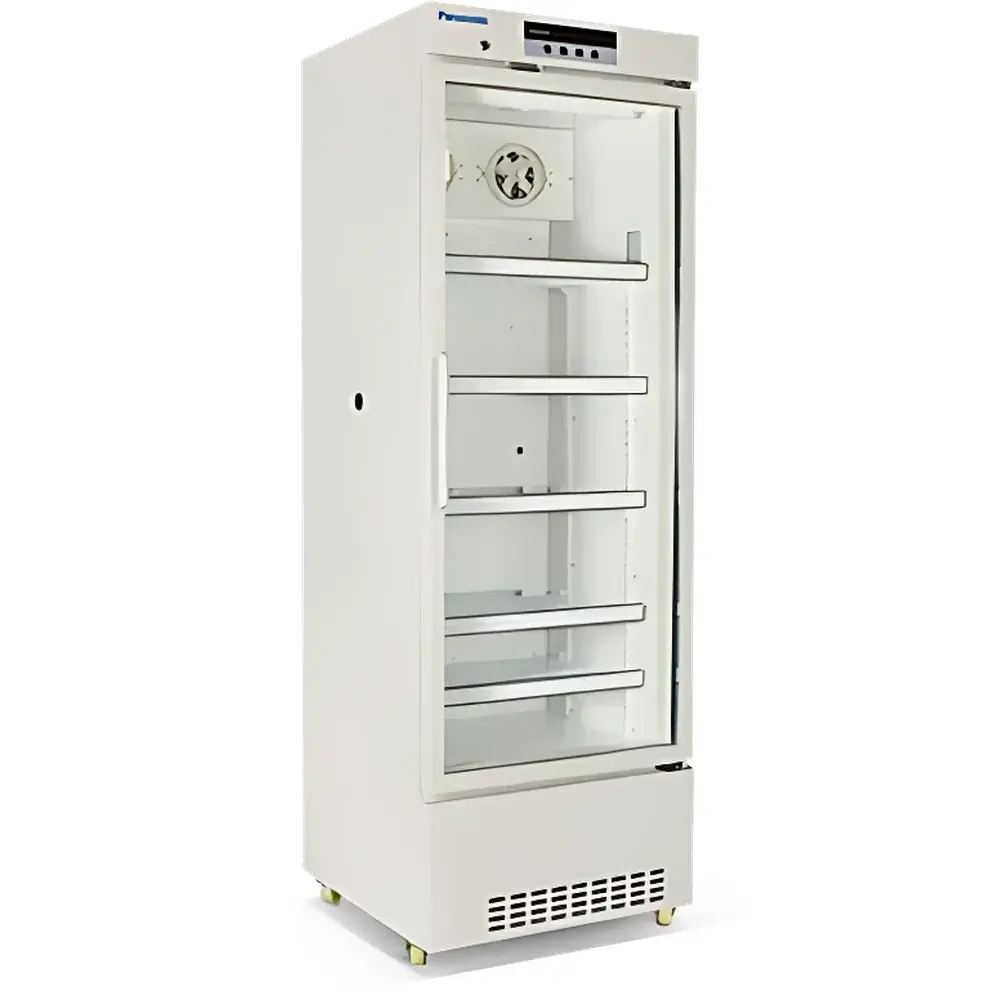
Panasonic MIR-163 & MIR-263 Microprocessor-Controlled Forced-Air Incubators
| Brand | Panasonic (Sanyo) |
|---|---|
| Origin | Japan |
| Model | MIR-163, MIR-263 |
| Temperature Range | Ambient +5°C to +80°C (at 20°C ambient) |
| Temperature Uniformity | ±1°C (at 20°C ambient, setpoint 37°C, no load) |
| Capacity | 93 L / 153 L |
| External Dimensions (W×D×H) | 580×595×820 mm / 730×645×870 mm |
| Internal Dimensions (W×D×H) | 450×460×450 mm / 600×510×500 mm |
| Net Weight | 50 kg / 67 kg |
| Power Consumption | 200 W / 300 W (220 V, 50 Hz) |
| Heating System | Sheathed Heater |
| Control Method | Microprocessor-based PID Control |
| Temperature Sensor | Thermistor |
| Temperature Stability | ±0.2°C (at 37°C), ±0.5°C (60–80°C) |
| Alarm | Dual visual/audible deviation alarm (±2.5°C offset), independent overheat protection |
| Timer | 00:00–99:59 h:min, auto-stop function |
| Display & Interface | LED display with touch-key keypad and key-lock function |
| Construction | Exterior – pre-painted steel |
Overview
The Panasonic MIR-163 and MIR-263 are microprocessor-controlled, forced-air incubators engineered for precision temperature maintenance in microbiological, mycological, and cell culture applications. Designed and manufactured in Japan, these units employ a robust sheathed heating system coupled with a microprocessor-based PID control algorithm to deliver exceptional thermal stability and repeatability. Unlike natural convection models, the MIR series leverages optimized internal airflow dynamics—enhanced by chamber geometry and heater placement—to ensure uniform heat distribution across the entire working volume, critical for consistent fungal growth, bacterial enumeration, or environmental stress testing. The operating range spans from ambient +5°C to +80°C, accommodating both mesophilic culture protocols (e.g., 30–37°C) and thermotolerant assays (e.g., 45–60°C for Aspergillus or Penicillium screening). All models comply with IEC 61010-1 safety standards for laboratory equipment and are constructed to meet GLP-aligned operational integrity requirements.
Key Features
- Microprocessor PID temperature control with real-time thermistor feedback, achieving ±0.2°C stability at 37°C and ±0.5°C at elevated setpoints (60–80°C)
- High-uniformity forced-air circulation architecture—validated at ±1°C uniformity (measured per ISO 15270:2018 Annex B protocol at 37°C, no-load condition)
- Dual-stage thermal safety: programmable deviation alarm (±2.5°C from setpoint) and independent mechanical overheat cutoff
- Full-function digital timer (00:00–99:59 h:min) with auto-stop, delayed start, and post-cycle hold modes for unattended operation
- SUS304 stainless-steel interior chamber and shelving—corrosion-resistant, non-porous, and compatible with alcohol-, bleach-, and hydrogen-peroxide-based decontamination
- LED display with tactile touch-key interface and configurable key-lock to prevent accidental parameter changes during active runs
- Glass wool insulation layer minimizes thermal bridging and reduces external surface temperature rise under continuous operation
Sample Compatibility & Compliance
The MIR-163 and MIR-263 support a broad spectrum of biological sample formats including Petri dishes, multi-well plates, test tubes, slant cultures, and Erlenmeyer flasks—up to 15 cm in height on standard shelves. Their stainless-steel interiors and absence of humidity control make them particularly suitable for mold incubation, antibiotic susceptibility testing (AST), and aerobic/anaerobic culture validation where condensation must be avoided. Units are CE-marked and conform to IEC 61010-1 (Safety Requirements for Electrical Equipment for Measurement, Control, and Laboratory Use) and IEC 61326-1 (EMC requirements). While not certified for USP or FDA 21 CFR Part 11 out-of-the-box, audit-ready operation is supported via manual logbook documentation, timestamped alarm records, and user-accessible calibration verification points.
Software & Data Management
These incubators operate as standalone instruments without proprietary software or network connectivity. All operational parameters—including setpoint, elapsed time, current chamber temperature, alarm status, and timer countdown—are continuously displayed on the front-panel LED interface. Event logs are not stored digitally; however, the dual-alarm system provides traceable visual (LED flash) and audible (buzzer) indicators for deviations and overtemperature events, enabling immediate operator response and manual entry into lab notebooks. For regulated environments, users may integrate external data loggers (e.g., compliant with ASTM E2810-21) via the optional analog output port (available on select configurations) to capture temperature history for GxP audits.
Applications
- Mycological cultivation and identification of filamentous fungi (e.g., Aspergillus, Trichophyton, Fusarium) per CLSI M38-A3 guidelines
- Bacterial growth promotion testing for sterility assurance and media performance qualification
- Environmental stress simulation for pharmaceutical stability studies (e.g., accelerated growth conditions per ICH Q1A)
- Enzyme activity assays requiring stable thermal environments between 30°C and 65°C
- Quality control of medical devices involving bioburden recovery validation (ISO 11737-1)
- Educational microbiology labs requiring durable, low-maintenance incubation platforms
FAQ
Are the MIR-163 and MIR-263 suitable for CO₂ or humidity-controlled applications?
No—these are dry, forced-air incubators with no integrated CO₂ regulation or humidification system. They are optimized for ambient-humidity microbial growth protocols.
Can the units be calibrated internally by the user?
Yes—each unit includes a user-accessible calibration offset function (±5.0°C range) via the front panel, allowing field adjustment against a NIST-traceable reference thermometer.
What is the recommended maintenance interval?
Panasonic recommends quarterly inspection of door gasket integrity, annual verification of temperature uniformity per ISO 15270, and biannual cleaning of the rear ventilation grilles to maintain airflow efficiency.
Is third-party validation support available?
While Panasonic does not provide IQ/OQ documentation directly, the MIR series’ design consistency, documented sensor linearity, and repeatable control performance enable straightforward vendor- or lab-led qualification using standard templates aligned with ASTM E2500-22.
Do these incubators meet energy efficiency standards for EU laboratories?
Yes—the MIR-163 (200 W) and MIR-263 (300 W) fall within Class A+ of the EU Energy Label framework for laboratory equipment when operated at 37°C, verified per EN 60068-3-5.




