
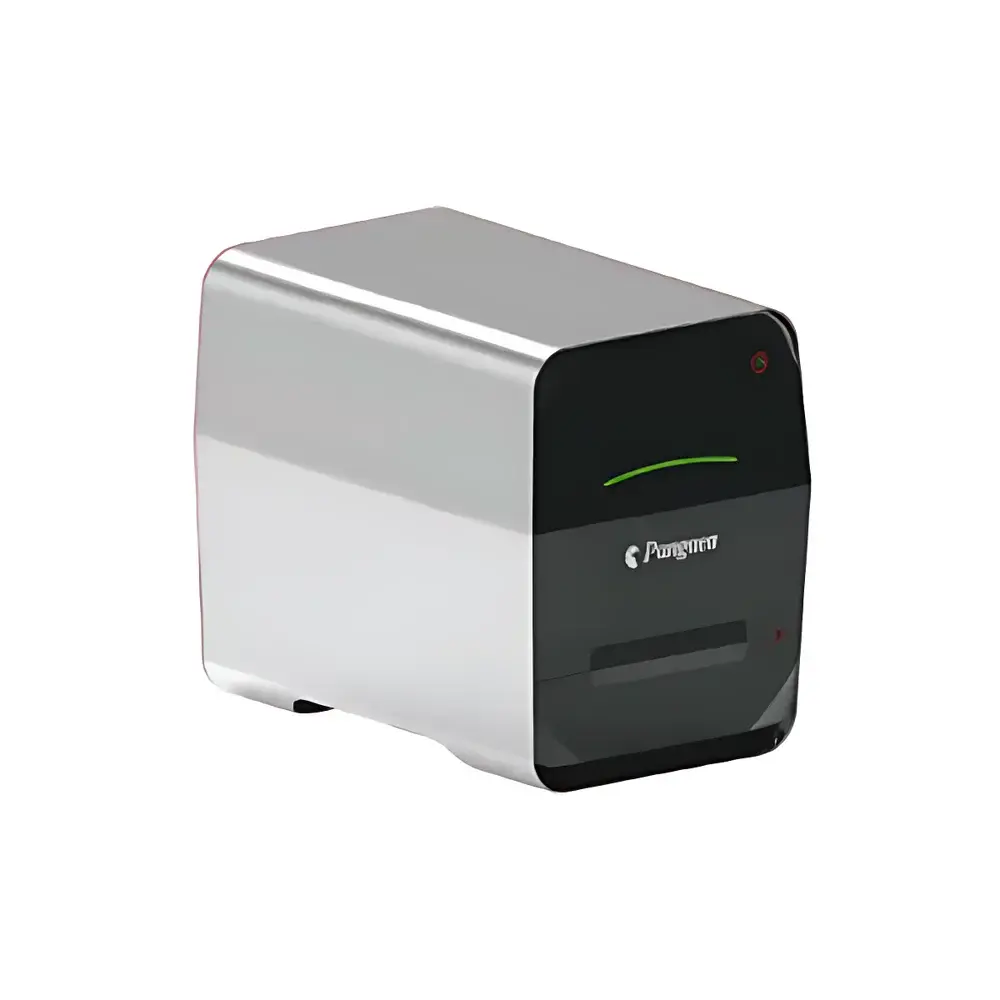
Pangaea by Aperbio Fast Real-Time Fluorescent Quantitative PCR System
| Brand | Aperbio |
|---|---|
| Origin | Jiangsu, China |
| Manufacturer Type | Original Equipment Manufacturer (OEM) |
| Instrument Type | Real-Time Fluorescent Quantitative PCR System |
| Sample Throughput | 96-well format |
| Heating Rate | 8.5 °C/s |
| Temperature Accuracy | ±0.1 °C |
| Well-to-Well Temperature Uniformity | ±0.15 °C |
| Thermal Control Technology | Marlow Semiconductor-based Peltier Modules |
| Optical Detection Architecture | Integrated Waveguide-Based Fluorescence Detection |
| Software Platform | CqMAN Quantitative Analysis Suite (Multi-language: English & Chinese) |
| Consumable Compatibility | Automated pressure-assisted sealing for both 0.1 mL and 0.2 mL tube formats |
| Automation Interface | RS-232/USB/Ethernet |
Overview
The Pangaea Fast Real-Time Fluorescent Quantitative PCR System by Aperbio is an engineered platform designed for high-fidelity nucleic acid amplification and quantification under stringent thermal and optical control. Based on the fundamental principle of real-time polymerase chain reaction (qPCR), the system monitors target DNA amplification in real time using sequence-specific fluorescent probes (e.g., SYBR Green I, TaqMan®, Molecular Beacons) or intercalating dyes. Its core architecture integrates Marlow semiconductor-based Peltier modules for rapid and stable thermal cycling—enabling precise temperature ramping at up to 8.5 °C/s—and a proprietary waveguide-coupled optical detection path that minimizes stray light, eliminates edge-well artifacts, and ensures consistent signal capture across all 96 wells. The system meets foundational requirements for reproducible Cq (quantification cycle) determination in research-grade molecular biology, clinical assay development, and quality-controlled diagnostics workflows.
Key Features
- High-speed thermal cycling: Achieves heating rates of ≥8.5 °C/s and cooling rates optimized for fast protocol execution without compromising amplification fidelity.
- Marlow semiconductor thermal control: Engineered for >500,000 thermal cycles with long-term stability; delivers ±0.1 °C absolute temperature accuracy and ±0.15 °C well-to-well uniformity across the full 96-well block.
- Waveguide-based fluorescence detection: Eliminates optical cross-talk and positional bias by directing excitation and emission light uniformly through integrated planar waveguides—no moving parts, no lamp aging, no recalibration drift.
- Intelligent pressure-sealing mechanism: Automatically adapts to both 0.1 mL and 0.2 mL tube formats, ensuring consistent thermal contact and seal integrity without manual adjustment.
- Modular automation interface: Equipped with standard RS-232, USB 2.0, and Ethernet ports; supports bidirectional communication with third-party robotic arms, sample prep systems, and LIMS integration per ASTM E1578 and ISO/IEC 17025 traceability frameworks.
Sample Compatibility & Compliance
The Pangaea system accommodates standard 96-well qPCR plates (full-skirted, semi-skirted, and non-skirted) as well as individual 0.1 mL and 0.2 mL tubes. All consumables are validated per ISO 13485-compliant manufacturing protocols. The instrument’s thermal and optical performance has been verified against ISO 20395 (Biotechnology — Quantitative nucleic acid amplification methods) and aligns with key elements of USP <111>, CLSI EP17-A2, and FDA 21 CFR Part 11 when used with audit-trail-enabled CqMAN software configurations. It supports GLP/GMP-ready operation through user access controls, electronic signatures, and immutable experiment logs.
Software & Data Management
CqMAN is a CE-marked, multi-language quantitative analysis platform compliant with IEC 62304 Class B software safety standards. It provides guided workflow setup—including template-driven experiment design, plate layout mapping, and thermal profile configuration—reducing operator dependency and minimizing procedural errors. Users may execute runs prior to finalizing plate annotation, enabling concurrent instrument utilization and data acquisition. Raw fluorescence curves, Cq values, efficiency calculations (via LinRegPCR or PCR Miner algorithms), melt curve derivatives, and statistical summaries (mean, SD, CV%) are exportable in CSV, PDF, and XML formats. Audit trails record all user actions, parameter changes, and result modifications with timestamps and operator IDs—fully traceable for regulatory submissions.
Applications
The Pangaea system serves diverse applications requiring robust, reproducible nucleic acid quantification: gene expression profiling (relative and absolute), microbial load assessment (e.g., viral/bacterial titer), SNP genotyping via allelic discrimination, miRNA quantification, NGS library QC, residual host cell DNA testing in biopharmaceuticals, and validation of CRISPR editing efficiency. Its speed and precision make it suitable for high-throughput screening in academic core facilities, contract research organizations (CROs), and QC labs operating under ISO 17025 or GMP Annex 11 environments.
FAQ
Does the Pangaea system support multiplex qPCR assays?
Yes—it delivers simultaneous detection across four independent fluorescence channels (FAM, HEX/VIC, ROX, Cy5), enabling robust 4-plex target quantification with spectral unmixing capabilities.
Is CqMAN software compliant with 21 CFR Part 11 requirements?
When deployed in validated configurations with enabled electronic signatures, role-based access control, and audit trail logging, CqMAN satisfies core technical controls outlined in FDA 21 CFR Part 11 Subpart B.
Can the system be integrated into a fully automated laboratory workflow?
Yes—its standardized communication protocols (RS-232, Ethernet TCP/IP) and open API architecture allow seamless integration with robotic liquid handlers, plate stackers, and enterprise LIMS platforms.
What is the expected lifetime of the Marlow thermal modules?
Rated for over 500,000 thermal cycles under continuous operation, with mean time between failures (MTBF) exceeding 15,000 hours per module.
Does the waveguide detection system require routine calibration?
No—unlike lamp- or LED-based systems, the solid-state waveguide architecture exhibits negligible intensity drift over time and does not require periodic photometric recalibration.




