
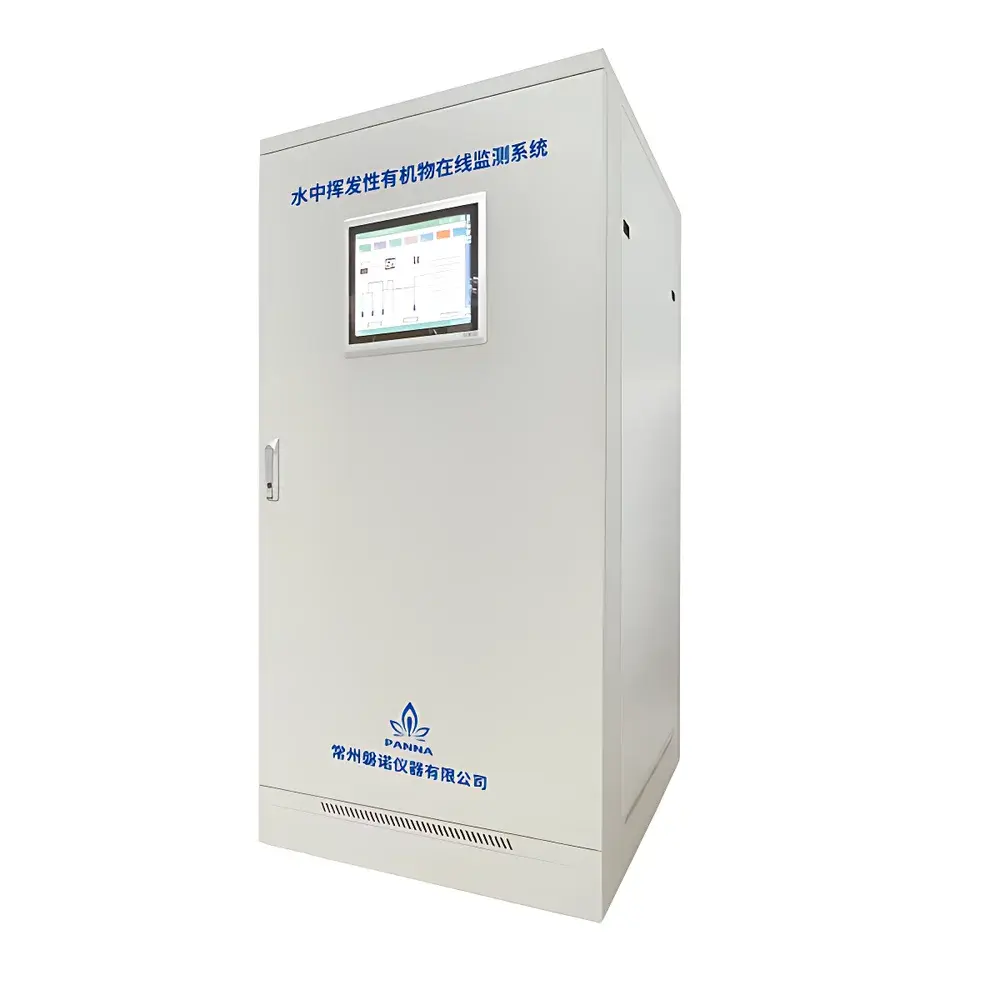
Pannatek PANNATEK-WVOC Online Water & Soil Volatile Organic Compounds Monitoring System
| Brand | Pannatek |
|---|---|
| Origin | Jiangsu, China |
| Manufacturer Type | Original Equipment Manufacturer (OEM) |
| Country of Origin | China |
| Model | PANNATEK-WVOC |
| Price Range | USD 42,000 – 70,000 |
Overview
The Pannatek PANNATEK-WVOC Online Water & Soil Volatile Organic Compounds Monitoring System is an integrated, fully automated analytical platform engineered for continuous, unattended quantification of volatile organic compounds (VOCs) in aqueous matrices—including surface water, drinking water sources, wastewater effluents, and pore water from soil leachates. It operates on the validated principle of purge-and-trap preconcentration coupled with capillary gas chromatography (GC), delivering trace-level detection (sub-ppb range) with high specificity and reproducibility. Unlike manual grab sampling followed by off-site laboratory analysis, this system enables real-time, 24/7 monitoring—critical for early warning of accidental spills, industrial discharges, or seasonal contamination events. Its architecture supports regulatory compliance-driven deployment in environmental monitoring networks where data integrity, temporal resolution, and auditability are non-negotiable.
Key Features
- Purge-and-trap sample introduction with temperature-controlled purging (±0.5 °C stability) and proprietary water vapor removal to prevent column flooding and baseline drift
- High-precision syringe pump-based liquid sampling (±1 µL volumetric accuracy) ensuring consistent injection volume across extended operation cycles
- Dual-detector configuration: Flame Ionization Detector (FID) for benzene, toluene, ethylbenzene, xylenes (BTEX), and aliphatic VOCs; Electron Capture Detector (ECD) optimized for chlorinated hydrocarbons (e.g., chloroform, tetrachloroethylene, vinyl chloride)
- Automated thermal desorption and trap conditioning with self-cleaning functionality to eliminate carryover between analyses
- Intelligent power management: automatic system recovery and method resumption after unexpected power interruption, preserving calibration status and sequence continuity
- Flexible operational modes—single-shot analysis, time-scheduled acquisition, or continuous cyclic monitoring—with user-defined interval logic (1–24 h)
Sample Compatibility & Compliance
The PANNATEK-WVOC accepts raw water samples directly—no filtration or pH adjustment required—within a turbidity range up to 100 NTU and total suspended solids (TSS) ≤ 50 mg/L. It accommodates both liquid-phase water samples and headspace extracts from soil slurries prepared per EPA Method 5035A equivalents. The system conforms to multiple national and method-specific standards, including JB/T 12965 (Online GC Instruments for Water VOCs), HJ 686–2014 (Purge-and-Trap GC for VOCs in Water), HJ 639–2012 (Purge-and-Trap GC-MS for VOCs), and GB 3838–2002 (Surface Water Quality Standards). Data transmission adheres to HJ 212–2017 protocol for environmental online monitoring systems, enabling seamless integration with provincial and national environmental information platforms. All analytical sequences support GLP-compliant metadata logging—including operator ID, sample ID, instrument status flags, and detector response curves—for full traceability during regulatory audits.
Software & Data Management
The embedded control software provides ISO/IEC 17025-aligned instrument control, method development, and data review workflows. It includes built-in calibration verification routines (e.g., daily bracketing with certified standard mixtures), auto-validation of peak identification via retention time locking, and configurable alarm thresholds for individual analytes. Raw chromatograms, processed reports (PDF/CSV), and audit logs are stored locally with optional encrypted cloud backup. Role-based access control (RBAC) enforces user privilege segregation, while electronic signatures and timestamped change logs satisfy FDA 21 CFR Part 11 requirements for regulated environments. Remote diagnostics and firmware updates are supported via secure TLS 1.2 communication channels.
Applications
- Drinking water intake protection zones: continuous surveillance of BTEX, trihalomethanes (THMs), and haloacetic acids (HAAs) upstream of treatment plants
- Industrial park effluent discharge monitoring: real-time tracking of chlorinated solvents and aromatic hydrocarbons against permit limits
- River basin early-warning networks: correlation of VOC spikes with rainfall-runoff events or upstream point-source releases
- Landfill leachate collection systems: detection of vinyl chloride and 1,1-dichloroethane indicative of anaerobic degradation pathways
- Emergency response deployment: rapid setup at spill sites using portable power and telemetry modules for incident-level VOC profiling
FAQ
What sample volume is required per analysis?
A fixed 5–25 mL water sample is programmable; typical default is 10 mL for optimal sensitivity across C2–C12 VOCs.
Does the system require carrier gas cylinders on-site?
Yes—high-purity helium or nitrogen (≥99.999%) is required for GC separation; optional integrated gas generator modules are available upon request.
Can the system be calibrated remotely?
Remote calibration initiation is supported, but physical standard introduction must occur on-site; calibration verification checks can be performed remotely.
Is soil VOC analysis performed directly on solid samples?
No—soil analysis requires preparation as aqueous slurry (per HJ 639–2012); the system analyzes the aqueous phase only.
What is the mean time between failures (MTBF) under continuous operation?
Based on field deployments in Chinese provincial monitoring stations, MTBF exceeds 3,200 hours (≈133 days) with scheduled preventive maintenance every 6 months.
Related Products







