
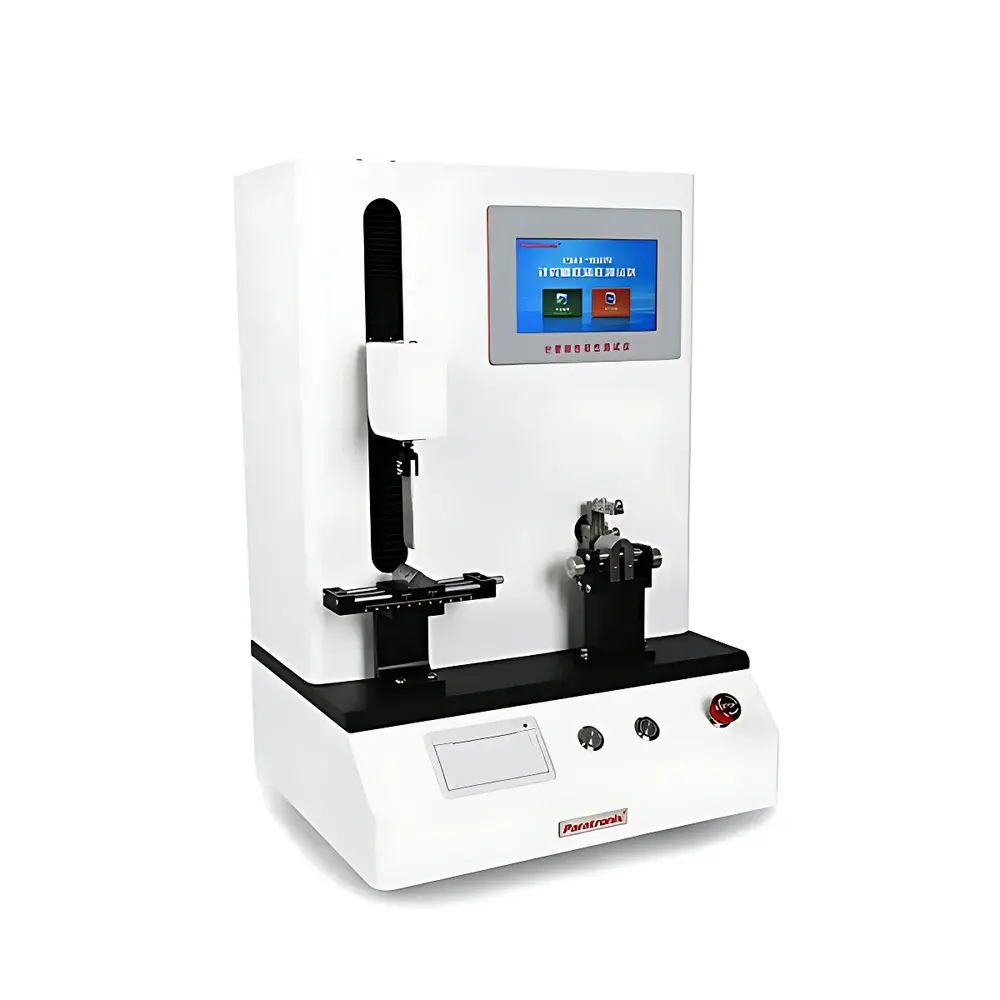
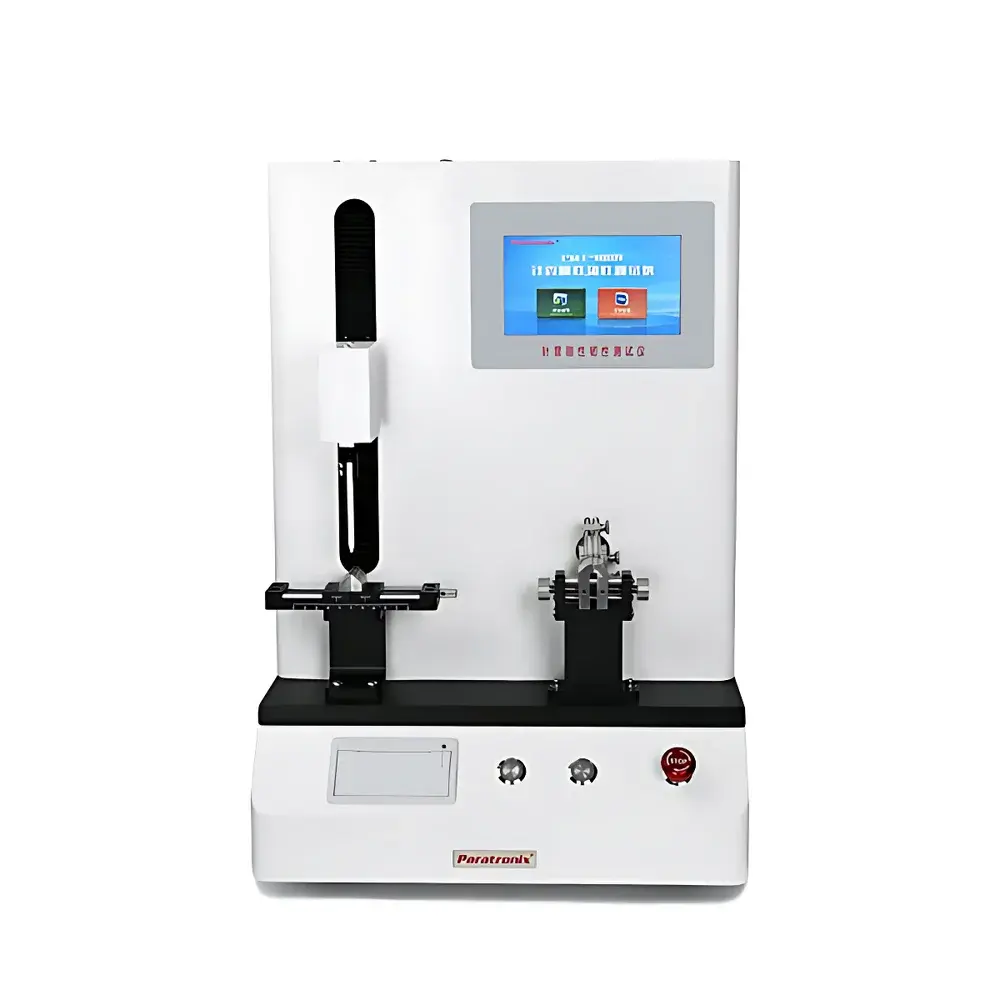
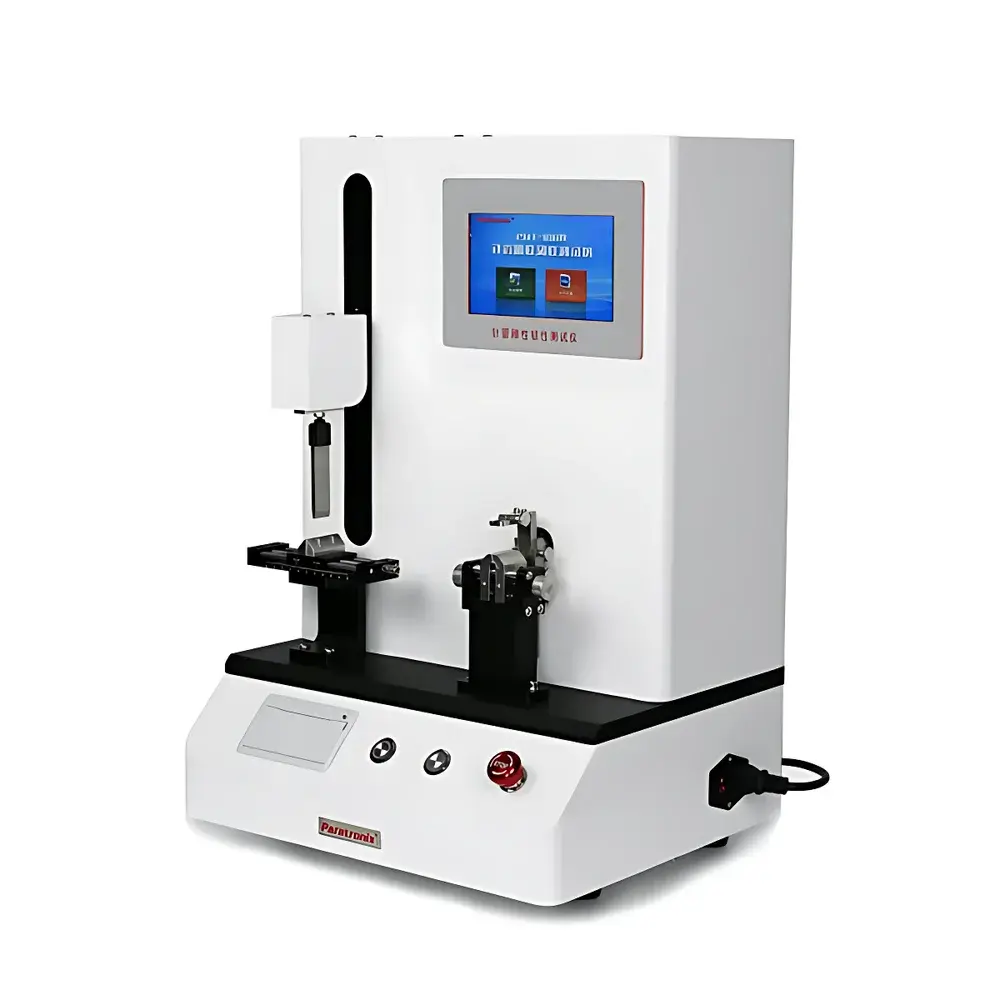
Paratronix PMT-100N Intravenous Single-Use Needle Cannula Rigidity and Flexibility Tester
| Brand | Paratronix |
|---|---|
| Origin | Shandong, China |
| Manufacturer Type | Direct Manufacturer |
| Product Category | Domestic |
| Model | PMT-100N |
| Max Test Force | 50 N |
| Loading Speed Range | 0.1–200 mm/min (infinitely variable) |
| Force Resolution | 0.01 N |
| Rigidity Measurement Range | 100 N |
| Rigidity Accuracy | ±0.3% F.S. |
| Deflection Resolution | 0.01 mm |
| Support Span Adjustment | 1–60 mm |
| Flexibility Test Frequency | 0.1–1.0 Hz |
| Bend Angle Range | 1–30° |
| Bend Angle Accuracy | ±0.1° |
| Bend Cycle Count | 1–999 cycles |
| Bend Gauge Length | 5–100 mm |
| Gauge Length Accuracy | ±0.1 mm |
| Effective Stroke | 150 mm |
| Power Supply | 220 V, 50 Hz |
| Dimensions (L×W×H) | 420 × 350 × 620 mm |
| Weight | ~30 kg |
Overview
The Paratronix PMT-100N Intravenous Single-Use Needle Cannula Rigidity and Flexibility Tester is a precision-engineered mechanical testing system designed specifically for evaluating the structural integrity of stainless steel hypodermic needle cannulae used in medical injection devices. It operates on standardized cantilever and three-point bending principles defined in international regulatory test protocols to quantify two critical mechanical attributes: rigidity (resistance to elastic deflection under axial load) and flexibility (fatigue resistance under repeated angular deformation). The instrument applies controlled, traceable force and displacement profiles to simulate clinical handling stresses—including insertion torque, lateral bending during tissue penetration, and post-insertion manipulation—ensuring compliance with mechanical performance thresholds required for safe intravascular access. Its architecture integrates high-stiffness load frame mechanics with closed-loop servo control and metrologically validated transduction, enabling repeatable sub-millimeter displacement resolution and force reproducibility within ±0.3% full-scale.
Key Features
- 7-inch full-color capacitive touchscreen interface with intuitive icon-driven workflow navigation and real-time graphical feedback of force-displacement curves
- Three-tier user permission management (Administrator / Supervisor / Operator) supporting audit trail generation and role-based access control per FDA 21 CFR Part 11 and EU Annex 11 requirements
- Dual-mode testing capability: independent rigidity (three-point bending) and flexibility (cyclic angular bending) modules within a single platform
- High-resolution load cell (0.01 N resolution) and linear encoder (0.01 mm deflection resolution) calibrated to ISO/IEC 17025-accredited standards
- Programmable support span (1–60 mm) and bend gauge length (5–100 mm), accommodating needle diameters from 0.2 mm to 3.4 mm (27G to 18G)
- Non-linear speed control (0.1–200 mm/min) with adaptive acceleration/deceleration profiling to minimize inertial overshoot during dynamic loading
- Onboard data storage capacity exceeding 10,000 test records with timestamp, operator ID, sample ID, and parameter configuration metadata
- Full alphanumeric sample labeling via physical keypad, enabling unambiguous traceability across production lots and validation batches
Sample Compatibility & Compliance
The PMT-100N is validated for use with stainless steel needle cannulae conforming to GB/T 18457–2024, ASTM F2182, ISO 7864, and ISO 9626. It supports testing of intradermal, subcutaneous, intramuscular, and intravenous single-use needles—as well as pre-filled syringe needle assemblies per YBB00112004–2015 and YBB000992004–2015. Rigidity testing follows the three-point bending method specified in GB 15811–2016 Section 6.5.1, where a defined force is applied at mid-span between two fixed supports; deflection is measured at the load point. Flexibility testing implements the reciprocating bend protocol per GB 15811–2016 Section 6.5.2, applying alternating angular displacement (1°–30°) at a defined gauge length for up to 999 cycles. All test sequences are programmable and exportable in CSV or PDF format for GLP/GMP documentation and regulatory submission.
Software & Data Management
The embedded firmware supports configurable test methods with editable parameters—including target force, bend angle, cycle count, dwell time, and pass/fail tolerance windows. Each test generates a structured dataset containing raw force-time/displacement-time arrays, peak values, hysteresis loops, and statistical summaries (mean, SD, CV%). Data export complies with 21 CFR Part 11 requirements: electronic signatures, immutable audit logs, and user-authenticated session locking. Optional PC software enables advanced curve fitting (e.g., Young’s modulus estimation from linear elastic region), batch comparison analytics, and integration with LIMS via HL7 or ASTM E1384 interfaces. All calibration certificates, maintenance logs, and IQ/OQ documentation templates are provided in English and aligned with ISO 13485:2016 quality system expectations.
Applications
- Quality control release testing of stainless steel needle cannulae in ISO 13485-certified manufacturing facilities
- Design verification and material qualification for new needle geometries (e.g., bevel angle, wall thickness, taper profiles)
- Stability assessment of needle mechanical properties after sterilization (EtO, gamma, e-beam) and accelerated aging
- Root cause analysis of needle fracture or buckling incidents reported during clinical evaluation
- Regulatory submission support for FDA 510(k), CE Marking (MDR Annex II), and NMPA registration dossiers
- Supplier qualification audits requiring objective evidence of mechanical consistency across production lots
FAQ
What standards does the PMT-100N comply with for rigidity and flexibility testing?
It fully implements test procedures defined in GB 15811–2016, GB/T 18457–2024, YBB00112004–2015, YBB000992004–2015, ISO 7864, and ASTM F2182.
Can the instrument test needles with non-standard diameters or lengths?
Yes—adjustable support spans (1–60 mm) and bend gauge lengths (5–100 mm), combined with programmable angular limits (1°–30°), allow adaptation to custom needle configurations beyond standard G-class designations.
Is calibration traceable to national metrology institutes?
All force and displacement sensors are factory-calibrated against NIST-traceable reference standards; optional annual recalibration services include ISO/IEC 17025-compliant certificates.
Does the system support automated reporting for regulatory submissions?
Yes—test reports include header metadata (operator, date, equipment ID), raw data plots, statistical summaries, and digital signatures compliant with FDA 21 CFR Part 11 and EU Annex 11.
What maintenance is required to ensure long-term measurement accuracy?
Routine verification using certified reference weights and displacement gauges is recommended quarterly; full sensor recalibration is advised every 12 months or after 10,000 test cycles.
Related Products



