
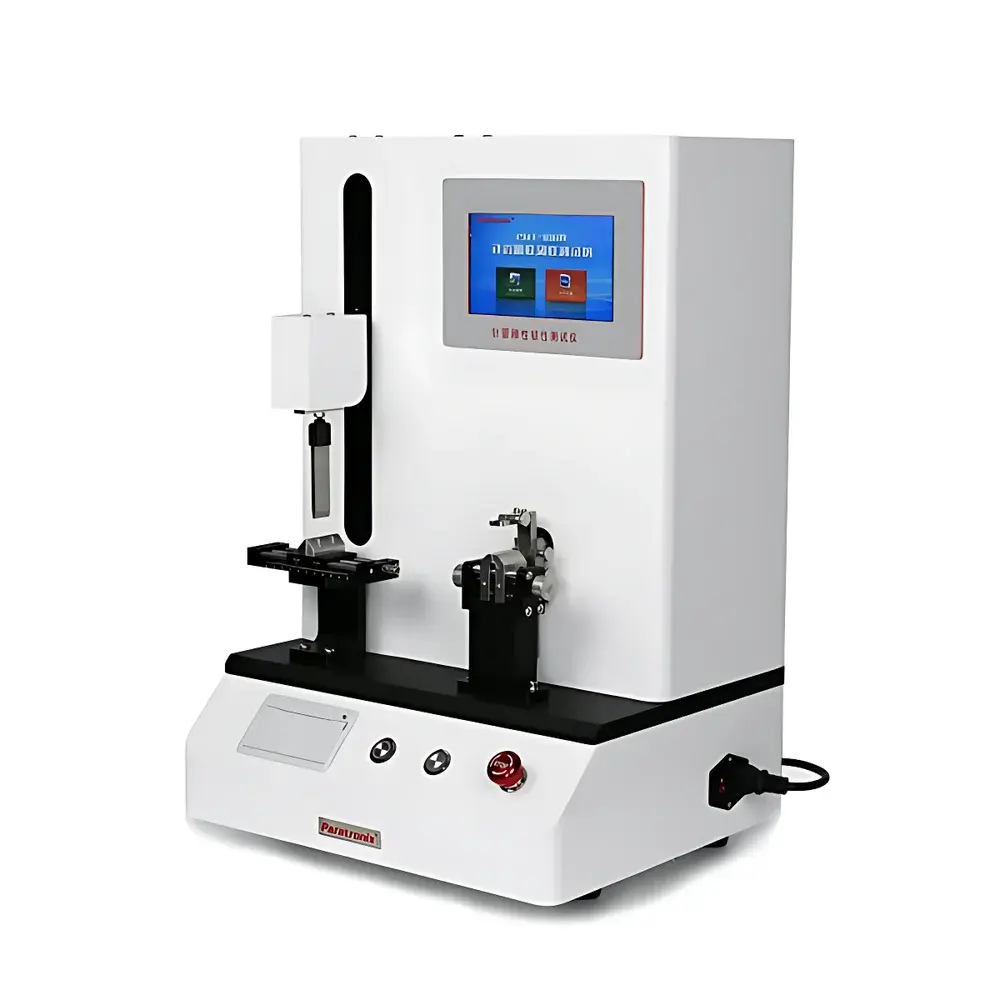
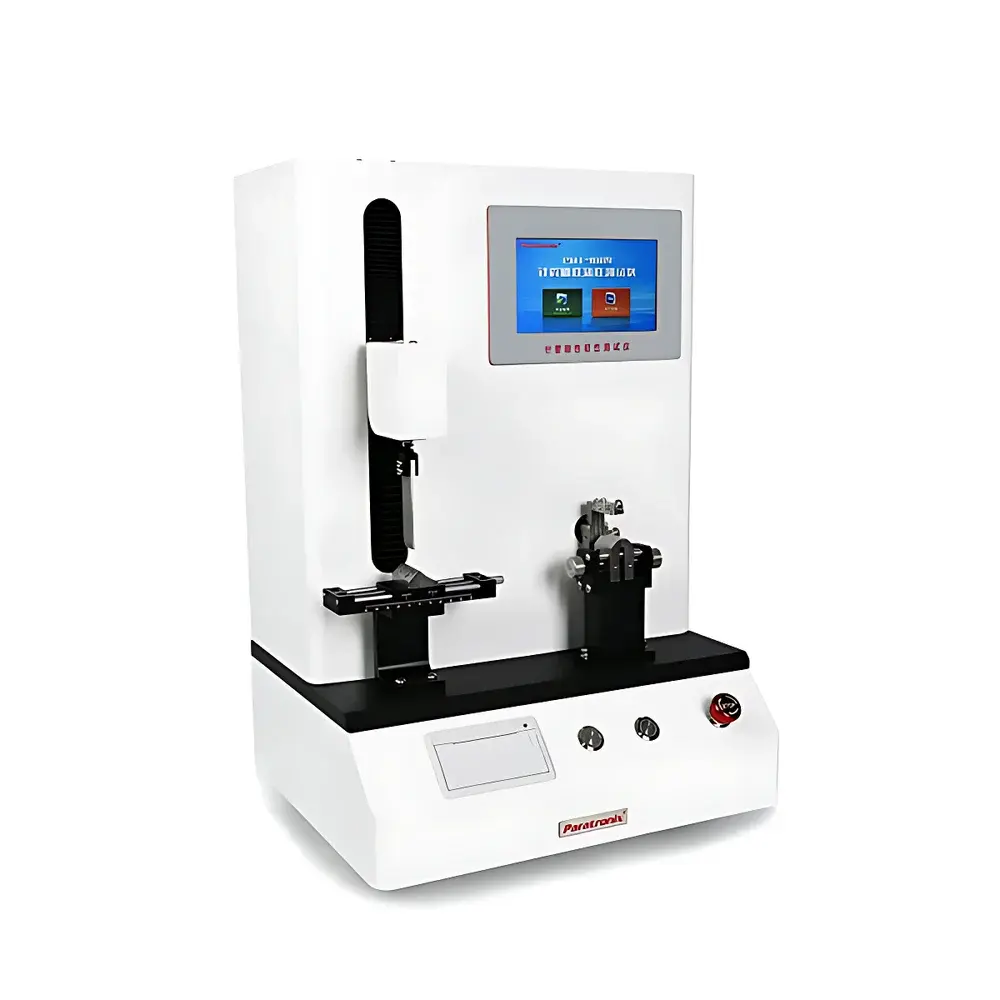
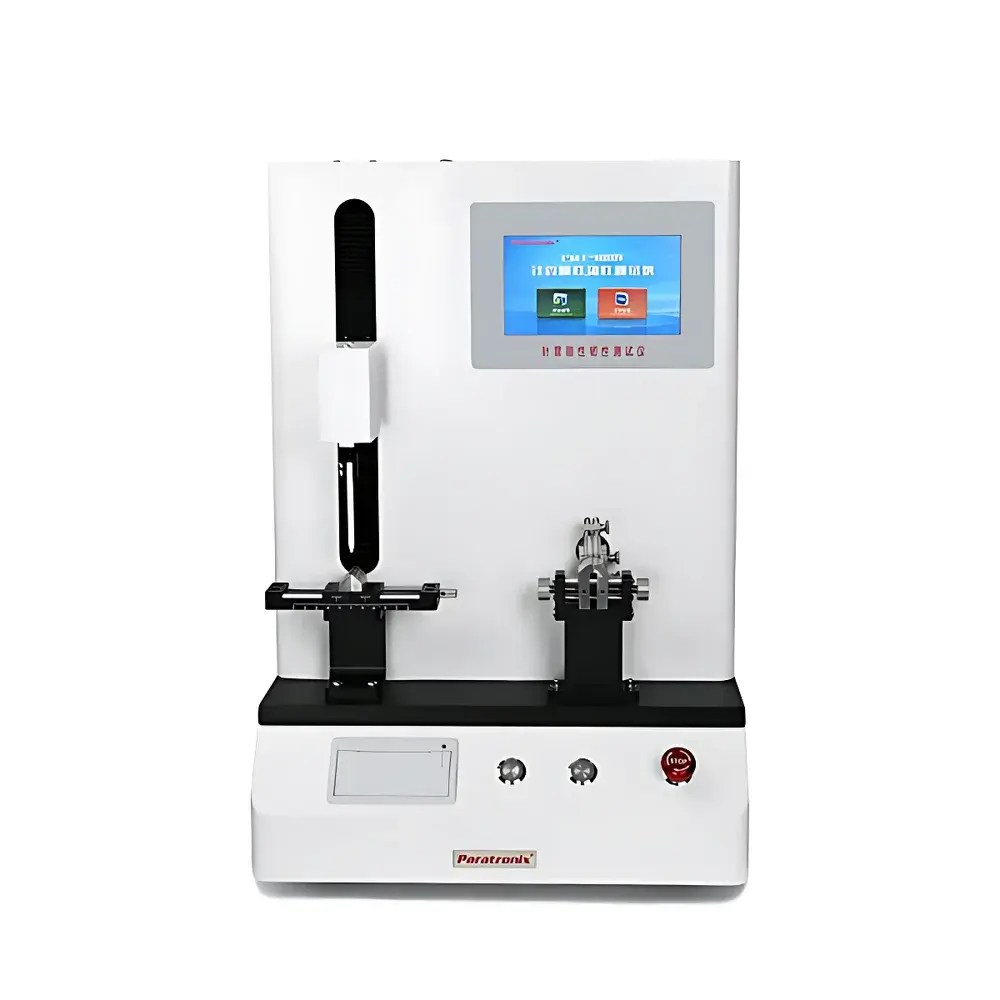
Paratronix PMT-100N Medical Needle Cannula Rigidity and Flexibility Tester
| Brand | Paratronix |
|---|---|
| Model | PMT-100N |
| Origin | Shandong, China |
| Manufacturer Type | Direct Manufacturer |
| Maximum Test Force | 50 N |
| Load Speed Range | 0.1–200 mm/min (infinitely variable) |
| Force Resolution | 0.01 N |
| Force Accuracy | ±0.3% FS |
| Deflection Resolution | 0.01 mm |
| Deflection Accuracy | ±0.01 mm |
| Support Span Adjustment Range | 1–60 mm |
| Bending Angle Range | 1–30° |
| Angular Accuracy | ±0.1° |
| Bend Cycle Count | 1–999 cycles |
| Bend Frequency | 0.1–1.0 Hz |
| Bending Gauge Length | 5–100 mm |
| Gauge Length Accuracy | ±0.1 mm |
| Specimen Diameter Range | 0.2–3.4 mm |
| Effective Stroke | 150 mm |
| Power Supply | 220 V, 50 Hz |
| Dimensions (L×W×H) | 420 × 350 × 620 mm |
| Weight | ~30 kg |
Overview
The Paratronix PMT-100N Medical Needle Cannula Rigidity and Flexibility Tester is a precision-engineered mechanical testing system designed specifically for the quantitative evaluation of rigidity (bending stiffness) and flexibility (fatigue resistance under repeated bending) of stainless steel hypodermic needle cannulas used in single-use medical devices. It operates on two standardized mechanical test principles defined in international and Chinese regulatory standards: (1) three-point bending for rigidity assessment—where a controlled axial force is applied at the midpoint of a horizontally supported needle segment to measure deflection; and (2) controlled-angle oscillatory bending for flexibility evaluation—where the needle is clamped at one end and cyclically bent through a user-defined angular amplitude across a specified gauge length. The instrument complies with core mechanical performance requirements outlined in GB 15811–2016 (equivalent to ISO 7864), YBB00112004–2015, YBB000992004–2015, and GB/T 18457–2024, ensuring alignment with global quality assurance frameworks for sterile injection devices.
Key Features
- 7-inch full-color capacitive touchscreen interface with intuitive icon-driven navigation and real-time graphical feedback during test execution
- Three-tier user permission management (Administrator, Supervisor, Operator) supporting audit-ready access control and traceability per GMP Annex 11 and FDA 21 CFR Part 11 requirements
- Dual-mode mechanical testing architecture: independent rigidity and flexibility modules integrated into a single platform without hardware reconfiguration
- High-resolution load cell (0.01 N resolution, ±0.3% FS accuracy) coupled with optical linear encoder-based displacement measurement (0.01 mm resolution)
- Infinitely variable crosshead speed control (0.1–200 mm/min) enabling precise replication of standard-specified loading rates across diverse needle gauges
- Motorized support span adjustment (1–60 mm) and bending gauge length positioning (5–100 mm) with ±0.1 mm repeatability
- Onboard data storage capacity exceeding 10,000 test records with timestamped metadata including operator ID, test mode, parameters, and pass/fail status
- Customizable specimen identification via alphanumeric keyboard input, facilitating batch traceability and QC documentation workflows
Sample Compatibility & Compliance
The PMT-100N accommodates stainless steel needle cannulas ranging from 0.2 mm to 3.4 mm outer diameter—including those used in intradermal, subcutaneous, intramuscular, and intravenous single-use syringes, as well as pre-filled syringe (PFS) assemblies. Its mechanical design conforms to the physical constraints and dimensional tolerances specified in GB/T 18457–2024 for medical-grade stainless steel tubing manufacturing. All test protocols align with the mechanical verification clauses of GB 15811–2016 (which adopts ISO 7864:2016), particularly Clause 5.3 (rigidity) and Clause 5.4 (flexibility). The system supports full compliance documentation packages—including calibration certificates traceable to national metrology institutes—and is validated for use in GLP and GMP-regulated environments requiring documented instrument qualification (IQ/OQ/PQ).
Software & Data Management
Embedded firmware enables fully automated execution of multi-step test sequences, including pre-load stabilization, ramped force application, deflection capture, and post-test unloading. Raw force–displacement and angle–cycle datasets are stored in CSV-compatible format with embedded metadata headers. Optional PC-based software (Paratronix TestSuite v3.2) provides advanced analysis tools: statistical process control (SPC) charting, trend analysis across production lots, comparative overlay of historical test curves, and automated generation of PDF test reports compliant with ISO/IEC 17025 reporting requirements. Audit trails record all parameter modifications, test initiations, and user logins with immutable timestamps—fully satisfying FDA 21 CFR Part 11 electronic record and signature requirements.
Applications
- Quality control release testing of stainless steel needle cannulas prior to final assembly into syringes or PFS systems
- R&D validation of new needle alloys, surface treatments (e.g., silicone coating), or geometry modifications (tapered tips, wall thickness variations)
- Stability studies assessing mechanical property degradation after accelerated aging or sterilization (EtO, gamma, e-beam)
- Supplier qualification audits requiring objective, repeatable quantification of bending performance
- Regulatory submission support—providing raw test data and methodology documentation for MDR (EU 2017/745) or FDA 510(k) submissions
- Root cause analysis of field complaints related to needle buckling, kinking, or breakage during clinical use
FAQ
What standards does the PMT-100N directly support?
It implements test methods defined in GB 15811–2016, YBB00112004–2015, YBB000992004–2015, and GB/T 18457–2024—with mechanical configurations and software logic aligned to the latest editions.
Can the system be calibrated internally without external service?
Yes—the firmware includes guided internal calibration routines for force and displacement channels using certified reference weights and gauge blocks, with full calibration history logging.
Is test method customization possible beyond standard protocols?
Yes—advanced users may define custom bending frequencies, angular amplitudes, cycle counts, and dwell times via the “User Protocol” mode, with full validation documentation support.
Does the instrument meet electromagnetic compatibility (EMC) requirements for laboratory use?
It complies with IEC 61326-1:2012 for laboratory equipment, including immunity to electrostatic discharge (ESD), radiated RF fields, and fast transient bursts.
What maintenance is required to ensure long-term measurement integrity?
Routine verification using traceable check standards every 30 days is recommended; annual full recalibration by an ISO/IEC 17025-accredited provider is advised for GMP-regulated operations.



