
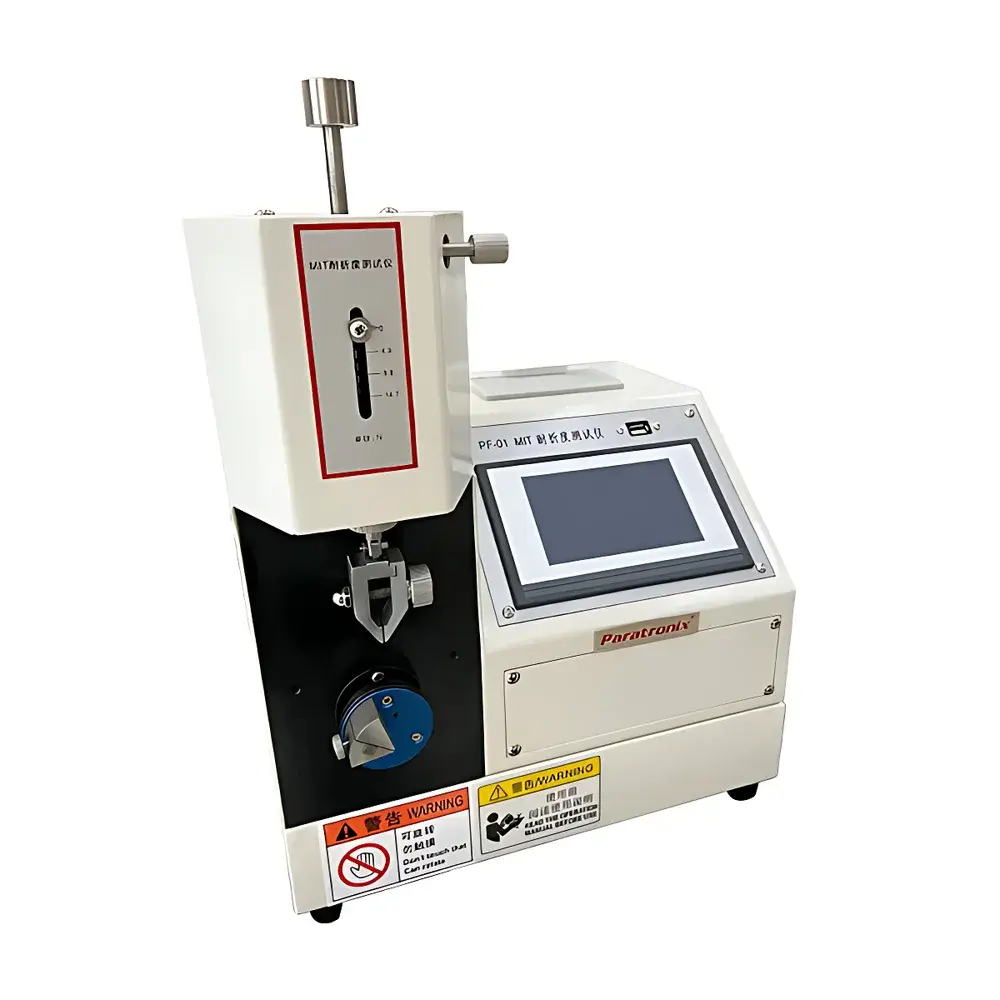
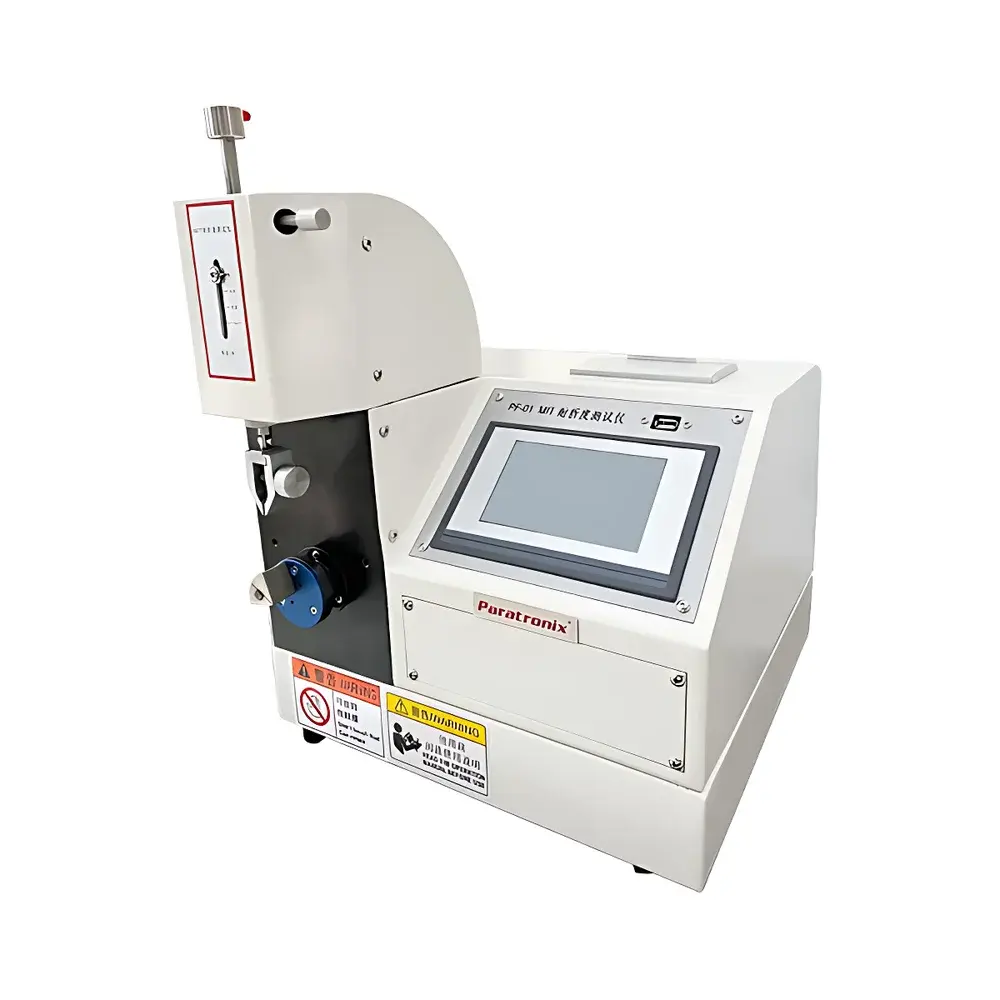
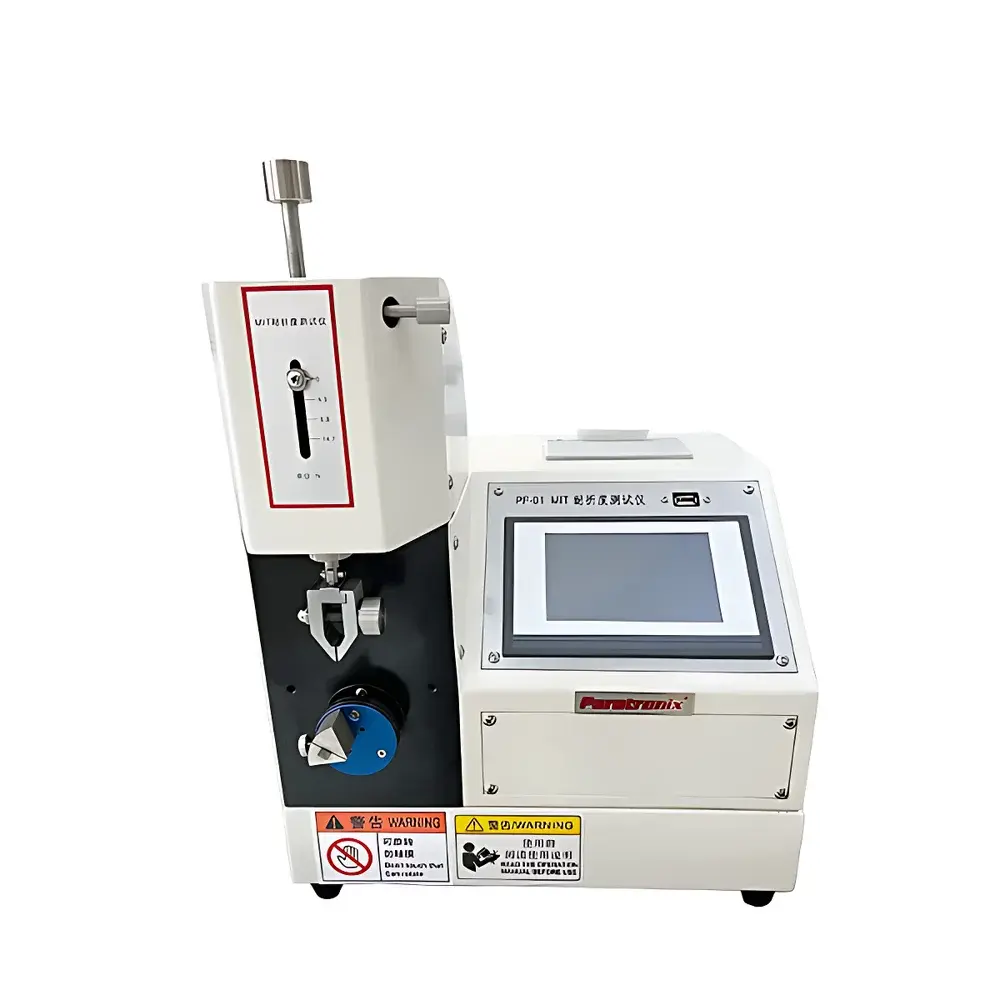
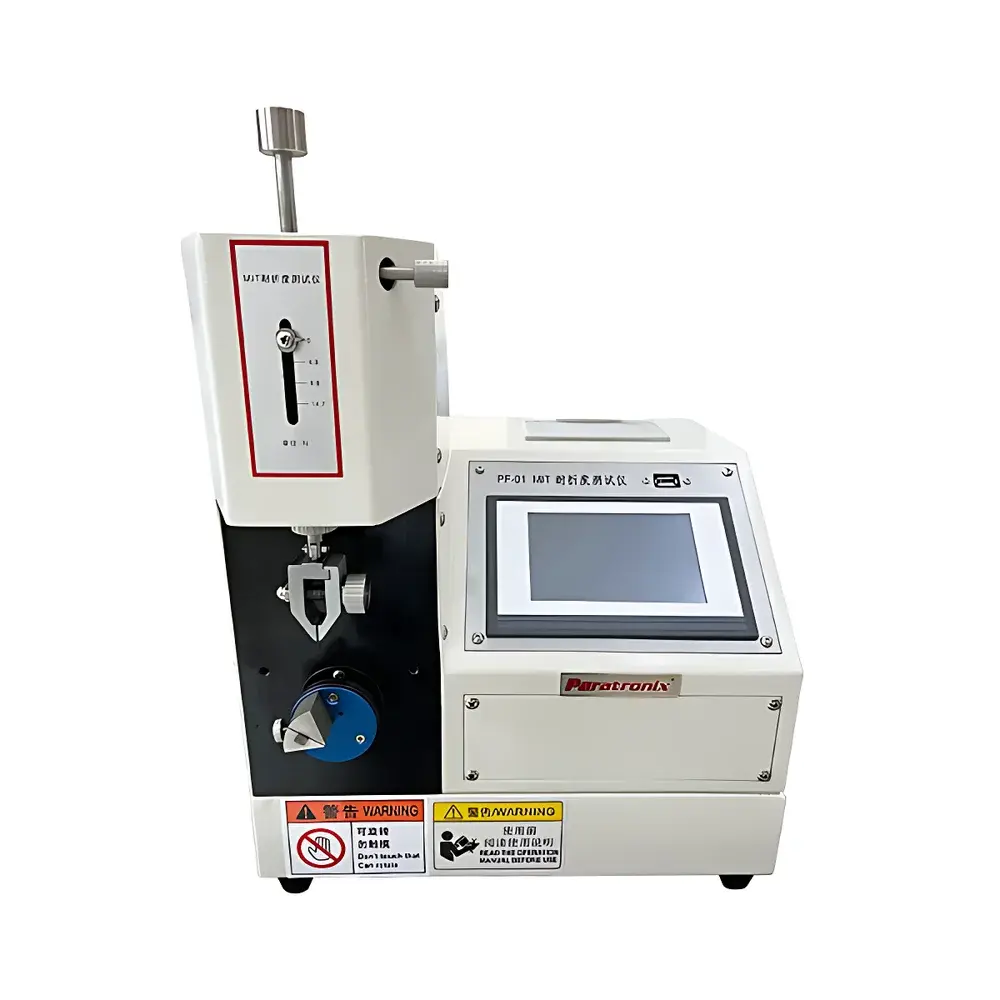
Paratronix PT-01 MIT Fold Endurance Tester
| Brand | Paratronix |
|---|---|
| Origin | Shandong, China |
| Manufacturer Type | Direct Manufacturer |
| Model | PT-01 |
| Measurement Range | 0–99,999 folds |
| Folding Angle | 0°–142° continuously adjustable |
| Folding Speed | 10–200 folds/min, stepless adjustment |
| Spring Tension | 4.91–14.72 N (9.81 N preload compresses spring ≥17 mm) |
| Tension Stability | Imported tension assembly |
| Tension Variation Due to Eccentric Rotation | ≤0.343 N |
| Folding Jaw Width | 19 ±1 mm |
| Crease Radius | 0.38 ±0.02 mm |
| Specimen Length | ≥140 mm |
| Temperature Drift at Crease | ≤1 °C after 4 h |
| Jaw Spacing | 9.5 mm |
| Lower Jaw Clamping | Knurled cylindrical knob for ergonomic, high-grip clamping |
| Crease Gap Options | 0.25 / 0.5 / 0.75 / 1.00 mm (user-selectable) |
| HMI | 5-inch LCD display with real-time data visualization |
| Output | Integrated thermal printer module |
| Operating Environment | 0–35 °C, RH <85% |
| Power Supply | AC 220 V, 50 Hz |
Overview
The Paratronix PT-01 MIT Fold Endurance Tester is an electromechanical instrument engineered for precise, repeatable quantification of paper and board fatigue resistance under controlled cyclic folding. It implements the standardized MIT folding endurance principle—where a conditioned specimen is subjected to repeated 180° folding under constant tensile load across a defined crease radius and gap—enabling objective evaluation of material ductility, fiber bonding integrity, and long-term flexural durability. Designed in strict alignment with ISO 5626, TAPPI T423, and GB/T 457, the PT-01 delivers traceable, reproducible fold counts that serve as critical quality indicators for packaging substrates including corrugated board, kraft linerboard, solid bleached sulfate (SBS) carton board, greyboard, leather substitutes, and thin polymer films. Its robust architecture supports both routine QC testing in production environments and method development in R&D laboratories.
Key Features
- Continuously adjustable folding angle (0°–142°) enables simulation of non-standard or application-specific bend geometries beyond conventional MIT protocols.
- Stepless folding speed control (10–200 folds/min) permits optimization for low-speed fatigue analysis or high-throughput screening without mechanical resonance artifacts.
- Imported high-stability tension assembly ensures consistent applied load (4.91–14.72 N), with ≤0.343 N variation induced by rotational eccentricity—critical for minimizing inter-test variability.
- Precision-machined folding jaws (19 ±1 mm width, 0.38 ±0.02 mm crease radius) guarantee uniform stress distribution and eliminate edge-induced premature failure.
- Modular crease gap selection (0.25 / 0.5 / 0.75 / 1.00 mm) allows method adaptation per substrate thickness and stiffness, supporting compliance with ASTM D2176 and ISO 5626 Annex A.
- Thermally stabilized crease zone (≤1 °C drift over 4 h) prevents thermal softening effects during extended test sequences, preserving measurement fidelity for high-cycle tests.
- Ergonomic knurled-column lower jaw clamp ensures secure specimen retention under dynamic loading while reducing operator-induced misalignment.
- Integrated 5-inch LCD interface displays real-time fold count, elapsed time, and active test parameters; all data logged internally prior to thermal printout.
Sample Compatibility & Compliance
The PT-01 accommodates a broad spectrum of flexible sheet materials: corrugated medium and linerboard, uncoated and coated kraft papers, folding boxboards (FBB), solid bleached sulfite (SBS), recycled greyboard, synthetic leather, metallized PET films, and laminated composites. Specimens must be ≥140 mm in length and cut parallel to the machine direction (MD) or cross direction (CD) per ISO 186 sampling requirements. All mechanical tolerances—including jaw spacing (9.5 mm), crease geometry, and tension calibration—conform to ISO/IEC 17025 traceability frameworks when operated within specified environmental conditions (0–35 °C, RH <85%). The system supports GLP-compliant documentation workflows through timestamped thermal printouts, satisfying audit requirements under FDA 21 CFR Part 11 when paired with secure lab record-keeping procedures.
Software & Data Management
While the PT-01 operates via embedded firmware without PC connectivity, its internal data logger captures fold count, test duration, and configuration metadata for each run. The integrated thermal printer produces permanent, tamper-evident records compliant with ISO 9001 clause 8.5.2 (Control of production and service provision). For laboratories requiring digital archiving, manual transcription into LIMS or Excel-based QA databases is supported by standardized output formatting. Optional calibration certificates—traceable to NIM (National Institute of Metrology, China) standards—are available upon request, including uncertainty budgets per ISO/IEC 17025 Annex A.3.
Applications
- Quality assurance of linerboard and corrugated medium for shipping container performance validation.
- Development of high-foldability barrier coatings for pharmaceutical blister packaging.
- Comparative fatigue analysis of recycled fiber blends versus virgin pulp formulations.
- Validation of embossing or creasing processes in folding carton manufacturing.
- Research on moisture-induced fold strength degradation in hygroscopic substrates.
- Regulatory submission support for packaging materials under USP <661>, ISO 11607, and EU Directive 94/62/EC.
FAQ
What standards does the PT-01 comply with?
The instrument is configured and validated per ISO 5626, TAPPI T423, GB/T 457, and ASTM D2176. Calibration protocols follow JJG (Light Industry) 64–2018.
Can the PT-01 test non-paper materials such as thin films or foils?
Yes—provided specimens meet minimum length (≥140 mm) and can be securely clamped without slippage. Crease gap and tension settings must be optimized empirically for non-fibrous substrates.
Is external software required to operate the tester?
No. All functions are self-contained; no drivers, USB connections, or proprietary software installations are needed.
How often should the folding jaws be recalibrated?
Annual verification against certified reference specimens is recommended. Critical users performing GMP-regulated testing may implement semi-annual checks per internal SOPs.
Does the thermal printer support label stock or only plain paper?
The integrated module accepts standard 58-mm thermal paper rolls only; adhesive labels are not compatible due to heat-sensitive backing limitations.





