
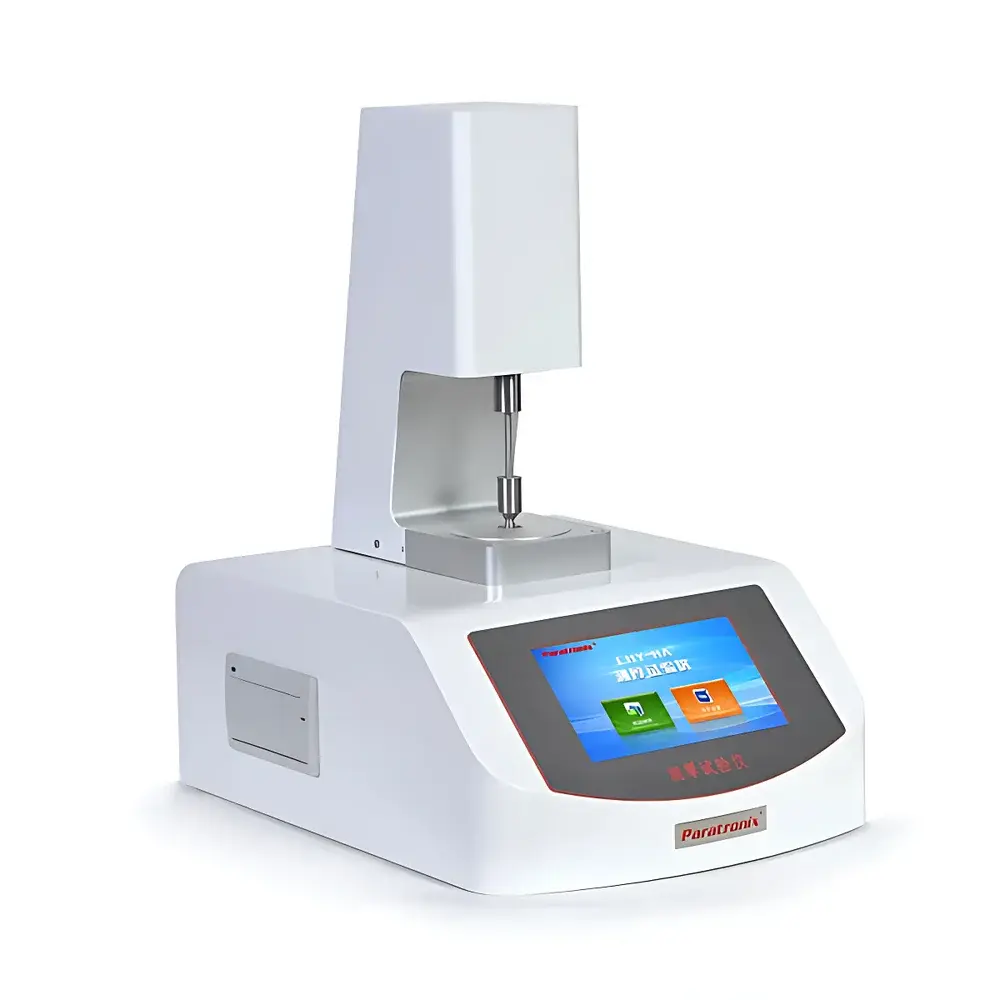
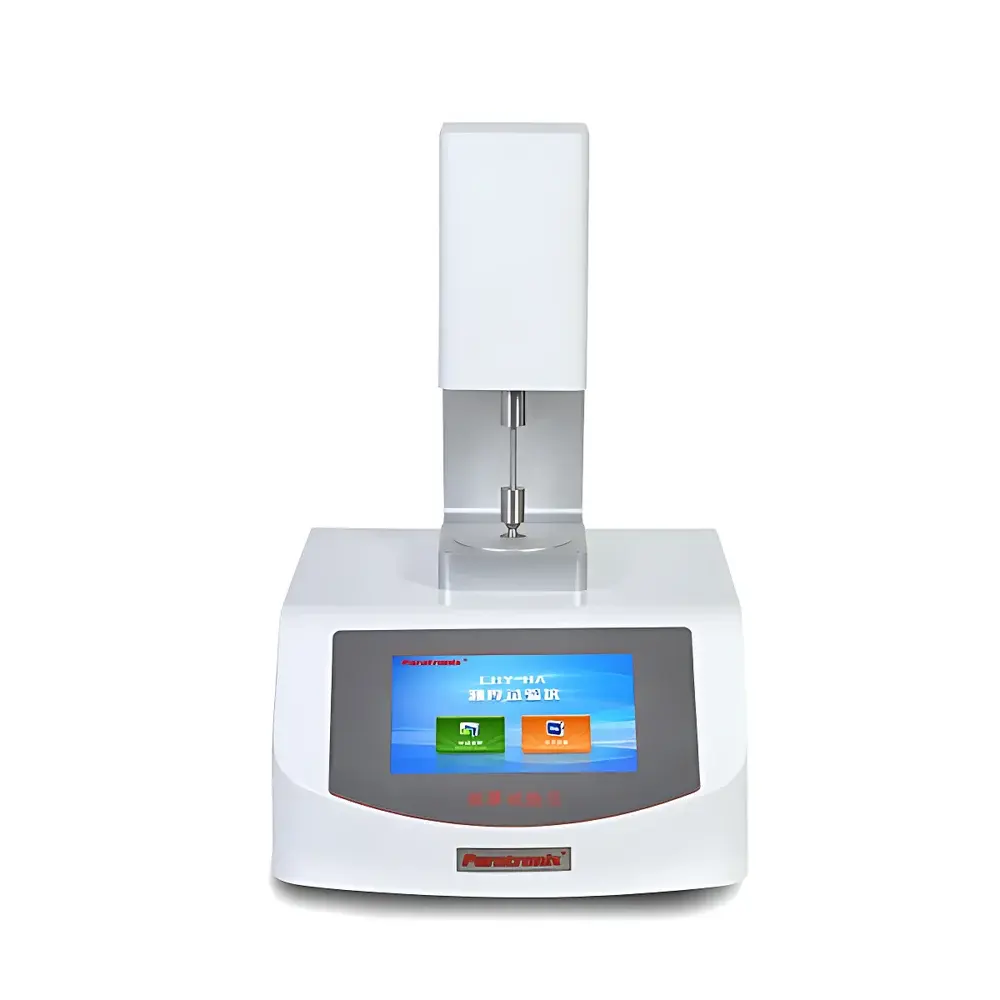
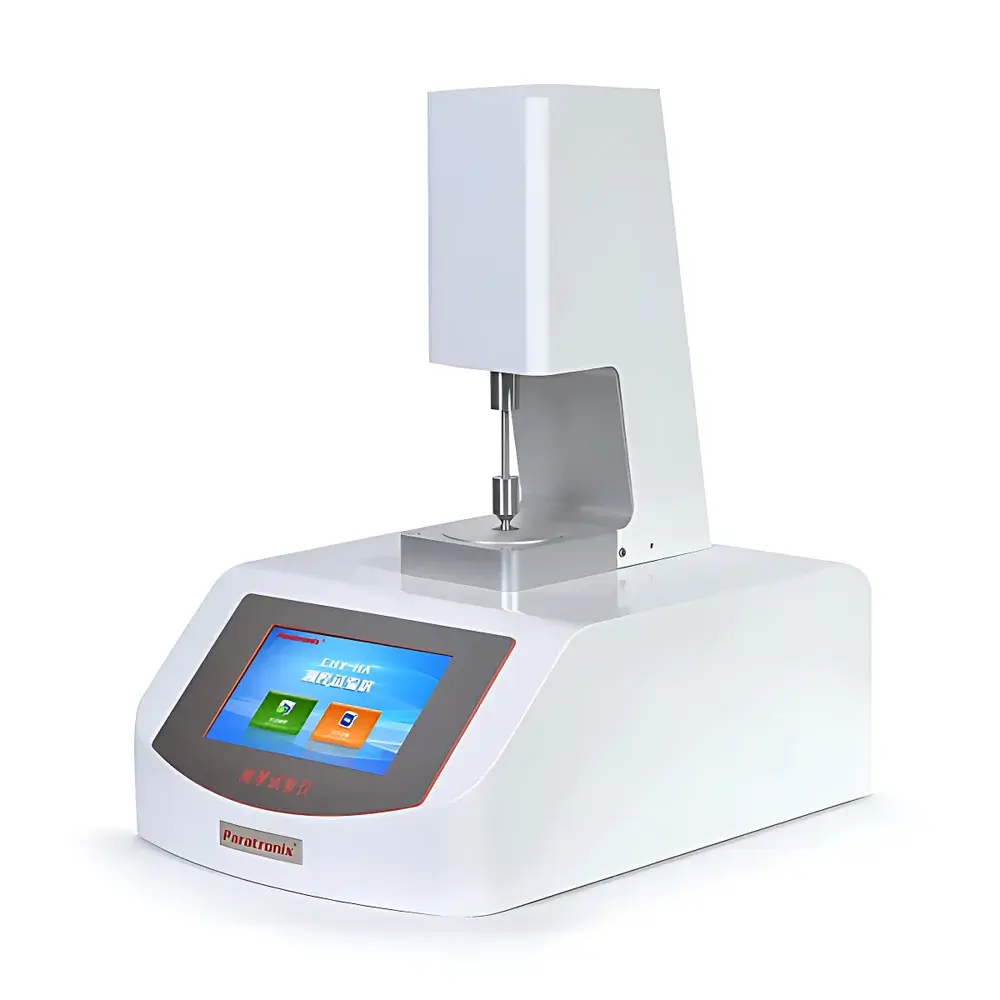
Paratronix PTT-03A Desktop Contact-Type Composite Film Thickness Tester
| Brand | Paratronix |
|---|---|
| Origin | Shandong, China |
| Manufacturer Type | OEM/ODM Manufacturer |
| Country of Origin | China |
| Model | PTT-03A |
| Measurement Range | 0–2 mm (standard), optional 0–6 mm / 0–12 mm |
| Resolution | 0.1 µm (1 µm optional) |
| Test Speed | 1–25 tests/min |
| Measuring Head Parallelism | ±0.2 µm (mechanically adjustable, verified with gauge blocks) |
| Accuracy | ±<0.3 µm |
| Contact Pressure | 17.5 ± 1 kPa (for films), 50 ± 1 kPa (for paper), customizable for other materials |
| Contact Geometry | Spherical probe |
| Power Supply | AC 220 V, 50 Hz / AC 120 V, 60 Hz |
| Dimensions (L×W×H) | 300 × 400 × 435 mm |
| Net Weight | ~30 kg |
| Compliance Standards | GB/T 6672, GB/T 451.3, GB/T 6547, ASTM D645, ASTM D374, ASTM D1777, TAPPI T411, ISO 4593, ISO 534, ISO 3034, DIN 53105, DIN 53353, JIS K6250, JIS K6328, JIS K6783, JIS Z1702, BS 3983, BS 4817, ASTM D6988, ASTM F2251, BS 2782-6, DIN 53370, ISO 9073-2, ISO 12625-3, ISO 5084, ASTM D3652, GB/T 24218.2, FEFCO No. 3, EN 1942 |
Overview
The Paratronix PTT-03A Desktop Contact-Type Composite Film Thickness Tester is a precision mechanical metrology instrument engineered for high-reproducibility thickness measurement of planar, flexible, and semi-rigid sheet materials. It operates on the principle of controlled-force mechanical displacement sensing: a calibrated spherical probe applies standardized pressure to the specimen surface, and a high-stability linear variable differential transformer (LVDT) or capacitive displacement sensor captures the axial deflection between two parallel plates — the fixed anvil and the movable measuring head. This contact-based method conforms strictly to international gravimetric and geometric metrology frameworks, ensuring traceability to national standards (e.g., NIST, NIM) when used with certified gauge blocks. Unlike non-contact optical or ultrasonic methods, the PTT-03A delivers direct physical measurement unaffected by material opacity, surface reflectivity, or internal heterogeneity — making it indispensable for quality control in packaging, papermaking, battery manufacturing, and thin-film electronics.
Key Features
- Modular probe interface with standard M2.5 thread mount, enabling rapid interchange of analog dial indicators, digital micrometer heads, or custom transducers
- Adjustable dead-weight loading system with removable calibration masses — supports full compliance with ASTM D645 (paper), ASTM D374 (electrical insulation), and ISO 534 (packaging materials) pressure requirements
- Embedded ARM Cortex-M7 microcontroller platform with real-time OS, delivering deterministic response timing and synchronized data acquisition at up to 25 measurements per minute
- 7-inch capacitive touch LCD display with 1024 × 600 resolution, showing live thickness values, statistical summaries (mean, min, max, standard deviation), and trend curves
- Integrated thermal printer supporting on-demand hardcopy output of test reports including timestamp, operator ID, sample ID, and measurement statistics
- Dual-range LVDT sensor architecture with factory-calibrated linearity compensation across 0–2 mm baseline range; extended ranges (0–6 mm, 0–12 mm) available via hardware configuration
- RS-232 serial interface compliant with EIA/TIA-232-F specification, enabling bidirectional communication with LIMS or MES systems for automated data logging and audit trail generation
Sample Compatibility & Compliance
The PTT-03A accommodates a broad spectrum of planar specimens: paperboard, corrugated linerboard, metallized PET film, lithium-ion battery separator membranes, silicon wafers (up to 300 mm diameter), nonwovens, geotextiles, and aluminum foil. Its spherical probe geometry (standard radius 2.5 mm) minimizes localized plastic deformation while maintaining uniform stress distribution under defined load conditions. All mechanical interfaces — including anvil flatness (≤0.4 µm TIR), probe sphericity (Grade 5 per ANSI B89.1.12), and frame rigidity (deflection <0.1 µm under full load) — are validated against ISO/IEC 17025 calibration procedures. The instrument meets the mechanical design and operational requirements of GLP and GMP environments, with full support for 21 CFR Part 11-compliant electronic records when paired with validated PC software.
Software & Data Management
While the PTT-03A operates autonomously via its embedded UI, optional Windows-based Paratronix Thickness Suite v3.2 provides advanced data governance capabilities: configurable test templates aligned with ASTM/ISO test methods, automatic pass/fail evaluation against user-defined tolerance bands, export to CSV/XLSX/PDF formats, and secure database storage with role-based access control. Audit trails record all parameter changes, calibration events, and report generations with immutable timestamps and operator authentication. Raw sensor data files retain full 16-bit resolution for post-acquisition reprocessing, and metadata tagging supports traceability to specific production lots, shift logs, or supplier batches.
Applications
This instrument serves as a primary thickness verification tool in QC laboratories across multiple regulated sectors. In packaging R&D, it validates caliper uniformity of laminated pouches prior to seal integrity testing. For paper mills, it verifies basis weight correlation per ISO 534 and detects caliper variation across reel width. Battery manufacturers use it to monitor separator thickness consistency — a critical factor influencing ionic resistance and dendrite suppression. Semiconductor fabs employ it for incoming inspection of polished silicon wafers where total thickness variation (TTV) must remain within ±0.5 µm. Regulatory submissions to FDA, EU Notified Bodies, or JIS-certified auditors routinely reference PTT-03A-generated thickness datasets due to its documented metrological traceability.
FAQ
Does the PTT-03A comply with ISO/IEC 17025 calibration requirements?
Yes — all factory calibrations are performed using NIST-traceable gauge blocks and documented per ILAC-P10:2023. Certificate of Calibration includes uncertainty budgets at 95% confidence level.
Can the instrument be integrated into an automated production line?
Yes — optional pneumatic actuation kit and PLC-compatible I/O module enable integration with conveyor-fed auto-loading systems and real-time SPC dashboards.
Is firmware upgrade supported remotely?
Yes — firmware updates are delivered via USB flash drive or RS-232, with cryptographic signature verification to ensure integrity and version rollback capability.
What maintenance intervals are recommended?
Annual verification of probe parallelism and pressure load accuracy is advised; daily zero-check using master gauge block is required before first measurement cycle.
Are custom probe geometries available for specialty applications?
Yes — conical, flat-faced, and elliptical contact tips can be supplied under NDA, with mechanical drawings provided for customer validation prior to fabrication.





