
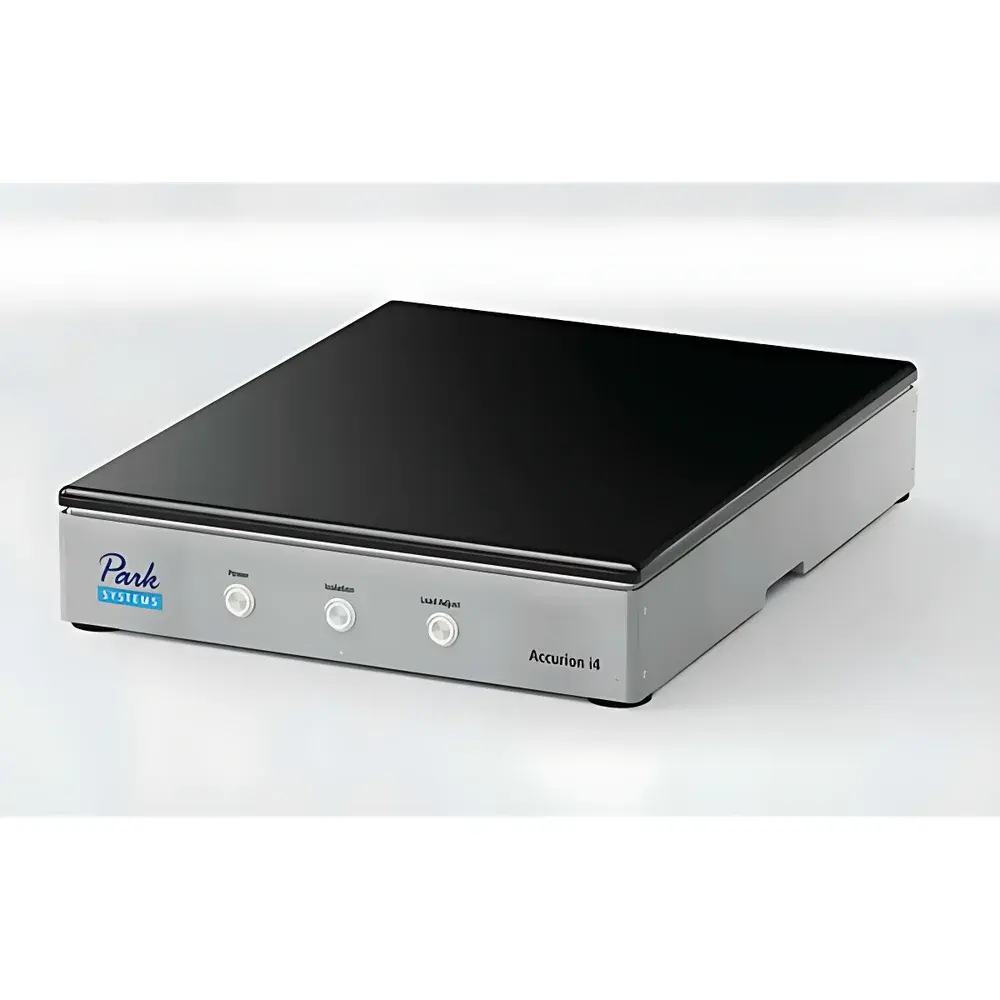
Park SYSTEMS i4 Active Vibration Isolation Table
| Brand | Park SYSTEMS |
|---|---|
| Origin | Germany |
| Model | i4 |
| Dimensions | 400 × 500 × 90 mm |
| Payload Capacity | 0–120 kg |
| Active Isolation Bandwidth | 0.6/1 Hz to 200 Hz |
| Degrees of Freedom | 6-DOF |
| Settling Time | ≤ 0.3 s |
| Power Supply | Standard AC Mains (No Compressed Air Required) |
| Stiffness at 1 Hz | 20–30× Higher Than Passive Air Tables |
Overview
The Park SYSTEMS i4 Active Vibration Isolation Table is an engineered solution for high-sensitivity instrumentation requiring broadband, real-time vibration suppression in laboratory and metrology environments. Unlike passive pneumatic isolation systems—whose performance degrades significantly below 2–5 Hz due to inherent mechanical resonance—the i4 employs a closed-loop, force-cancellation architecture based on inertial sensing and electromagnetic actuation. This enables continuous, dynamic compensation across all six degrees of freedom (6-DOF), delivering effective isolation from sub-hertz ground-borne disturbances—including building sway, footfall, HVAC-induced floor motion, and low-frequency traffic vibrations—up to 200 Hz. Its compact form factor (400 × 500 × 90 mm) and zero-compression-air design make it suitable for integration beneath scanning probe microscopes (SPMs), optical interferometers, nanoindenters, and other resolution-critical instruments where positional stability at the nanometer scale is non-negotiable.
Key Features
- True active feedback control: Real-time inertial sensing (accelerometers + position transducers) coupled with high-bandwidth electromagnetic actuators generates instantaneous counter-forces to suppress incoming vibration energy.
- Broadband isolation bandwidth: Operates effectively from 0.6 Hz (or 1 Hz, depending on configuration) to 200 Hz—covering both infra-low-frequency structural modes and mid-frequency mechanical noise.
- Ultra-fast settling time: Achieves mechanical stability within ≤ 0.3 seconds after perturbation, compared to 30–60 seconds typical for high-performance air tables—critical for high-throughput imaging and automated measurement sequences.
- 6-degree-of-freedom compensation: Independently controls translational (X, Y, Z) and rotational (pitch, yaw, roll) motion vectors, eliminating coupling effects that compromise lateral resolution in SPMs or beam path stability in interferometric setups.
- High static stiffness at low frequencies: Delivers 20–30× greater effective stiffness at 1 Hz versus conventional passive isolators, minimizing drift and improving long-term positional repeatability during extended acquisitions.
- Plug-and-play operation: Powered directly from standard AC mains; no external air compressor, plumbing, or leveling adjustments required. Front-panel push-button interface enables immediate activation and mode selection.
- Modular scalability: Designed to support standardized payloads up to 120 kg, with optional custom top plates, mounting interfaces, and integration kits for OEM instrument manufacturers.
Sample Compatibility & Compliance
The i4 is compatible with a wide range of vibration-sensitive instruments, including atomic force microscopes (AFMs), scanning tunneling microscopes (STMs), confocal Raman spectrometers, laser Doppler vibrometers, and precision weighing systems. Its mechanical interface conforms to ISO 10816-1 (mechanical vibration evaluation standards) and supports compliance with GLP/GMP environmental control requirements when deployed in regulated analytical laboratories. While not intrinsically certified to FDA 21 CFR Part 11, its deterministic, audit-ready control logic and absence of analog signal drift enable traceable, repeatable operation consistent with data integrity frameworks. The system meets CE marking requirements for electromagnetic compatibility (EMC Directive 2014/30/EU) and low-voltage safety (LVD Directive 2014/35/EU).
Software & Data Management
The i4 operates autonomously via embedded firmware and requires no host PC for basic functionality. Optional USB- or Ethernet-connected diagnostic software provides real-time spectral monitoring (FFT-based vibration amplitude vs. frequency), system health logging, and configurable alarm thresholds. All operational parameters—including sensor gain, actuator saturation limits, and filter roll-off profiles—are stored in non-volatile memory with version-stamped firmware updates. Audit trails generated by the optional software module comply with ALCOA+ principles (Attributable, Legible, Contemporaneous, Original, Accurate, Complete, Consistent, Enduring, Available) for regulated applications, supporting retrospective validation of environmental conditions during critical measurements.
Applications
- Nanoscale surface characterization using AFM/STM in non-basement lab spaces with elevated ambient vibration levels.
- High-magnification optical metrology (e.g., white-light interferometry, digital holography) where sub-nanometer vertical stability is essential.
- In-situ mechanical testing platforms requiring simultaneous load application and displacement sensing without vibrational cross-talk.
- Quantum optics setups involving free-space laser alignment and single-photon detection, where tabletop micro-motion induces phase noise.
- Calibration laboratories performing ISO/IEC 17025-accredited dimensional measurements under variable floor excitation conditions.
FAQ
Does the i4 require compressed air or external vacuum sources?
No. The i4 is fully electrically powered and contains no pneumatic components.
Can the i4 be integrated into existing instrument enclosures or cleanroom environments?
Yes. Its low-profile design (90 mm height) and lack of exhaust or venting allow seamless integration into constrained spaces and ISO Class 5–8 cleanrooms.
What is the maximum payload for guaranteed performance specifications?
The published specifications—including bandwidth, settling time, and stiffness—are validated for payloads between 0 kg and 120 kg. Performance remains stable across this full range without recalibration.
Is remote monitoring or network control supported?
Standard operation is local-only; however, the optional Ethernet interface enables SNMP-based status polling and integration with facility-wide environmental monitoring systems.
How does the i4 handle transient shocks, such as door slams or nearby equipment startup?
Its high-bandwidth feedback loop detects and suppresses transient impulses within milliseconds, preventing step-like displacement artifacts common in passive systems.



