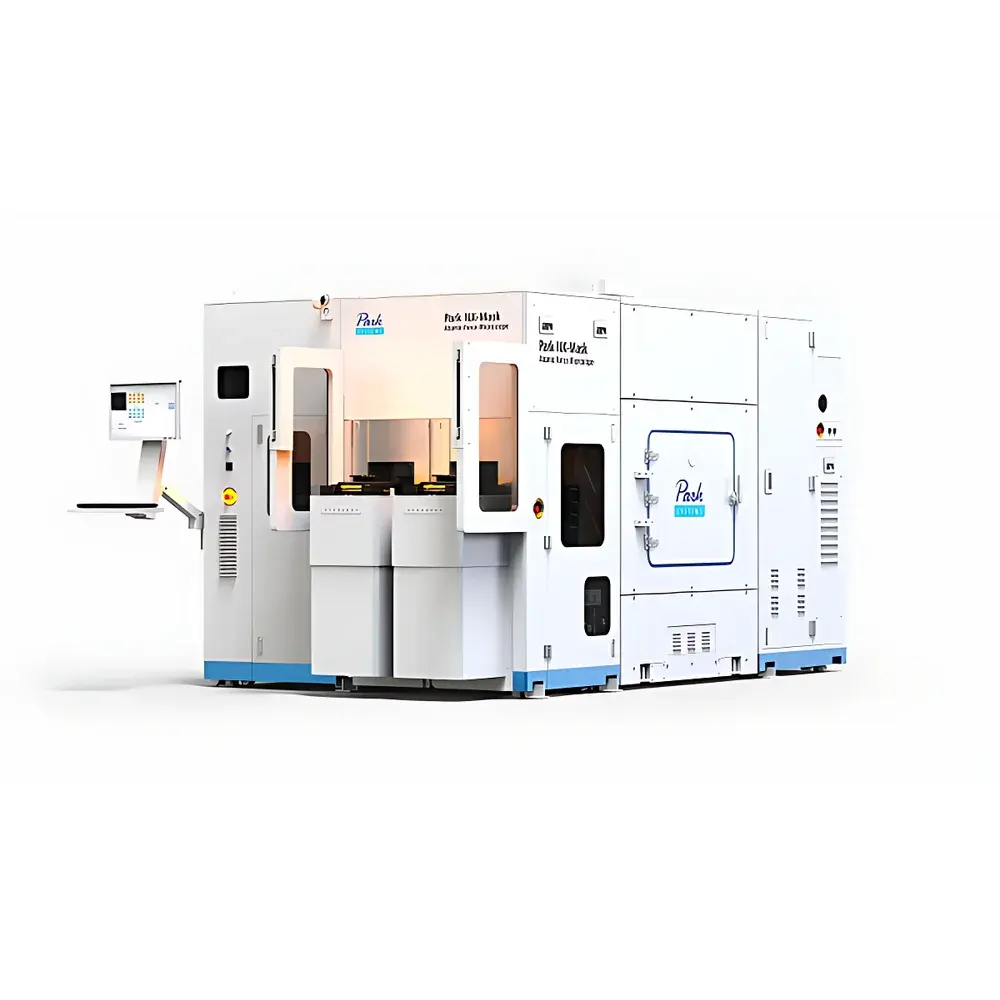
Park SYSTEMS NX-Mask Atomic Force Microscopy-Based EUV Mask Repair System
| Brand | Park SYSTEMS |
|---|---|
| Origin | South Korea |
| Model | NX-Mask |
| Application | EUV photomask defect repair and metrology |
| Technology | Non-contact atomic force microscopy (AFM) |
| Key Capabilities | Defect detection, nanoscale mechanical removal, post-repair 3D topography verification |
| Compliance | Designed for cleanroom-integrated semiconductor mask shops |
| Deployment | Dual-pod compatible for inline EUV reticle handling |
| Operational Environment | Ambient air, no vacuum, no beam-induced charging, no chemical reagents |
Overview
The Park SYSTEMS NX-Mask is a purpose-built atomic force microscopy (AFM)-based metrology and repair platform engineered exclusively for extreme ultraviolet (EUV) photomasks and advanced reticles used in high-NA lithography. Unlike conventional electron-beam or laser-based repair tools, the NX-Mask employs a proprietary non-contact AFM scanning methodology combined with nanomechanical probe actuation to detect, characterize, and physically remove sub-20 nm contaminants—such as tin (Sn) debris from EUV source plasma—without inducing electrostatic charging, surface damage, or pattern distortion. Its operational principle relies on real-time topographic feedback and force-controlled tip-sample interaction, enabling deterministic removal of foreign material while preserving underlying Mo/Si multilayer reflectivity and absorber edge fidelity. The system is designed for integration into Class 10 or better mask shop environments and supports dual-pod EUV reticle carriers compliant with SEMI E152 and E162 standards.
Key Features
- Non-contact AFM scanning for defect localization and classification without tip contact or surface perturbation
- Nanoscale mechanical defect removal using calibrated cantilever deflection feedback—no ion beams, lasers, or wet chemistry
- Integrated pre-repair mapping and post-repair 3D topographic verification within a single vacuum-free platform
- Dual-pod reticle handling interface supporting automated transfer between inspection, repair, and verification stations
- Ambient-air operation: eliminates vacuum chamber cycling, reduces footprint, and avoids charge accumulation on low-k dielectric layers
- Sub-nanometer height resolution and <5 nm lateral repeatability in both detection and repair modes
- Real-time force-distance curve monitoring during repair to ensure consistent material removal depth and minimal substrate disturbance
Sample Compatibility & Compliance
The NX-Mask accommodates standard 6-inch and 9-inch EUV masks with Mo/Si multilayer coatings and TaN/TaBN absorber stacks. It accepts masks mounted in SEMI-compliant dual-pod carriers (e.g., ASML Reticle Pod, Dainippon Screen R-Pod), enabling seamless handoff between front-end metrology and back-end repair workflows. All measurement and repair protocols are traceable to NIST-traceable reference standards, and the system architecture supports audit-ready data logging aligned with ISO 9001 and ISO/IEC 17025 requirements. While not a regulated medical device, its software architecture includes configurable user access levels, electronic signatures, and time-stamped action logs—features commonly required for GLP/GMP-aligned mask qualification in logic and memory fabs.
Software & Data Management
Control and analysis are executed via Park XEI software v4.5+, which provides a unified interface for automated defect navigation, repair recipe definition, and metrological validation. The software supports scripting via Python API for custom workflow automation—including batch processing across multiple defects, correlation with prior inspection data (e.g., from KLA eDR7280 or Hermes systems), and export of metrology reports in ASTM E2913-compliant format. All raw AFM images, force curves, and repair logs are stored in HDF5 format with embedded metadata (timestamp, operator ID, mask ID, process step). Audit trails comply with FDA 21 CFR Part 11 requirements when configured with enterprise authentication and digital certificate management.
Applications
- Removal of Sn residue and carbon contamination from EUV mask surfaces post-exposure
- Correction of absorber bridge or break defects in sub-10 nm node patterns
- Quantitative assessment of repair-induced roughness (Sa, Sq) on Mo/Si multilayers per ISO 25178-2
- Verification of critical dimension (CD) integrity after repair using cross-sectional AFM line profiles
- Supporting mask qualification for high-NA EUV lithography where defect tolerance approaches atomic-scale dimensions
- Enabling rapid turnaround for mask requalification in pilot-line and volume manufacturing environments
FAQ
Does the NX-Mask require vacuum or inert gas purging during operation?
No. The system operates under ambient cleanroom conditions (N₂-purged optional) and does not rely on electron beams or plasma, eliminating vacuum pumping cycles and associated throughput penalties.
Can it repair defects on reflective EUV masks without degrading reflectivity?
Yes. By avoiding thermal or energetic beam exposure, the NX-Mask preserves the structural integrity and interfacial smoothness of the Mo/Si multilayer stack—critical for maintaining >70% EUV reflectivity at 13.5 nm.
How is repair accuracy validated post-process?
Through fully automated non-contact AFM topography scans that generate quantitative 3D surface maps, root-mean-square roughness (Sq), peak-to-valley height (Spv), and defect residual height—all traceable to SI units via calibrated Z-sensor response.
Is the system compatible with existing mask shop automation infrastructure?
Yes. It supports SECS/GEM communication protocols and integrates with factory host systems via TCP/IP and OPC UA interfaces for recipe dispatch, status reporting, and data archiving.