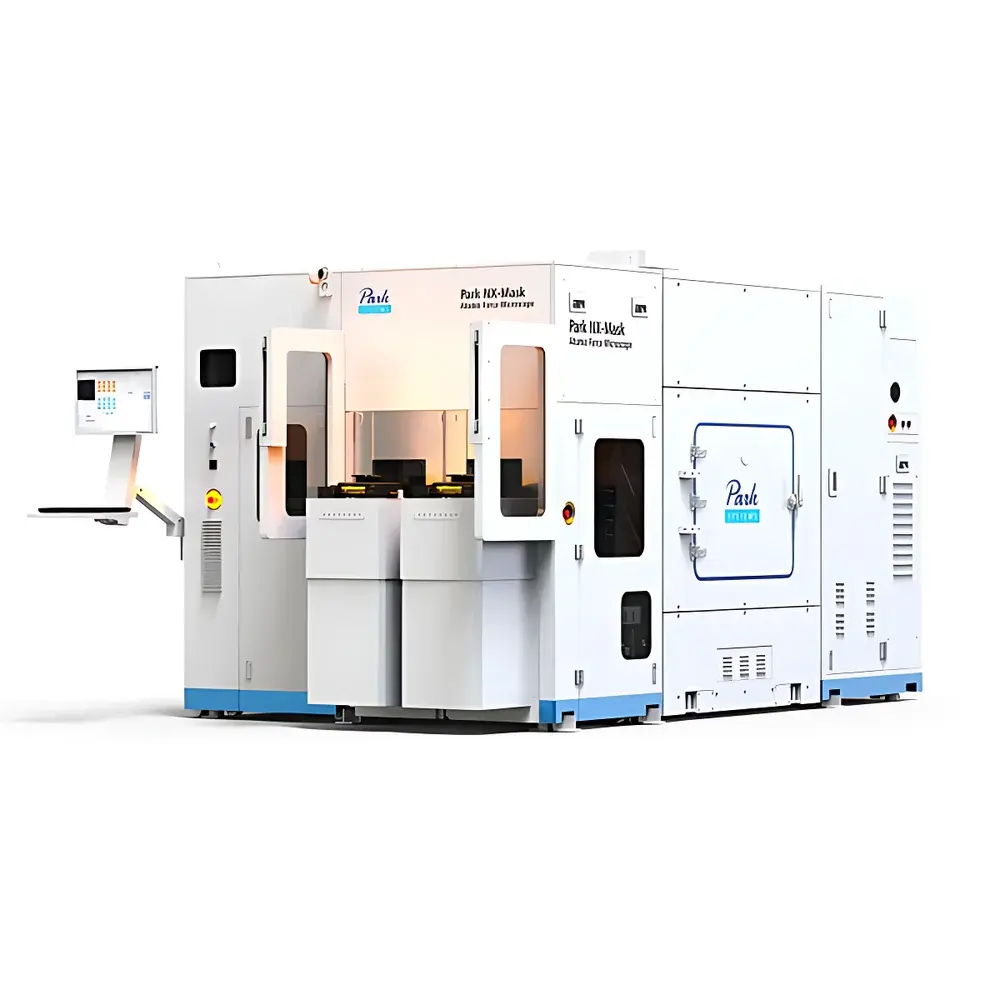
Park SYSTEMS NX-Mask EUV Mask Repair Atomic Force Microscope
| Brand | Park SYSTEMS |
|---|---|
| Origin | South Korea |
| Model | NX-Mask |
| Application | EUV photomask defect repair, AFM-based nanomechanical removal and verification |
| Compliance | Designed for ISO 14644-1 Class 1–5 cleanroom integration |
| Software | XEI™ with automated defect-to-repair workflow, audit-trail logging per FDA 21 CFR Part 11 requirements |
| Repair Mechanism | Non-contact, voltage-controlled AFM tip nanoscrubbing and localized mechanical lift-off |
| Resolution | Sub-5 nm lateral resolution in topography and phase imaging |
| Sample Handling | Dual-pod EUV reticle cassette compatibility (SEMI F47 compliant) |
| Vacuum Requirement | None |
| Charging Risk | Electrostatically neutral operation |
| Chemical Usage | Dry, solvent-free process |
Overview
The Park SYSTEMS NX-Mask is a purpose-built atomic force microscope (AFM) engineered exclusively for the nanoscale repair and metrological verification of extreme ultraviolet (EUV) photomasks used in advanced semiconductor lithography. Unlike conventional laser- or ion-beam-based mask repair tools, the NX-Mask leverages contact-resonance and voltage-modulated nanomechanical interaction between a conductive AFM probe and mask surface to remove tin (Sn) contamination particles, carbonaceous residues, and pattern edge defects—without inducing subsurface damage, electrostatic charging, or chemical residue. Its operational principle relies on controlled tip-sample interaction forces (typically <100 nN) calibrated via real-time force-distance spectroscopy, enabling deterministic material removal at sub-5 nm spatial fidelity. The system is deployed in front-end-of-line (FEOL) mask shops where EUV mask yield loss from particle-induced reflectivity degradation or pattern fidelity errors must be mitigated under strict ISO 14644-1 cleanroom conditions.
Key Features
- True dry, non-destructive repair: Eliminates reliance on focused ion beams (FIB), laser ablation, or wet chemistry—preserving multilayer Mo/Si stack integrity and avoiding interfacial delamination.
- Integrated defect detection → repair → verification workflow: All three stages executed sequentially within a single vacuum-free chamber using identical probe geometry and calibration reference.
- Dual-pod EUV reticle handling: Fully compatible with SEMI F47-compliant dual-cassette carriers, enabling seamless integration into automated mask track environments without manual intervention.
- Electrostatically neutral operation: No electron beam, no plasma, no high-voltage charging sources—critical for preventing charge accumulation on low-k dielectric capping layers (e.g., Ru or Rh).
- Real-time force feedback control: Closed-loop Z-servo adjusts probe engagement depth based on instantaneous cantilever deflection and resonance frequency shift, ensuring consistent removal depth across varying topographies.
- Traceable metrology-grade verification: Post-repair topography and phase images are quantitatively compared against pre-repair baselines using XEI™ software’s pixel-wise deviation mapping and ISO 25178-2 surface texture parameters.
Sample Compatibility & Compliance
The NX-Mask supports standard 6-inch and 9-inch EUV photomasks with multilayer reflective stacks (Mo/Si, ~40 bilayers), capping layers (Ru, Rh, or SiNx), and absorber films (TaBN, TaN, or Ni). It accommodates both binary and phase-shift masks, including those with ultra-thin (<10 nm) absorber features. All motion stages and environmental controls comply with SEMI E10 (Specification for Definition and Measurement of Equipment Reliability, Maintainability, and Availability) and SEMI E172 (Guideline for Photomask Cleanroom Classification). System-level documentation supports GLP/GMP audit readiness, with full electronic records retention—including timestamped operator actions, probe usage logs, and repair parameter sets—aligned with FDA 21 CFR Part 11 requirements.
Software & Data Management
Controlled by Park SYSTEMS’ XEI™ platform, the NX-Mask runs a dedicated MaskRepair Suite featuring automated defect coordinate import (via KLARF or ASCII-based coordinate files), intelligent tip wear compensation algorithms, and repair parameter libraries mapped to common defect morphologies (e.g., Sn agglomerates, Cr splatter, resist scum). All image data are stored in vendor-neutral TIFF-6.0 format with embedded metadata (probe ID, scan rate, setpoint, gain settings). Audit trails record every user-initiated action, including login/logout timestamps, parameter modifications, and export events—with cryptographic hashing applied to raw datasets to ensure data integrity during regulatory review.
Applications
- Removal of Sn debris from EUV mask surfaces post-exposure in scanner tools.
- Correction of absorber edge roughness (LER) exceeding ITRS specification thresholds (>1.5 nm 3σ).
- Localized repair of pinhole defects in capping layers compromising oxidation resistance.
- Post-repair validation of reflectivity uniformity via correlated AFM + EUV reflectometer workflows.
- Root-cause analysis of defect recurrence through time-series topographic comparison across multiple repair cycles.
FAQ
Does the NX-Mask require vacuum or inert gas purging during operation?
No. The system operates in ambient cleanroom air (N2-purged option available) with no vacuum chamber or gas consumption.
Can it repair defects on high-aspect-ratio EUV absorber structures?
Yes—its low-force, high-bandwidth Z-control enables stable scanning and targeted removal on features with aspect ratios up to 10:1 without tip snagging or sidewall damage.
Is probe replacement automated or manual?
Probe exchange is semi-automated: the system performs in situ optical alignment and spring constant calibration after each new probe installation, requiring only one operator intervention per cartridge.
How is repair repeatability validated across different operators?
XEI™ enforces role-based parameter locking; all repair protocols are version-controlled and assigned unique digital signatures, ensuring identical execution regardless of operator identity.
Does the system support integration with factory automation systems (MES/AMHS)?
Yes—via SECS/GEM interface (SEMI E30/E37 compliant) for job dispatch, status reporting, and alarm forwarding to host manufacturing execution systems.