
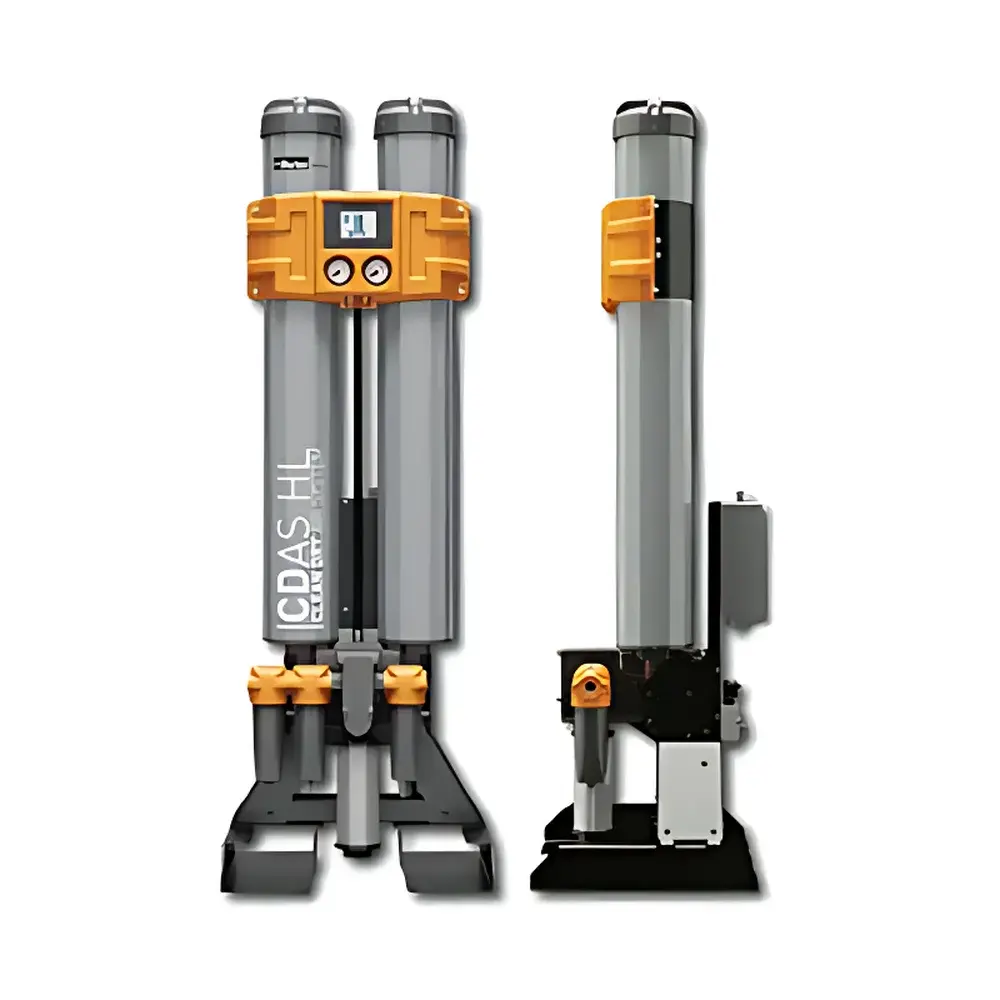
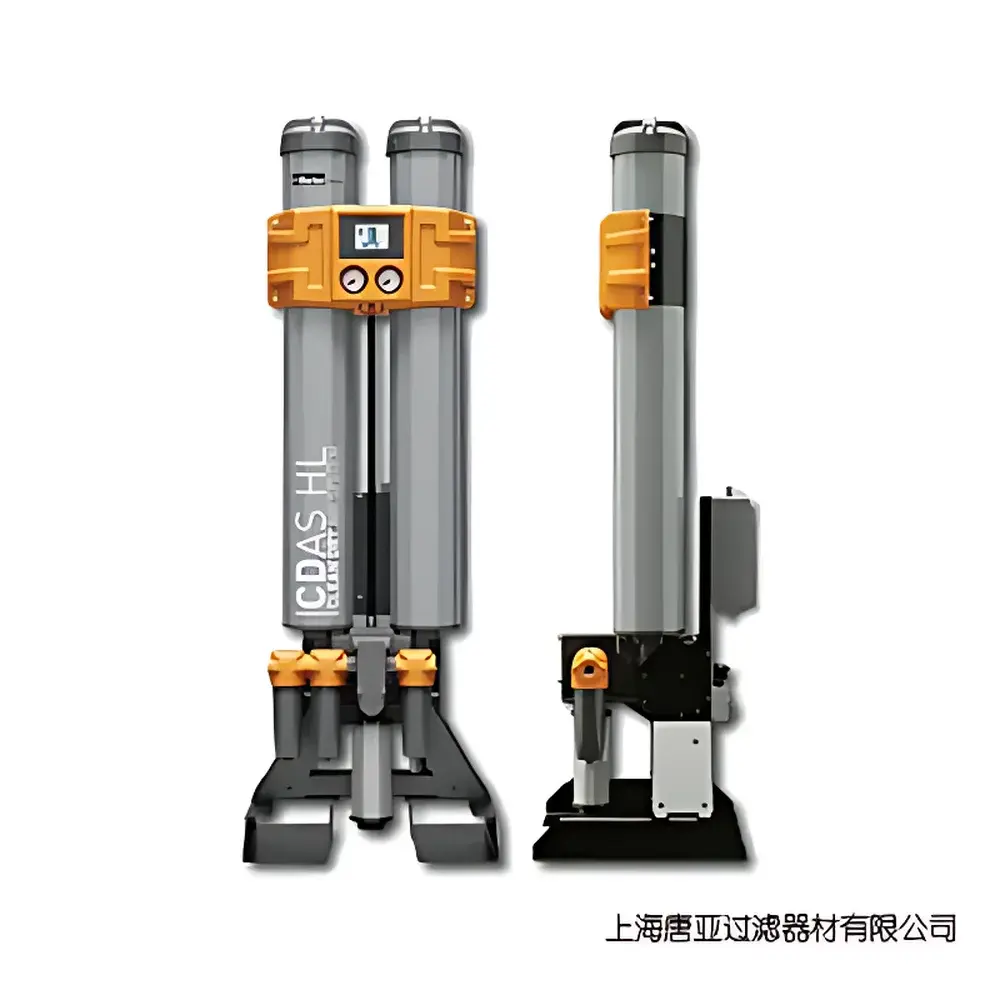
Parker CDAS HL 65 Heatless Desiccant Air Dryer
| Brand | Parker |
|---|---|
| Origin | USA |
| Model | CDAS HL 65 |
| Flow Rate | 55–300 m³/h |
| Operating Pressure | 4–16 bar |
| Pressure Dew Point | –20 °C to –70 °C |
| Filter Certification | ISO 8573-1 compliant (OIL-X series) |
| Desiccant Cartridge Lifetime | 5 years |
| Warranty | 10 years |
| Installation | Pallet-truck compatible |
| End Cap Type | Threaded |
| Purge Control | Tool-free adjustable minimum operating pressure setting |
| Flow Optimization | Low-pressure-drop valve architecture with robust cylinder design |
Overview
The Parker CDAS HL 65 is a heatless, twin-tower desiccant air dryer engineered for continuous, high-reliability compressed air drying in laboratory, analytical instrumentation, and critical process environments. Utilizing pressure-swing adsorption (PSA) technology, it removes water vapor from compressed air streams by passing the air through two vertically oriented towers filled with high-strength, snowstorm-packed desiccant media. While one tower dries the incoming air under working pressure, the other undergoes regeneration using a controlled purge airflow—enabling uninterrupted operation with no external heat source required. Designed to meet stringent ISO 8573-1 purity classes (Class 2 or better for moisture, depending on inlet conditions), the CDAS HL 65 delivers consistent pressure dew points ranging from –20 °C to –70 °C, ensuring compatibility with sensitive gas chromatography (GC), mass spectrometry (MS), FTIR, and laser-based optical systems where trace moisture can compromise calibration stability, detector response, or sample integrity.
Key Features
- Large-format backlit LCD display providing real-time visualization of inlet/outlet pressure, dew point status, tower cycle timing, purge ratio, alarm history, and maintenance countdowns.
- Snowstorm-packed desiccant cartridges—uniformly dense, mechanically stable, and resistant to attrition—guaranteed for 5 years of service under specified operating conditions (≤90% relative humidity inlet, ≤45 °C inlet temperature).
- OIL-X series coalescing and particulate filters pre-installed upstream of the drying towers; validated per ISO 8573-1:2010 Annex B for Class 2 oil aerosol removal and Class 1 solid particle filtration.
- Threaded end-cap design enables rapid, tool-free cartridge replacement without disassembling piping or requiring system depressurization beyond standard isolation valves.
- Integrated purge air regulator with tactile adjustment knob allows precise tuning of purge flow at minimum operational pressure—no torque wrenches or calibration tools required.
- Optimized internal flow path geometry and low-pressure-loss directional control valves minimize system pressure drop (<0.15 bar at rated flow), reducing compressor energy consumption and extending downstream equipment service life.
- Structural cylinder housing fabricated from reinforced aluminum alloy with corrosion-resistant anodized finish; designed for ≥10,000 hours of continuous duty and certified for 10-year limited warranty coverage.
Sample Compatibility & Compliance
The CDAS HL 65 is intended for use with clean, oil-free or oil-lubricated (with proper upstream filtration) compressed air supplies feeding analytical instruments, environmental test chambers, semiconductor metrology tools, and cleanroom support systems. It complies with ISO 8573-1:2010 for compressed air purity classification (moisture, oil, particles), and its filter assemblies are tested per ISO 12500-1 and ISO 8573-2. The unit supports GLP/GMP-aligned operational documentation through configurable event logging (alarms, cycle transitions, filter change timestamps), and its deterministic purge logic ensures reproducible dew point performance across batch runs—critical for regulated QC/QA workflows. No software-based audit trail is embedded; however, all operational parameters are accessible via the local interface for manual recordkeeping in accordance with FDA 21 CFR Part 11 supplementary requirements.
Software & Data Management
The CDAS HL 65 operates as a standalone, microprocessor-controlled hardware system with no external PC dependency. All configuration, monitoring, and diagnostics are managed locally via the integrated touchscreen interface. Event logs—including tower switch events, high-dew-point alarms, low-pressure warnings, and scheduled maintenance prompts—are stored in non-volatile memory for up to 12 months. Data export is not supported; however, timestamped screen captures may be manually documented for internal SOP compliance. Optional analog 4–20 mA outputs (for dew point or pressure signals) and dry-contact alarm relays are available upon request for integration into building management systems (BMS) or centralized lab infrastructure dashboards.
Applications
- Supplying ultra-dry air to GC carrier gas systems, especially when using thermal conductivity detectors (TCD) or electron capture detectors (ECD) sensitive to moisture-induced baseline drift.
- Providing instrument-grade air for FTIR spectrometers, Raman analyzers, and laser interferometers where condensation on optical surfaces must be eliminated.
- Supporting pneumatic actuators and precision valves in automated sample handling platforms requiring stable, low-humidity control air.
- Drying purge air for nitrogen generators, zero-air generators, and catalytic scrubbers used in ambient air monitoring stations.
- Feeding cleanroom HVAC makeup air systems where ISO Class 5–7 environments mandate sub-zero dew point air to prevent microbial growth on filters and ductwork.
FAQ
What is the recommended inlet air quality for optimal CDAS HL 65 performance?
Inlet air must be filtered to ISO 8573-1 Class 4 (≤5 µm particles) and contain ≤5 mg/m³ total oil (aerosol + vapor); oil-free compressors are strongly advised. Inlet temperature should not exceed 45 °C, and pressure must remain within 4–16 bar.
Can the CDAS HL 65 be installed in a vertical orientation only?
Yes—the unit is engineered for floor-standing vertical installation only. Sideways or inverted mounting invalidates the warranty and compromises desiccant bed uniformity and purge distribution.
Is remote monitoring possible without third-party gateways?
No native Ethernet, Modbus, or wireless connectivity is included. Remote oversight requires external signal acquisition via optional 4–20 mA outputs or relay status contacts interfaced with a PLC or SCADA system.
How often must the OIL-X filters be replaced?
Filter replacement intervals depend on upstream air quality; Parker recommends inspection every 2,000 operating hours and replacement every 4,000 hours—or sooner if differential pressure exceeds 0.7 bar.
Does the 10-year warranty cover desiccant cartridge replacement?
The 10-year warranty covers structural integrity and electronic control functionality. The 5-year desiccant lifetime is a separate performance guarantee subject to documented adherence to inlet air specifications and maintenance schedules.



