
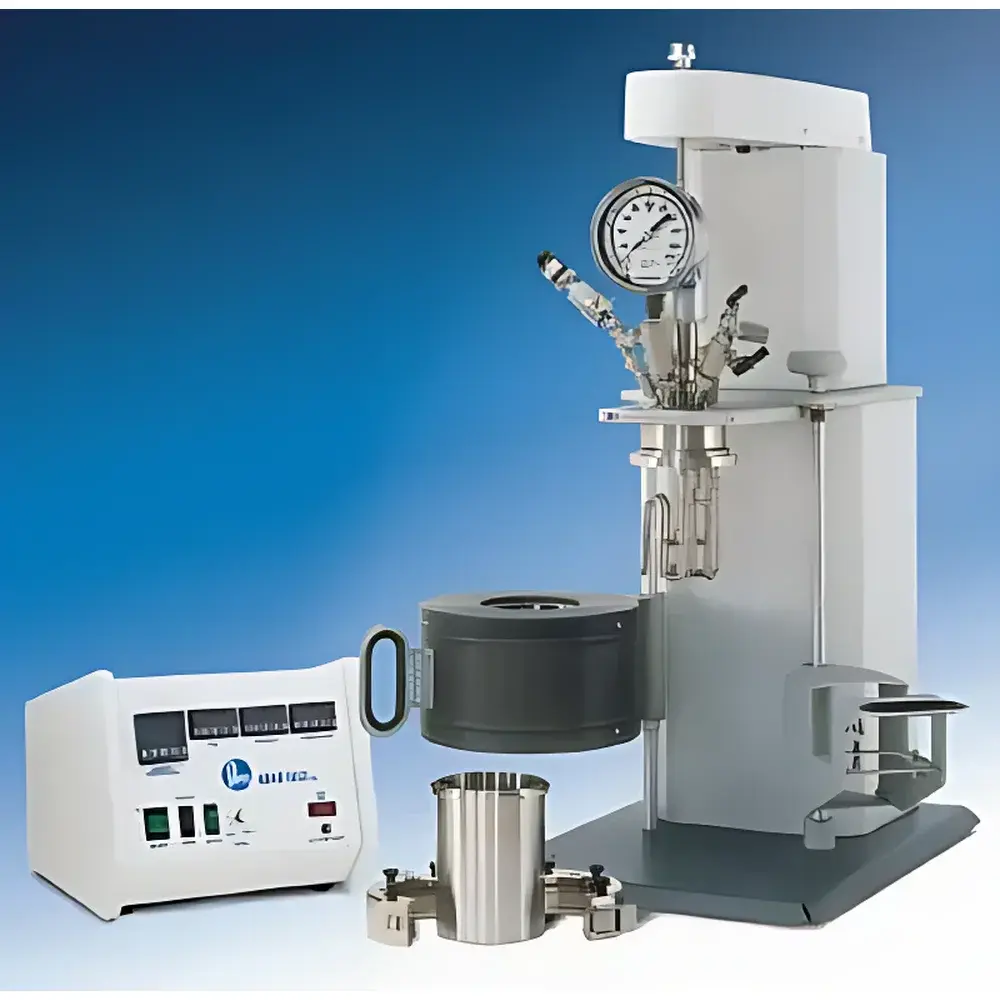
PARR 4520 Series High-Pressure Laboratory Reactor
| Brand | PARR |
|---|---|
| Origin | USA |
| Manufacturer Authorization | Authorized Distributor |
| Import Status | Imported |
| Model | 4520 |
| Volume Range | 1000 mL – 2000 mL |
| Maximum Operating Pressure | 130 atm (13.2 MPa) |
| Maximum Operating Temperature | 350 °C |
| Construction Materials | 316 Stainless Steel, Hastelloy® C-276, Hastelloy® C-2000 |
| Certifications | ASME BPVC Section VIII Div. 1, CSA, CE, ISO 9001, uV Listed |
| Vacuum Capability | Not Designed for Vacuum Service |
| Regulatory Compliance | Compliant with ASTM G187 (High-Pressure Reaction Vessel Safety), FDA-relevant design principles for pharmaceutical process development |
Overview
The PARR 4520 Series High-Pressure Laboratory Reactor is a precision-engineered benchtop reaction system designed for controlled synthesis, catalytic testing, hydrogenation, oxidation, polymerization, and hydrothermal material synthesis under rigorously defined thermodynamic conditions. Built upon over a century of pressure vessel engineering heritage from Parr Instrument Company (Moline, Illinois, USA), the 4520 platform integrates ASME-certified pressure containment architecture with modular thermal management and real-time process monitoring capabilities. Its operational envelope—up to 130 atm (13.2 MPa) and 350 °C—is validated through full-scale hydrostatic and pneumatic testing per ASME BPVC Section VIII Division 1 requirements. Unlike generic pressure vessels, the 4520 employs dual-seal geometry (metal-to-metal primary + elastomeric secondary), redundant pressure relief pathways (rupture disk + spring-loaded safety valve), and integrated temperature-sensing wells aligned with ASTM E2877 for traceable thermal profiling. This architecture ensures repeatable kinetic data acquisition in research-grade environments where pressure integrity directly impacts reaction pathway selectivity and product distribution.
Key Features
- ASME-stamped pressure vessel body constructed from 316 stainless steel or corrosion-resistant superalloys including Hastelloy® C-276 and C-2000—validated for aggressive media such as HCl, HF, and high-concentration sulfidic streams.
- Dual-zone heating system with independent PID-controlled mantle and internal immersion heater, enabling precise thermal ramping (0.1–10 °C/min) and isothermal stability ±0.5 °C across the full 25–350 °C range.
- Integrated digital pressure transducer (0–150 atm, 0.1% FS accuracy) with analog output and RS-485 Modbus RTU interface for third-party SCADA integration.
- Standard configuration includes magnetic drive agitator (0–1200 rpm, torque-limited), gas addition manifold with mass flow controllers (MFCs) for H₂, O₂, CO, N₂, and inert gases, and liquid feed port with syringe pump compatibility.
- Robust mechanical design featuring reinforced flange joints, hardened alloy stirrer shafts, and leak-tested sealing surfaces per ASTM E479—ensuring >10,000 cycles of maintenance-free operation under cyclic pressurization.
Sample Compatibility & Compliance
The 4520 reactor accommodates heterogeneous slurries, viscous polymer melts, multiphase gas–liquid–solid systems, and supercritical fluid media without compromising seal integrity or measurement fidelity. Its material options meet NACE MR0175/ISO 15156 requirements for sour service applications and ASTM A240/A479 specifications for high-temperature structural alloys. All electrical components carry CSA and CE marks; pressure relief devices conform to ISO 4126-1 and PED 2014/68/EU. The system supports GLP-compliant operation through optional audit-trail-enabled controller firmware (21 CFR Part 11 ready), with electronic signatures, user access levels, and immutable event logging for QA/QC documentation in pharmaceutical and contract research settings.
Software & Data Management
PARR’s proprietary Reactor Control Software (RCS v5.2) provides synchronized acquisition of pressure, temperature, agitation speed, gas flow rates, and torque data at up to 10 Hz sampling frequency. Raw datasets export in CSV and HDF5 formats compatible with MATLAB, Python (Pandas/NumPy), and AspenTech simulation environments. Trend visualization includes real-time derivative plots (dP/dt, dT/dt) for early detection of exothermic onset or phase transitions. For regulated environments, optional 21 CFR Part 11 compliance packages include electronic signature workflows, role-based permissions, and encrypted database storage with SHA-256 hashing for raw data integrity verification.
Applications
- Catalytic reaction screening (e.g., Fischer–Tropsch, ammonia synthesis, asymmetric hydrogenation) under industrially relevant partial pressures and residence times.
- Hydrothermal synthesis of MOFs, perovskites, and quantum dot precursors requiring precise control of supersaturation kinetics.
- Corrosion studies in simulated oilfield brines (pH 2–6, Cl⁻ >100,000 ppm) using Hastelloy-lined vessels per NACE TM0169 protocols.
- Process safety evaluation via adiabatic calorimetry coupling (with optional Phi-factor calibration) for RC1-type thermal runaway assessment.
- Green chemistry development—including CO₂ hydrogenation to methanol and lignin depolymerization—leveraging programmable gas dosing and in situ FTIR probe ports (optional).
FAQ
What pressure and temperature ratings apply to the standard 4520 reactor configuration?
The base model is rated for continuous operation up to 130 atm and 350 °C, with burst pressure exceeding 260 atm per ASME hydrostatic test requirements.
Can the 4520 be configured for corrosive halide-containing reaction media?
Yes—vessels fabricated from Hastelloy® C-276 or C-2000 are available for service in HCl, HF, and mixed acid environments; material selection follows NACE MR0175/ISO 15156 Annex A guidelines.
Is vacuum capability supported?
No—the 4520 is engineered exclusively for positive-pressure operation; vacuum-rated variants (e.g., Model 4570) require separate specification and validation.
Does the system support automated gas blending and stoichiometric control?
Yes—integrated MFCs with gas-specific calibration curves enable precise multi-gas delivery (e.g., H₂/N₂ mixtures) and dynamic composition adjustment during reaction progression.
How is compliance with pharmaceutical development standards addressed?
Optional 21 CFR Part 11-compliant firmware, IQ/OQ documentation packages, and GMP-aligned maintenance logs are available for use in API process development and regulatory submission support.



