
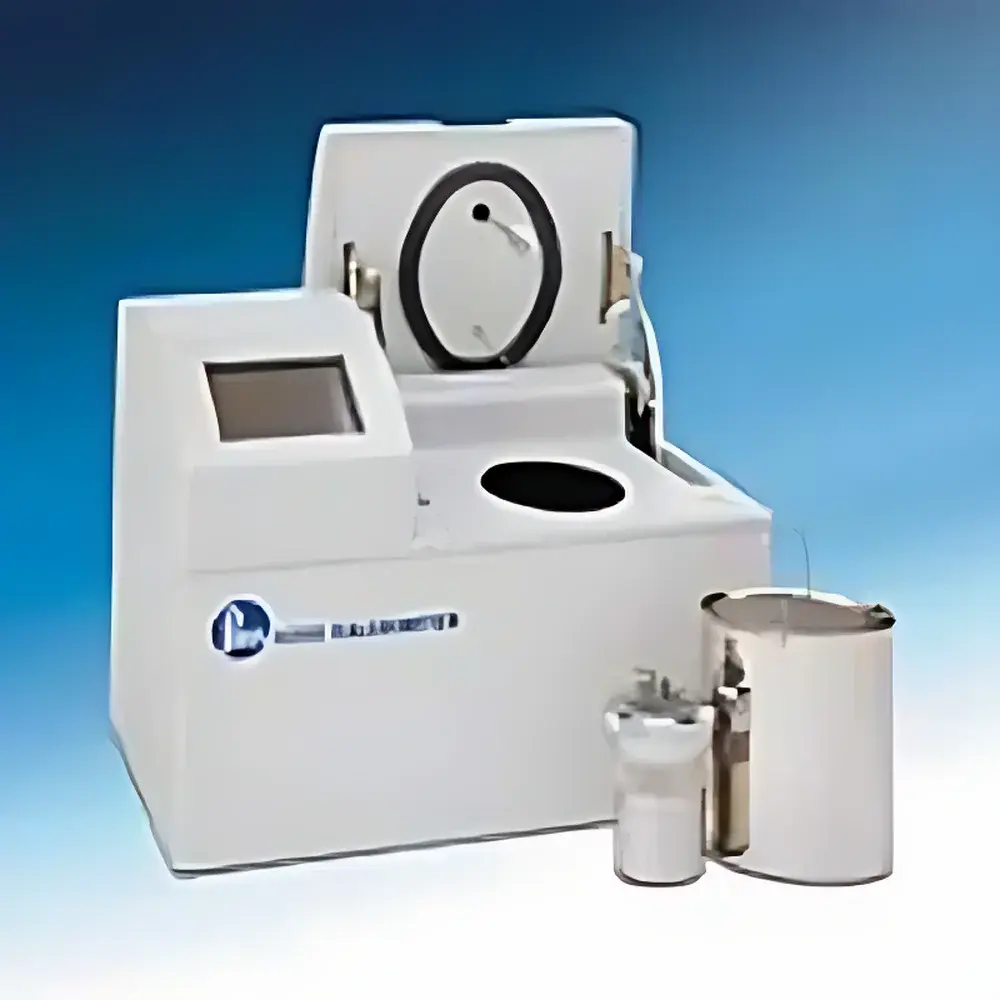
Parr 6200 Automated Isoperibol Oxygen Bomb Calorimeter
| Brand | Parr |
|---|---|
| Origin | USA |
| Model | 6200 |
| Measurement Mode | Isoperibol |
| Temperature Range | 0–40 °C |
| Temperature Resolution | 0.0001 °C |
| Precision | ±0.1% RSD |
| Single-Sample Test Time | 6–7 min |
| Heat Capacity | 33,000 J |
| Outer Water Jacket Volume | 2 L |
| Inner Water Bucket Volume | 342 mL |
| Oxygen Bomb Pressure Rating | 200 atm |
| Bomb Volume | 342 mL |
| Data Storage Capacity | 1000 tests |
| Interface Options | RS-232, USB, Ethernet, Balance Integration, Printer Port |
| Operating System | Linux-based embedded controller |
| Calibration & Reporting | Automatic correction for fuse wire, nitric acid formation, sulfur oxidation, and hydrogen combustion enthalpy |
Overview
The Parr 6200 Automated Isoperibol Oxygen Bomb Calorimeter is a high-precision, microprocessor-controlled instrument engineered for the accurate determination of gross calorific value (GCV) of solid and liquid fuels and organic materials. Based on the fundamental principle of constant-temperature (isoperibol) calorimetry, the system measures the heat released during complete combustion of a sample in a high-pressure oxygen environment within a sealed stainless-steel bomb. Combustion occurs at 30–35 bar (≈200 atm) O₂ pressure, ensuring stoichiometric oxidation of carbon, hydrogen, sulfur, and other combustible elements. The resulting temperature rise in the inner water bucket—thermally isolated by a precisely regulated outer jacket—is detected via a high-stability platinum resistance thermometer (PT100) with 0.0001 °C resolution. The calorimeter’s 33,000 J heat capacity and dual-volume water system (342 mL inner bucket, 2 L outer jacket) provide exceptional thermal inertia and measurement reproducibility, meeting the stringent stability requirements of ISO 1928, ASTM D5865, and GB/T 213.
Key Features
- Isoperibol design with fully automated heating/cooling circulation control ensures stable jacket temperature within ±0.01 °C over full 0–40 °C operating range
- Fifth-generation Linux-based embedded controller with real-time OS architecture for deterministic data acquisition and fault-tolerant operation
- Touchscreen LCD interface with intuitive navigation, multilingual support (English, Chinese, Spanish), and context-sensitive help
- Automatic thermodynamic corrections per ASTM D240 and ISO 1928: includes fuse wire energy, nitric acid formation enthalpy, sulfuric acid correction, and latent heat of vaporization for hydrogen combustion
- Movable bomb assembly with quick-lock bayonet mechanism enables rapid loading/unloading while maintaining pressure integrity and alignment repeatability
- Integrated balance interface supports automatic sample mass import (via RS-232 or USB), eliminating manual entry errors and supporting GLP-compliant audit trails
- Expandable data storage (1000 test records onboard) with optional SD card slot for firmware updates, method backups, and offline data export
- Comprehensive I/O suite: IEEE-488 (GPIB), RS-232, USB 2.0, 10/100BASE-T Ethernet, and parallel printer port for laboratory integration and LIMS connectivity
Sample Compatibility & Compliance
The Parr 6200 accommodates a broad spectrum of heterogeneous samples—from pulverized coals (bituminous, anthracite, lignite), coke, and biomass pellets to liquid hydrocarbons (diesel, jet fuel, crude oil), explosives (TNT, RDX), animal feed, foodstuffs, plastics, and municipal solid waste. Sample mass ranges from 0.5 g to 1.2 g (solids) or 0.2–0.8 mL (liquids), with optional crucibles and ignition aids (e.g., benzoic acid standard, iron wire, Ni-Cr fuse). The instrument complies with global regulatory and standardization frameworks including ASTM D5468 (waste fuels), ASTM D3286/D1989 (coal and coke), ISO 9831 (animal feed), DIN 51900 (isoperibol method), BS 1016-5, and GJB 770B (propellants). All hardware—including the ASME-certified oxygen bomb—meets PED 97/23/EC, CE-EMC 2014/30/EU, Low Voltage Directive 2014/35/EU, and CSA C22.2 No. 61010-1 requirements. The system supports 21 CFR Part 11–compliant electronic signatures and audit trail generation when paired with validated software modules.
Software & Data Management
Data acquisition, calculation, and reporting are handled by Parr’s proprietary CalWin v5.x software, compatible with Windows 10/11 and deployable in virtualized environments. The software implements full traceability: each test record contains timestamped raw thermogram data, operator ID, calibration certificate IDs, environmental parameters (barometric pressure, ambient humidity), and step-by-step correction logs. Reports generate three standardized calorific values—gross calorific value (GCV), net calorific value (NCV), and bomb calorific value—with uncertainty budgets calculated per ISO/IEC 17025:2017 Annex A. Export formats include CSV, PDF/A-2b (archival), XML (for LIMS ingestion), and direct SQL database push. Optional validation packages include IQ/OQ/PQ documentation, risk assessment (FMEA), and change control logs for GMP/GLP laboratories.
Applications
The Parr 6200 serves as a primary reference instrument in coal quality assurance labs (ISO 1928 compliance for trading contracts), petrochemical QC departments (ASTM D240/D4809 for refinery feedstock screening), defense R&D facilities (energetic material certification per MIL-STD-1701), agricultural research centers (feed energy evaluation per AOAC 968.10), and environmental testing laboratories (waste-to-energy feedstock characterization per EPA SW-846 Method 9040C). Its robustness and repeatability make it suitable for routine high-throughput analysis in ISO/IEC 17025-accredited facilities, where inter-laboratory precision <0.15% RSD is required across matrix types.
FAQ
What standards does the Parr 6200 comply with for coal analysis?
ASTM D5865, ASTM D3286, ASTM D1989, ISO 1928, GB/T 213, and BS 1016-5.
Can the instrument correct for sulfur and nitrogen contributions automatically?
Yes—it applies real-time corrections for sulfuric acid formation enthalpy and nitric acid formation from atmospheric nitrogen, per ISO 1928 Annex B.
Is remote monitoring and control supported?
Yes—Ethernet connectivity enables secure HTTP/HTTPS access to live thermograms, instrument status, and queued tests via standard web browsers.
What safety certifications apply to the oxygen bomb assembly?
PED 97/23/EC (CE-PED), ASME Section VIII Div. 1, and China Special Equipment Manufacturing License (A1 Level).
Does the system support audit trail and electronic signature functionality?
When used with validated CalWin software and configured per site-specific SOPs, it meets 21 CFR Part 11 requirements for electronic records and signatures.



